


Wisconsin’s apocalyptic Canadian wildfire smoke events have made the entire state acutely aware of how dangerous air pollution can be for public health. But for decades, one third of Wisconsin residents have been chocking on dangerous levels of a more invisible pollutant – ozone.
Often called smog, ozone is one of Wisconsin’s worst air pollution issues. Of the six air pollutants federally regulated because of their direct harm to human health, Wisconsin meets the federal standard for all of them, except ozone. Our state has a persistent ozone pollution problem especially on the eastern lakeshore of Wisconsin. The entirety of Milwaukee and Ozaukee Counties are in “nonattainment” (federal Clean Air Act speak meaning that an area does not meet the federal standard) as are portions of Sheboygan, Washington, Waukesha, Racine, and Kenosha Counties.
Reducing air pollution through the landmark 1970s federal Clean Air Act legislation has been hugely successful. There is less air pollution, including ozone, in Wisconsin compared to the 1970s or even the early 2000s. That success is significant – Wisconsin lives have been saved.
The success of the Clean Air Act’s ozone program comes from more stringent controls on emissions of nitrogen oxides and volatile organic compounds, the two primary precursors of ozone, in nonattainment areas. Under the ozone program, nonattainment areas are classified as Marginal, Moderate, Serious, Severe, or Extreme based on the severity of their ozone pollution, and each higher classification has stronger pollution-control requirements. Importantly, when an area fails to attain the ozone standard by a certain deadline, the EPA is required to reclassify, or “bump up,” the area to the next higher classification.
Unfortunately, Wisconsin’s reduction in ozone levels has plateaued in the last decade, and in recent years has worsened in some places. Because of this, Wisconsin nonattainment areas were automatically reclassified from Moderate to Serious in 2024. This reclassification is a big deal – to Wisconsinites‘ health and to polluters that face more limits on their emissions.
A recent Clean Wisconsin analysis asked: What is the health effect of not meeting the federal ozone standard on communities in our state? The answer was sobering. Annually, Wisconsinites breathing in just the ozone pollution above the federal standard is estimated to result in 2-4 excess deaths, 138 emergency room visits, and 57,600 occurrences of asthma symptoms in the seven counties. This amounts to $88,600,000 – $112,000,000 in health harms every year due to ozone pollution above the level deemed unhealthy by the EPA.
Our federal and state governments have to step up and regulate the sources of emissions that form ozone. Yet we know that right now the EPA is too busy acting out their deregulatory agenda that will only worsen air pollution in Wisconsin and across the country.
Wisconsin sources emit ozone precursors and contribute to the state’s ozone pollution. And with the rapid expansion of gas plants for electricity and data centers seeking onsite backup diesel generators, especially in southeastern Wisconsin, we are heading down a path of higher in-state emissions that worsen our state’s already bad air pollution.
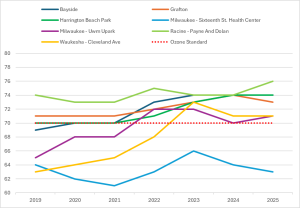
It is true that a portion of Wisconsin’s ozone pollution stems from out-of-state sources, such as pollution from cars and trucks in the Chicago region and industry in Indiana. That pollution travels over Lake Michigan, which in the warmer months has sunny and hot conditions exceptionally favorable for ozone formation. But that doesn’t mean that Wisconsin shares no responsibility to address the persistent ozone pollution that is harming our state’s residents.
Importantly, the Clean Air Act’s automatic reclassification requirement is focused purely on existing ozone levels – not where that ozone pollution stems from. It provides no comfort to the Wisconsinites experiencing dangerous levels of ozone that some portion of that pollution comes from out of state. They deserve action not excuses.
The bump up to Serious requires Wisconsin to further regulate emissions that form harmful ozone, such as requiring industry to do more to address the persistent pollution problem. Despite this, the State of Wisconsin filed a lawsuit early last year asking a federal court to undo the automatic reclassification of the ozone nonattainment areas from “Moderate” to “Serious.”
EPA had been defending the reclassification in court since 2024 under both the Biden and Trump administration, but then, in late July and without warning, it suddenly reversed its position and abandoned its defense of the reclassification.
Now, in response to the state’s and EPA’s refusal to address worsening ozone pollution, Clean Wisconsin is asking the court for permission to intervene in the case and defend the reclassification. If we are successful, new requirements will go into effect to mitigate ozone pollution, improving the air quality for millions of Wisconsin residents.
Wisconsin emitters and the Wisconsin Department of Natural Resources, the agency that regulates air pollution in the state, share a responsibility to address Wisconsin’s persistent ozone pollution. At a moment when our ozone pollution is getting worse, protective federal regulations are being rolled back, and more emitting facilities are being built, we need leadership from our agencies and elected officials, not blame shifting or ignoring the problem. Wisconsin lives are a stake, and Clean Wisconsin will continue holding regulators accountable.
