

Where to Listen:




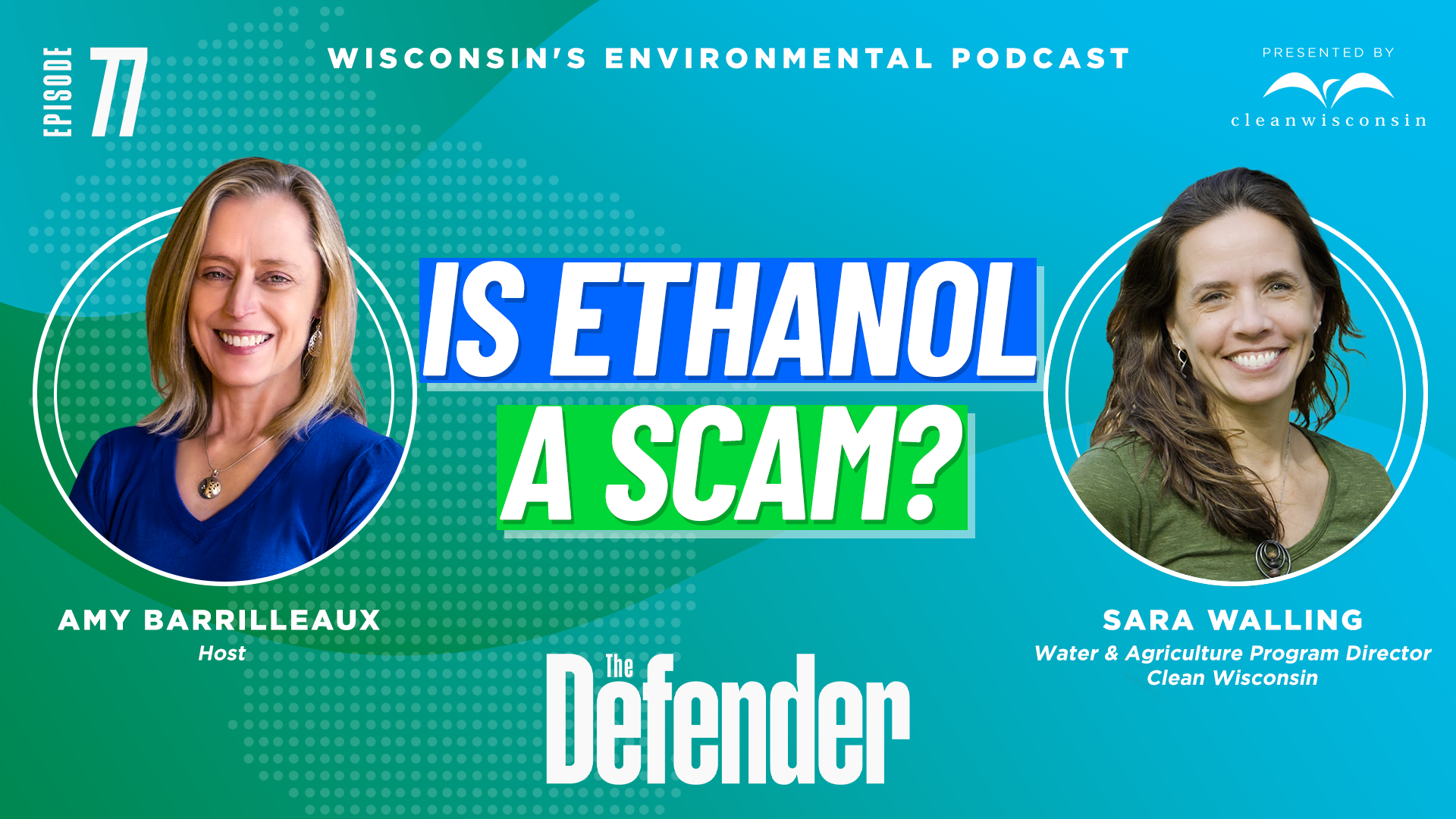
Have we been sold a bill of goods about ethanol? In this episode, a look at the toll ethanol is taking on our health and water right here in Wisconsin.
Host:
Amy Barrilleaux
Guest:
Sara Walling, Water and Agriculture Program Director, Clean Wisconsin
Resources for You:
New Report: Nitrate Contamination Driving Health Crisis in Wisconsin
Proposal to increase E-15 would cause substantial harms in Wisconsin
Common Pesticides Used in Wisconsin and Potential Health Harms
Health Brief: Nitrates in Wisconsin’s Drinking Water
Transcript:
Amy Hi there and welcome to The Defender, Wisconsin’s environmental podcast. I’m Amy Barrilleaux. The Defender is powered by Clean Wisconsin, your environmental voice since 1970. We’ve been hearing for years that ethanol is the cleaner, more affordable fuel option. The problem is, experts say it’s not really true. As Congress considers legislation that would make bigger ethanol blends available all year long at the pump, it might be time to look at the truth about our most widely used biofuel. In this episode, the toll ethanol is taking on our drinking water and our health right here in Wisconsin. That’s right now on The Defender. Have we been sold a bill of goods about ethanol? Well, if you think it’s cheaper, much of the savings are wiped away by losses in fuel efficiency. And if you it’s cleaner, better for the climate, turns out it’s actually worse. Here in Wisconsin, where we grow a million acres of industrial corn for ethanol, it’s actively hurting us. Joining me to talk about how is Clean Wisconsin Water and Agriculture Program Director, Sara Walling. Sara, thanks for being here.
Sara My pleasure. Thanks for having me.
Amy So, when you think about ethanol, I mean, at least when I think about it, I feel like it became a thing to reduce emissions because of climate change. And now we know that really because of all the emissions that happen when it’s farmed, when the corn is farmed and then when it is produced into ethanol, there’s not really a climate benefit or it could even be worse for the climate than just plain old gasoline. But your concerns about ethanol go even beyond the climate. So what is in your mind? Or what are some of the reasons why ethanol is maybe not all it’s cracked up to be?
Sara Yeah. I think it’s important when we, you know, to kind of break that down a little bit, to be able to think, go back in time a little ways. And that, by that, I mean, you, know, when we first started talking as a country and it may go globally, maybe about, you know, reducing emissions, reducing our reliance on fossil fuels. That’s really when this concept came into being of like, we need to be providing our own energy as a nation. So we have some energy independence. And so, being able to not have to rely on… Know, volatile countries like the Middle East has long been as our source of oil for gasoline and whatnot, that became a big driver. And so the notion that we could produce biofuels, you know, seemed really attractive, of course, because the notion of biofuel, it sounds great, right? And it is in a lot of ways because it’s a renewable resource. We can grow corn year after year, and fossil fuels ahve a finite amount, and at some point. We may run out of many of those things or have a much harder time getting access to them. So initially, it was really a good idea to try to find more renewable sources of energy and in this case for gasoline production. But the problem with ethanol is that to your point, the way that the math works out in the long run, all of the… Energy literally that goes into making the kernel of corn that goes to that ethanol plant to just be turned into ethanol that costs a lot more energy than the energy that ethanol is going to put out in the first place. So one of the things we talk about when we talk about whether one fuel is a good replacement for another is the life cycle analysis. And you kind of hit on that a little bit where, you know, you want to look at the entirety of what it takes to make a gallon of ethanol versus a gallon of gasolene to make that a real true comparison. And initially, when ethanol first came to be, the thought was, and the math was that it was over, it was better than gasoline because overall it created more energy and offset these other bad things that gasoline production requires. But as we’ve gotten to turn, peel back the layers of the onion, if you will, on ethanol production, it really becomes, it’s a much harder, more complicated system. So. To grow a corn crop takes a lot of things. So it takes a lots of inputs and by inputs, I mean fertilizer, I mean pesticides, I mean the fuel to run the tractor, to plant it, to spray pesticides and herbicides on it, to harvest it, all those things. There’s also a lot that goes into that ahead of time. So the production of that fertilizer and the pesticide also need to be taken into consideration and that is where things kind of went wrong early in those early days. Those parts, the inputs, the things that corn needs to grow and be a productive crop to turn into ethanol require a lot of energy and a lot of CO2 emissions from nitrogen fertilizer production, phosphorus fertilizer production pesticide, herbicide, et cetera. And so once we started calculating and including all of those energy and, you know, natural resource costs. That’s when the imbalance was identified that in actuality it takes more energy to create a gallon of ethanol than that gallon of ethanol is able to, you know, balance to replace by being a replacement for gasoline. Does that make sense?
Amy It does. So more energy going in to make the ethanol than if you put it in your gas tank, then it would basically give you to power your car. Another thing I just want to touch on real quickly, we talk about growing corn for ethanol. And to somebody who doesn’t know anything about corn, you think, well, corn is corn. Well, we can just eat it then, if we’re not going to use it for ethanol, but the corn that we see out in the fields all over Wisconsin is not grown for human food. It’s a totally different type of corn that’s used for, I guess, livestock feed and then also for ethanol. So it’s a lot of corn, about four million acres that we don’t really eat.
Sara Yeah, that’s a really good point to make. So a vast majority of it goes to the livestock production world. We like our dairy, we like our cheese and our yogurt. And so that is gonna continue. But a large chunk of that same acreage, so about a quarter of all of the corn that we produce in our state currently goes directly for ethanol production. And again, you might wonder, well, that seems fine. It’s all out there. I can’t tell the difference, sure. But every acre of corn, again, takes a lot of inputs. It takes a lot of nitrogen fertilizer in particular. Takes some phosphorus or, you know, it takes fertilizer and nutrients largely, I guess I would say. And then it also takes a large amount of pesticide application to ensure that you get the yields out of that corn crop that you want so that the farmer can be profitable. Well, we’ve had this thing happen over the last several years where the cost of all of those inputs, so the 200 pounds of nitrogen fertilizer that they might be putting on per acre, the amount of pesticides, the fuel that it’s costing to run the tractors to plant and do all those other production processes, that’ll cost more than the farmer is getting at the end of the growing season when they go to sell their corn. So there’s this imbalance that’s happened for the fourth year in a row where the cost to produce an acre of corn is much larger than the profit that the farmer will get per acre of corn, per bushel of corn at the end of the season. To the tune of about 88 cents per bushal of corn the average corn farmer is expected to lose this year. That equates to about $160,000 for a thousand acre farm, for example. So this isn’t peanuts.
Amy So that seems kind of catastrophic if, I mean, when you look around Wisconsin and even the Midwest, there’s corn everywhere. Like these farmers, that’s their key crop in a lot of places. So is this kind of new, maybe not new, but renewed push for ethanol that we’re seeing nationally and here in Wisconsin like an effort to inject some funds into farmers’ pockets or what’s going on?
Sara Yeah, so moving forward from our current ethanol blend of 10%, which is in pretty much all of your regular gasolines if you’re not buying premium, you already have a 10% blend. There’s been a proposal to increase that blend to 15%. That extra 5% in our gas tanks would overall just increase the demand for corn for ethanol production in this country. So it’s. Intended to be kind of a backdoor way of increasing the market for corn in this country because we have a lot of competition globally. Argentina and Brazil for instance are growing a lot more corn than they were 10 years ago and so that’s making it the demand for our corn less and therefore the cost the price that farmers get for it less. And so by creating this artificial new demand, if you will, for more ethanol, the thought is that that will increase the demand for this and therefore the price per bushel of corn will go up with it, but that’s not a guarantee. And in fact, as we watch the agriculture, you know, become this global marketplace that it is, those pressures from China not buying our corn and moving to purchases from Argentina, Argentina and Brazil making more corn for their own ethanol production. These are all mechanisms that we have very little control over. And the ideas of this kind of artificial injection of a new demand through E-15 is just doing just that. It’s creating an artificial market that they’re hoping will bring up the costs, or excuse me, the price that a farmer has paid for their ethanol at the end of the day. So again, it’s not a guarantee. And in the same token, it’s definitely not gonna happen for this crop year. So the price that a farmer has to pay for their nitrogen fertilizer is extremely high right now in large part because of the war on Iran and the issues that we’re having, the warrant that’s happening in Ukraine is putting a lot of pressure on again, these global markets where we get our fertilizer. That’s not going away. So that’s not gonna reduce the cost of nitrogen fertilizer. So the overall cost to production for a farmer this year is still extremely high. And the demand for this E15 isn’t gonna come quickly enough for that price that the farmer gets at the end of this crop season to take effect. So it’s a longer term goal that they’re hoping for, but in the meantime, it further entrenches our farmers in this, you know, very monocrop row crop system of corn. On corn, corn to soybean rotations and that kind of thing that we’re finding year after year is not going to be a long-term economically sustainable crop system for our farms to maintain.
Amy So it sounds like the economic realities of growing corn are becoming pretty bleak for our farmers. And we also don’t always think about the environmental realities of growing corn because it doesn’t look harmful, but there is a tremendous amount of harm. You work on water issues. How would you characterize the impact of growing those four million acres of corn?
Sara Yeah, that’s a really good point. So you’re right. Yes, agriculture in general is kind of a leaky system. You know, plants, we apply nutrients to those plants. We hope they take them up and use them to make the food that we eat or the flowers we’re growing, for instance. So there’s a certain amount of that we have to accept, but corn in particular is exceptionally inefficient at using its nitrogen. So an acre of corn, give or take, requires anywhere from 160 to 220 pounds of nitrogen to be applied according to the university’s recommendations. What we’re finding, what agronomists have found over the years, is that of that amount of fertilizer being applied to corn, the plant itself is only capable of taking up and using somewhere between 40 to 60 percent of the nitrogen that we apply in the first place. And so that means about 40 to 60% of that nitrogen is available, not being used by the plant. And it either leaches downward into the groundwater, some surface water runoff, or there’s connections between groundwater and surface water. So it’s making its way to groundwater or our lakes and streams, or it’s being volatilized into the air as a really strong greenhouse gas, as nitrous oxide. So… Any of the nitrogen that the corn plant can’t use is going one of two directions. Up in the air is nitrous oxide or down into our groundwater or surface water systems as nitrates. Nitrates are an issue for us for a number of reasons. They have a huge health implications. And so drinking groundwater that’s contaminated with nitrates, even at very low levels is being shown to have significant correlations to increased cancers and neural tube defects and other such things. So we talk about a lot about nitrate issues like blue baby syndrome, a lot of people think about. And while that does occur, that’s really just one example. And fairly infrequently do we find that to be the case. But more and more of our public health research is demonstrating that even chronic. Levels of exposure of nitrates at low levels, below the 10 parts per million maximum contaminant level allowed in our health-based standards can create really significant human health implications.
Amy So when you talk about the human health impacts of having nitrates in our groundwater, which in turn gets pumped up into our water wells, how big of a problem is nitrate contamination of drinking water in Wisconsin?
Sara Nitrate contaminates more of our groundwater systems than any other contaminant. Nitrates are our most ubiquitous groundwater and surface water contaminant at this point in time. We have a large degree of our public water systems and our private well owners, our rural homeowners who live on their own well and septic tanks that have their groundwater contaminated with nitrates today, even at very low levels. So it’s costing us as rate payers within a municipality to pay for our water utility to treat that water to remove those nitrates just so that we have safe drinking water. And then the cost is borne by the homeowners themselves if they find that their groundwater is contaminated with nitrates. The trend is increasing as far as the number of private well owners identifying nitrate contamination in their wells. We think that about 10% of the state’s wells are contaminated above the 10 parts per million current health-based standard. But there are, as I mentioned, considerable amounts of research that are indicating that even lower levels than 10 parts per million are harmful to us as humans. And there’s an effort underway to request that the federal government look more closely at the human health implications of lower levels of nitrate contamination on human of outcomes.
Amy Do you think most people are connecting this? I mean, I think we’ve kind of heard, oh, nitrates in water, that’s bad and it’s happening. But are people connecting corn, which you see all over, especially southeastern Wisconsin, but really all over the place with this kind of health threat that’s brewing in rural Wisconsin?
Sara Yeah, I would say that there’s certainly not enough individuals out there who realize where the nitrate contamination that they might be experiencing in their private well or that their community is experiencing comes from agricultural sources. Not enough folks out there I think really do make that connection between the potential that agriculture has to contaminate our drinking water with nitrates and the ethanol production that we’re talking about here today. So an increase in ethanol production. Will increase the demand for more corn and likely cause more farmers to plant more corn. Perhaps even taking areas that haven’t been in corn production and in any agricultural production and putting them into agricultural, into corn production to satisfy that demand. So the last time that we had a, once E10 became a thing and we were trying to get ethanol into all of our gas tanks that way. We saw a huge increase in the acreage of corn production in Wisconsin and nationally. So we anticipate that an increase to E15 would cause a similar land use change and create more corn production than we even have today. So on a per acre basis, every corn plant’s only using 40 to 60% of the nitrogen that… That just creates more and more available to leach to our groundwater and surface water systems and go up in the air as nitrous oxide.
Amy And it’s not just nitrates, although that is a huge deal. Again, as you said, I have the most prevalent groundwater contaminant in the state. There’s also a lot of pesticides that go on these millions of acres of corn that are out there. It is pollinator month, so I know one type of pesticide called neonicotinoids, or neon’s for short, is rampant in conventional corn production. So what is going on with those pesticides in Wisconsin?
Sara Yeah, good point. So yes, a lot of pesticides are being used on corn production. So herbicides being one of them. A lot of us know already about, you know, the use of glyphosate for weed suppression in corn systems. And that’s a very, you know, real pesticide use in a corn systems, the other one you mentioned is neonicotinoids, which are a group of insecticides in this case, that their job is to, you know repel pest insects that would reduce yields. The problem with this, especially within corn, is that every single grain of conventional corn, so every grain that isn’t an organic corn seed is already treated with enough neonic insecticide when it leaves the seed company and makes its way to a farmer’s field. Enough neonics are on that corn kernel to kill a half a million bees. And the real problem with that is certainly the outcome to our insect and pollinator populations, but it’s also that farmers don’t have a choice. Unless they go to the organic seed market, which is more expensive and doesn’t always offer the same hybrids that they might like to grow, they don’t have a choose beyond having a corn seed that is already treated with neonics. And so, So, you know, from my perspective. Farmers are paying for a product that they don’t necessarily always need and they may not always understand and recognize as part of this problem with pesticide contamination of our water systems, our groundwater and the upstream, if you will, impacts to aquatic insects, birds, us as humans and all that kind of thing.
Amy Kind of a whole host of chemicals being applied to or even treating the seeds of corn, conventional corn when it gets planted. I know there was some research that came out of Iowa that looked basically at health impacts that Iowans are experiencing and cancer rates. I think it caused a little bit of a stir because when you think corn and unfortunately nitrates, traits you can look to Iowa to see one of the biggest places for that in the country. What is your reaction to this kind of study that pointed to, I think, some cancer hotspots that may be related to chemical pollution from cornfields?
Sara Yeah, there was a very, the Harkin Institute study from Iowa Environmental Council was really informative in that way. That was really one of the very first looks at trying to correlate exposure of rural community members to nitrates and pesticides and what that looks like for cancer outcomes especially. And, you know, frankly, I was not all that surprised by personally by the findings because we’ve been looking at these issues for quite some time here at clean Wisconsin, but it was a really big eye opener, I think, for a lot of folks to recognize that little of Iowa that has a, you now, very small but very rural and very farm centric in economy has the second highest rates of cancer in the nation. And recognizing exposure pathways, what these community members and communities are being impacted and are exposed to led to the need for this study. And the results showed really clearly that these exposure pathways through pesticides, both insecticides, herbicides, fungicides, as well as constant exposure to even low levels of nitrates have. This high correlation to increased cancers, thyroid disease, and reproductive issues.
Amy So everything you’re saying is pretty alarming. I would say because all you have to do is walk outside and you can see corn just about everywhere And you know in the fall, you’ve got your corn mazes and you know It’s just so woven into at this point our fabric in Wisconsin I know it wasn’t always four million acres of corn in Wisconsin But now it’s hard for us to picture rural Wisconsin without it. What do you want people to to know or to do in reaction to some of this information that we’re kind of laying down?
Sara That’s a really good and a really tough question, because if there were easy solutions to a lot of this, we would already be a lot further down those pathways. I think there is a growing interest of farmers to understand the implications of what their crop production is doing to their environment, both for themselves and their families and the larger water and land resource. I think that there needs to be a little more interest by the seed companies and chemical companies to really give farmers options. And one of those being neonic untreated seeds would be great to see come online. But I think in the bigger context of things, and especially for the general public to understand is knowing where your food comes from. Asking questions. And then that applies also to your farmers, you know, being able to really think through what you’re applying and why you’re applying it. And if how necessary it is, I think our human nature is such that, you know we often take the easy route. And If there’s a prescription to address the problem, then we will follow that because it’s usually the easiest way to do it. And we’ve really turned away from things like integrative pest management, which um, doesn’t rely so heavily on pesticides to deal with, you know, insect and weed issues and that kind of thing, and chooses biological controls first. And we’ve really moved away from that because of the ease of being able to use chemicals and just increase the fertilizer amount to ensure that you’re going to get the best yield without really looking at the economics. If a farmer is I spent the greater part of my career before coming to Clean Wisconsin three years ago, working directly with farmers to help them balance their nutrient needs to what the actual need of the crop was and incorporating the concepts of environmental issues. So helping to… Make changes within a given field so that you’re not applying as much as close to the streams, or that you are applying cover crops that are able to scavenge any extra nitrogen that’s being left in the soil before it can leach down to the groundwater. So there’s a suite of adjustments that agricultural producers can make, and many are, to try to reduce the risks of nitrate losses to groundwater. And reduce the use of pesticides, but often that isn’t necessarily the guidance that they’re getting from their seed companies and input dealers as far as what they need to go into. So I’d love to see also our agricultural co-ops take a more proactive approach and role into helping their farmers understand the implications of chemical and nutrient uses. And right size a lot of those to be more conscientious for their own public health needs as well as our environmental future.
Amy Yeah, I think we have a lot of work to do to kind of get a handle on our food production systems and our non-food production systems like ethanol and protect what we all recognize is a hugely critical resource, which is our water resources. But I think maybe the first step is just helping people become aware of what’s going on. So Sarah, thank you so much for taking the time to talk with me about this. And I’m sure will be. Talking many more times about farming in the state and about protecting our water. I really appreciate it.
Sara Thanks for having me.
Amy And thank you for listening to The Defender. We have a lot of information on the health harms of nitrates and neonicotinoid pesticides in Wisconsin. Just check out the show notes or head to cleanwisconsin.org slash podcast. And if you’re listening on Civic Media Radio, welcome to the conversation. If you’re streaming on your favorite podcast platform, be sure to rate the show and leave a review. It helps other people find us. I’m Amy Barrilleaux, talk to you later.
