

Where to Listen:




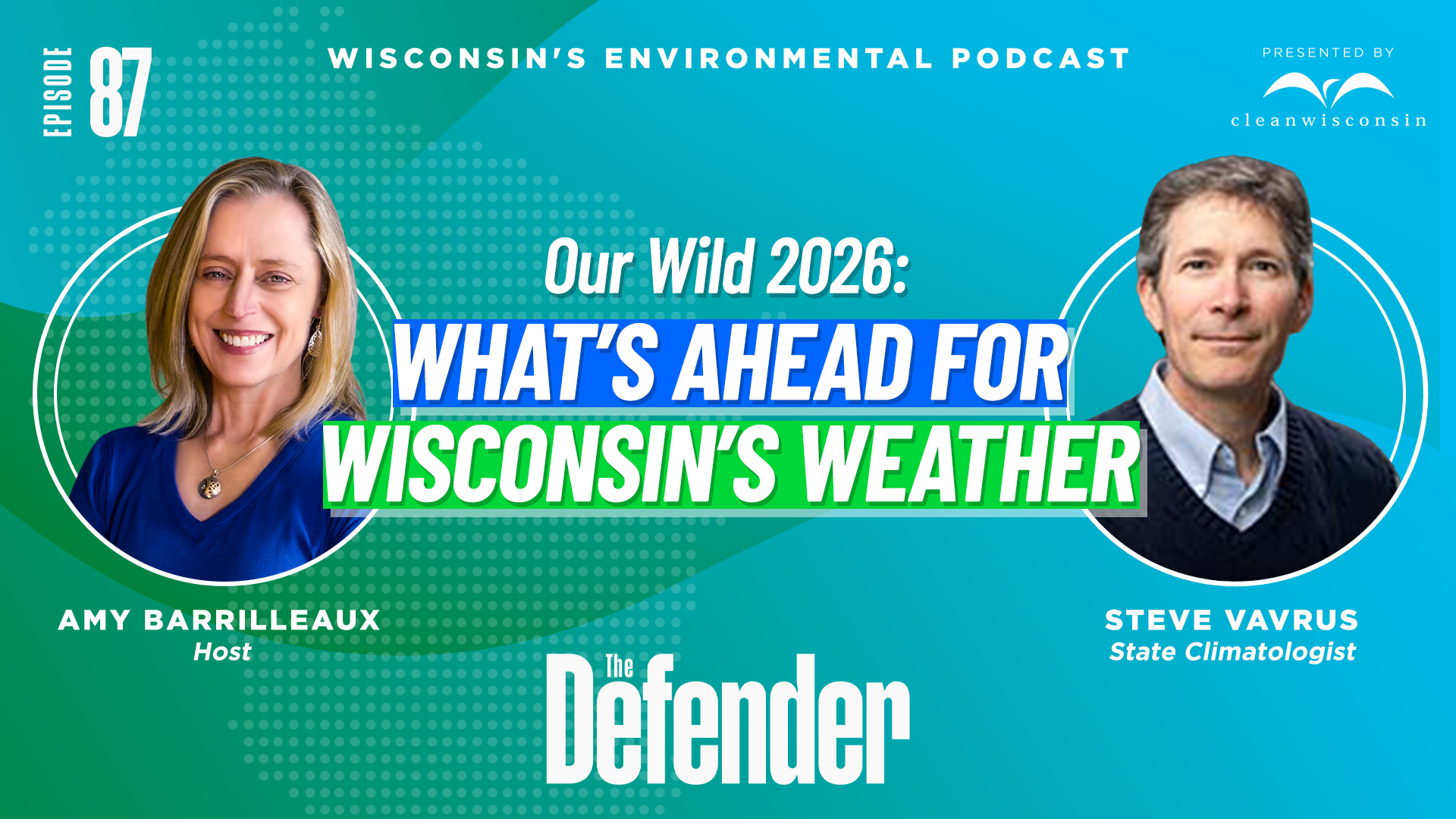
We all know Wisconsin’s weather is full of extremes and wild swings, like snow one day, sandals the next, and then back to snow. But 2026 has been wild even for us. In this episode, Amy talks with Wisconsin’s state climatologist about what just happened this year, and what’s next.
Host:
Amy Barrilleaux
Guests:
Steve Vavrus, State Climatologist
Resources for You:
Wisconsin Center for Climatic Research
One Year Later: What the Milwaukee Flood Took and What it Left Behind
Transcript:
Amy Hello and welcome, this is the Defender, Wisconsin’s environmental podcast, and I’m your host, Amy Barrilleaux. The Defender is powered by Clean Wisconsin, your environmental voice since 1970. We all know Wisconsin’s weather is full of extremes, wild swings, like snow one day, sandals the next, and then back to snow. But 2026 has been wild even for us. This could be one of the most extreme years yet. In this episode I talk with Wisconsin’s state climatologist about what just happened this year and what’s next. And don’t forget it’s time for a little listener appreciation, I’m still giving away cool artist design stickers perfect to stick on your laptop or your travel mug and show your support for a clean, healthy environment. Details at the end of the show, that’s right now on The Defender. When you look back at 2026 so far, it feels a little weird. Hail, floods, droughts, smoke, crazy humidity. Joining me to help make sense of all of that is Wisconsin State climatologist, Steve Vavrus. Steve, thank you so much for joining me.
Steve Happy to be here. Thank you.
Amy Uh, so I have one word to describe the weather that we’ve been through so far in 2026 in Wisconsin, and that is, um, intense, like it feels like so much has happened and we’ve through so many different, uh, types of weather events. When you look at where we are this year, as a state climatologist is the statewide view, what kind of goes through your mind?
Steve Your perception is absolutely right. It’s been intense, it’s been tumultuous, it has been eventful this year, even more than usual. Wisconsin’s a place that’s not immune or certainly is accustomed to having extreme weather, but this year has been an extreme of extremes. And I’m really struck by the variety of extreme weather we’ve experienced starting in January and continuing just about every single month through August and now we’re entering September.
Amy So when we talk about extreme weather, I mean, that’s so many different kinds of things you could talk about. I know here in Madison, we had those giant hail balls. There was also a big dry spell. Maybe it wasn’t quite a drought, but it was not particularly wet. And then we had all this crazy humidity. So what does that kind of all those things, is that just kind of like, well, this is a typical year. We’re just noticing it more. Or how atypical has this year been?
Steve Well, there’s always the concern that maybe our perception is clouded by the fact that there’s more concern about climate change, but we can break it down and look at individual events as well as the aggregate and see that we really are seeing more extreme weather overall. The State Climatology Office has created a new Extreme Weather Index that tries to quantify different types of weather extremes, and we see that that index is showing almost a 30% increase. Since the 1890s.
Amy So I talked a little bit about the hail. I know we had flooding in some parts of the state. We’re coming off of just over a year since some terrible flooding in Milwaukee. So what are the moments, as you look back over the past year, that jump out at you as kind of important to take note of?
Steve Yeah, there’s been so many, it’s hard to take stock of all of them, starting with that severe cold wave we had in late January.
Amy I don’t even remember what you’re talking about, because late January, you’re like, oh, a cold wave, that’s normal, right? Or is it not normal?
Steve It was abnormal in the sense of its intensity. For one of the few times in the last 30 years, parts of Wisconsin dropped below minus 40 degrees. Not just wind chill, but actually air temperature away in the north. And that’s become very, very uncommon anymore. And then we had a historic blizzard in northeast Wisconsin. Really, the whole state received the blizzard conditions, but the northeast was hit the hardest. And even for an area that’s used to snow and cold and and wind that pretty much shut down that whole part of the state. And then fast forward to April, we had the wettest April statewide on record, and then we turned around and had the fourth driest May on record. So this these rapid swings and then of course the severe weather outbreak in April. We had more tornadoes in one week during that than we normally have the year in Wisconsin so Pretty much take your pick of any month of the year and you’ll find some sort of extreme weather event that’s been notable.
Amy It’s so strange hearing you talk about all this, because I’m like, oh, I don’t remember that, or that’s fuzzy, it kind of all runs together. I mean, I do remember the hail, because there was some real damage all over the place with that. But when you talk to people, how often do people kind of go, wait, what happened six months ago? I mean do we just kind of stop paying attention after a while, or stop remembering?
Steve Think our memories are clouded by distance in the past. We remember things that happened most recently. My job is to remember these things in our office in the State Climatology office. It has a job to document them and interpret them. So I’m more, I keep tabs on this more than most people, but even I can forget some of these events from several months ago just because there’s been so many. The wildfire smoke that we had in July for a day to. That was really extreme. And that was just one of many different types of extremes we’ve been dealing with.
Amy So When you look back, I mean, your job is not weather person, right, to give us the weekly forecast. Your job is to look at long-term trends. What is the… Are we in an unusual place, I guess, in terms of long- term trends in Wisconsin? How different are things, these extremes and these moments now compared with 20 years ago or 40 years ago? Is that the kind of the time scale that we should be paying attention to?
Steve Yeah, our office really looks as far back as we can, and some of our data go back to the early 1890s, in some cases, even the 1880s. In fact, Madison’s data record goes back to 1869, so we really have a long time period to judge by, historical context. And we can see very clearly that the climate’s been getting warmer and wetter over this period. We even have some indirect data from Lake Mendota ice cover, and so we can that. We don’t get as many days of ice cover nowadays as we used to. And so we do have ways to document whether these changes are part of a long-term trend or whether they may be more of a fluke. I would probably put the blizzard in Northeast Wisconsin more in the flukey category, whereas the trend toward more heavy rainfalls, that’s an ongoing one that’s probably gonna continue in the future.
Amy You probably get this question a lot, but what about that crazy cold spell that we had that I’ve apparently blocked out in early January? How can we have these cold spells and then still say, you know, these record cold spells in some cases, and then say, well, Wisconsin’s climate is getting warmer?
Steve Yeah, so it’s the difference between weather and climate. So climate is longer term, it’s thought of often as average weather, or I think of it more as accumulated weather. When you take into account the extremes, the averages, the day-to-day fluctuations in weather, that’s climate. That’s the whole picture. But within that, even though unmistakably the climate’s been getting warmer, we do have these oddball occurrences of a severe cold wave in January, for instance. I think an analogy people can use is the stock market. It’s been going up for years overall, but there are still some days when there’s a big plunge. And that doesn’t mean that the market hasn’t been continuing to go up and it may continue in the future, who knows? But it just shows that the long-term sometimes is not always consistent with the day-to-day variations.
Amy So a state climatologist feels like a lot of responsibility. It’s a big amount of stuff to look at, especially these days. What got you interested in the weather and the climate and kind of understanding these big picture things?
Steve I grew up in Indiana and we had some severe winters when I was a kid and I became fascinated with weather. We had a big tornado alley in Indiana. So a lot of things piqued my interest in weather and then as I got older and looked for a major in college, I thought meteorology was a good fit. When I got to the University of Wisconsin, climate and climate change was becoming big news and so I kind of latched on to that. And it really, I think they complement each other because you can be very interested in day-to-day weather as I am, but knowing the climate system and the long-term climate records helps you to put these variations on the short-term into a long-terms perspective.
Amy Do you ever walk out your door and think, uh-oh, this is weird, or this is a bad sign, or I got to write this down when I get to work?
Steve Absolutely. There’s been a number of times recently when I felt that way. When we have out of season events in particular, the severe weather we had in April was one example, but even more so was the example of the first ever documented February tornadoes in the state. So February 9th I believe in 2024 we had three tornadoes and one or two of them were pretty strong. I remember walking outside on that afternoon and just thinking, this is surreal, this is early February and yet the sky is stormy, there’s tornado sirens going off. That was one of those instances where I felt like I was in another world.
Amy Yeah, and then, you know, this summer we’ve had some times when it feels like I’m back home in Louisiana. You know, we’ve got this kind of intense humidity. You can’t fling up in the windows at night because it’s still just as warm outside. How important are those kind of cool nights in Wisconsin? I think it’s something that we used to be able to rely on.
Steve Absolutely. This is one of the unmistakable climate change trends we’re seeing is we haven’t really had an increase in hot weather during the day. Say days of 90 degrees or higher for whatever reason. But where we are seeing it is at nighttime. So nights when the temperature doesn’t drop below 70, it’s really muggy. It’s it’s miserable to sleep in very much like this week. And people who don’t have air conditioning or inadequate air conditioning, they can really have their health compromised because their bodies don’t really have a chance to cool off during a heat wave. And this is a big public health concern. And so as we see this trend toward more humidity, as we’ve been experiencing in Wisconsin and nationally, that humidity helps to keep the temperatures up at night. And this a rising concern for us.
Amy So, so far this year, we’ve had giant hail, big floods, a blizzard, a deep freeze, droughty conditions, super heavy rain. Does that, is that basically summing it up? Am I forgetting a thing?
Steve We’ve probably forgotten a thing or two, but I would point out that those of us in southern Wisconsin probably don’t realize just how bad the drought is right now in the northern part of the state. Just last week or two the U.S. Drought Monitor characterized the conditions as extreme drought in many northern counties, especially the farther north and northwest you go. And in fact, it’s become so bad that the Wisconsin State Drought Task Force has just been reconstituted. This is an ad hoc group of weather and climate experts, including the National Weather Service and State Climatology Office and a number of state agencies. We get together weekly to assess the situation and ultimately make recommendations to the governor’s office, if warranted.
Amy It’s true. You know, I think some of these things are so kind of hyper local, like that hail storm, for example, that we we only know what’s in our backyards. It’s hard to kind of pull it all together. You talked about kind of get becoming interested in climate because climate change started become a big topic these days. Do you feel like people are still talking as much about climate change or or coming to you in situations like this and interviewing interviewing you about climate change because I feel like We’ve got so much going on that sometimes people are kind of, oh yeah, yeah, climate change. Are you getting a sense of any of that?
Steve I think that to some degree people have just internalized it, there’s just been an acceptance that oh yeah the weather is different now than it used to be. Differences of opinion about what to do about it or where to put it on the list of concerns. One thing I like to remind people of is we’re as a society very concerned right now about affordability on people’s minds is that weather events, extreme weather really contributes to costly events. It can raise our insurance premiums. It has already. Some insurance companies are pulling out of parts of the country because it’s unaffordable to insure those regions, largely due to wildfire and hurricanes, but even hail and flooding. Severe storms are the costliest for insurance companies.
Amy Did you ever think, when you came up here to Wisconsin, that we would start to routinely have our summers dealing with terrible air quality issues from fires? Because you think, oh, it’s a good thing to live near huge forested land, and now it feels like maybe it’s not a good thing because we end up on the receiving end of so much terrible pollution.
Steve The wildfire smoke has really emerged as a new climate change issue. I would say it was not even on my radar five years ago in a place like Wisconsin. It was, if you’re in California, some place where the fires actually occur, but downstream effects like we’ve been seeing in, not only in Wisconsin, but the entire northeast and other parts of the country, that is something new. That’s something the past few summers we’ve really experienced. And in fact, three of the past four summers in Wisconsin, we’ve seen extreme episodes of one sort or another. It wasn’t just in July of this year, but last July and August, we had a sustained period of extreme wildfire smoke. And so if this is becoming the new normal and time will tell, that creates a different problem because wildfire smoking, as our health experts tell us, is extremely harmful. And we may not even have a full handle on just where it ranks in terms of concern about health versus, say, extreme heat impacts.
Amy I think there were moments this summer where it could have been a nice cool night and you could have opened your windows and really enjoyed that summer night, but then you open your windows, and you get a bunch of smoke. So I guess even when the weather is cooperating, we don’t know what the smoke is going to do.
Steve Yeah, exactly. And so we had somewhat hot weather during that wildfire smoke episode this summer, but even when it cooled off a bit, we ended up having the smoke around. And again, if you don’t have air conditioning, you have a double problem, right? You want to open your windows to let some of the heat out, but then you let the smoke in. And people were in a real bind because it was a no-win situation for two or three days.
Amy So what can we expect in the years to come? Because even if we do everything right with respect to climate change, lowering greenhouse gas emissions and really getting our stuff together and taking this crisis seriously, we’re still dealing with what’s already here. And so there’s a big focus on resilience. How do we face these extreme moments? As we look ahead here in Wisconsin, what can we expect over the next 5 to 10 years? I mean, I’m going to guess we can expect more intense craziness from time to time.
Steve Yeah, so there’s definitely some effects that we feel pretty confident about. One of them is the overall warming in every season probably throughout the state. Another one is heavier rainfalls. This is a trend we’ve been seeing for many, many decades, even more than a century now. That’s likely to continue. Another one that’s emerged more recently as a concern is this flip-flop between very wet weather and very dry weather. A great example was this spring when we had the wettest April on record in Wisconsin and then the fourth driest May. Milwaukee had its wettiest ever April followed immediately by its driest ever May. So that kind of flip-flop we’ve not found in any other station at any other part of date, and so this is potentially unprecedented. And it makes preparation really difficult, because then you don’t know, do you prepare for really wet weather? Do you prepare dry weather? If you have to prepare for both almost at the same time, that creates some real challenges.
Amy So I guess the flip-flop is our future. I mean, if you could leave anybody, I guess, with a message about your work or why studying all this is important, what would you say?
Steve There’s so much we can do to prepare for the changes in climate. I mean, one of the silver linings, I would say, of the extreme weather and changes we’ve had lately is that they provided us with stress tests. In many cases, we understand now where we’re vulnerable. For instance, did a dam fail? Did a certain piece of infrastructure not make it? Were there unfortunately too many heat related deaths or trips to the emergency room? So those are all indications that we’ve got a problem and we know where those problems are and we can try to address those In the case of extreme heat, this is one of those cases where there’s a lot of things we can do We’ve learned from communities across the country and around the world of what works and what doesn’t work There really should not be any heat mortality That’s something that’s very preventable, but we need to be prepared for it as the climate warms, as we get warmer winters and probably less snow cover in the future. This is also something we need to prepare for. If you’re in the outdoor tourism industry, for example, you may need to start hedging and looking for ways to not put all your eggs in the snow and lake ice basket and think about ways that you can accommodate days when there just isn’t enough snow on the ground or ice on the lakes.
Amy I guess, you know, as a state where so much of our economy is driven by farming, you know, that sort of flip-flop thing, the intense rain and the intense dry, changing in our kind of growing seasons and all that can be pretty devastating. Do you get a lot of farmers or folks in the agricultural industry kind of asking about how do we prepare for this?
Steve Yeah, we work at the state climatology office and our partner organization, WICCI, the Wisconsin Initiative on Climate Change Impacts, works with farmers and growers of various types and they’re very aware of the weather changes. They’re in the front lines of it, but they also are a very resilient group and they’ve dealt with weather extremes their whole life, their livelihood depends on it. So they’re creative and ingenious in knowing how to adapt, but they’re really being challenged because of what’s been happening lately. And in some cases, it’s not even clear what the net effect is of these flip-flops in precipitation, which we’re calling precipitation ping pong, this back and forth. Because, for instance, if you have a drought, if you started overly wet, you have some sort of cushion because of where you started. And likewise, if you started off really dry, you need some precipitation. If you get the heavy, rainy period, that could provide some benefit. So I think it’s an important research topic of this precipitation ping-pong, is whether it, you know, in what ways is it a cumulative or an amplifying detriment? In other ways, is there some benefit between going back and forth where there’s compensation between the two.
Amy I think the hardest thing about going back and forth is, at least in terms of heavy rains, you know, I always learned that in terms our aquifers, you know the water system below our feet that provides a lot of our drinking water, we kind of need that long steady rain or those, you now, snow, the snow cover that lets the water kind of get down into the soil, into the rocks, and then finally deep into the aquifer system. Heavy rainfall, it feels like it just washes a bunch of stuff into a body of water and then it goes away. How much has the flash flooding picture in Wisconsin changed because of this changing climate?
Steve Yeah, so we are seeing more intense rainfalls, say days of two inches or heavier rainfalls. Those have been getting more common with time. We had the most incredible example of that a year ago in Milwaukee with the 14 and a half inches within a day. Still hard to believe that that amount fell. So we’re definitely seeing more of these intense daily rainfalls we’re working on whether we’re seeing that more of a prolonged period, but we’re on the daily time scale seeing more of that. And with that comes what we’re calling as a reduction in effective precipitation. Effective meaning it’s effective at penetrating or infiltrating into the ground where it can replenish groundwater, for example. If you have just a normal amount of rainfall but it all falls within 20 minutes, that doesn’t help too much, right? Because so much runs off. Similarly in winter, snow cover is a really good insulator. If we don’t have that snow cover and it’s still cold enough, the ground is frozen. And now, if we get a winter rain, for example, it runs off instead of infiltrating into the soil. So that would be another case where the precipitation effectively was not as much as it shows up on the data sheet.
Amy So I think the lesson here is that weather and climate are way more complicated than we might think when we’re just kind of like figuring out whether we need a coat.
Steve Absolutely, yeah. The way these things play out, the order in which they play out the swings between one one extreme and another, it’s very complicated. And examples like the wildfire smoke that I don’t think any climatologist in Wisconsin was overly concerned about five, ten years ago. Suddenly we’ve seen several examples several years in a row when it’s become a real problem.
Amy Well, thank you so much for all the work you’re doing. And I guess the rest of us just need to invest in rain jackets, coats, umbrellas, waders, I don’t know, whatever. So we can be ready for these extremes. But definitely something that’s important to everybody.
Steve Yeah, we definitely need to be prepared for a different future. It’ll still be recognizable. We’ll certainly still have the four seasons in Wisconsin, but they’re gonna look somewhat different than we’ve been accustomed to.
Amy Well, a recognizable future is at least something. Thank you so much for taking the time to talk with me about this. It’s fascinating as always.
Steve Thank you, Amy. I appreciate it.
Amy And thank you for listening to The Defender. As I mentioned, at the top of the show, we have some very cool artist-designed stickers we’re giving away while supplies last. All you have to do to get one is send me your name and address to podcastatcleanwisconsin.org. And feel free to drop a note any time with questions or comments on the show. I’m Amy Barrilleaux, talk to you later.
