

Where to Listen:




Communities across Wisconsin are starting to push back when energy utilities come to town with big plans for big gas plants. But how do you turn opposition into victory?
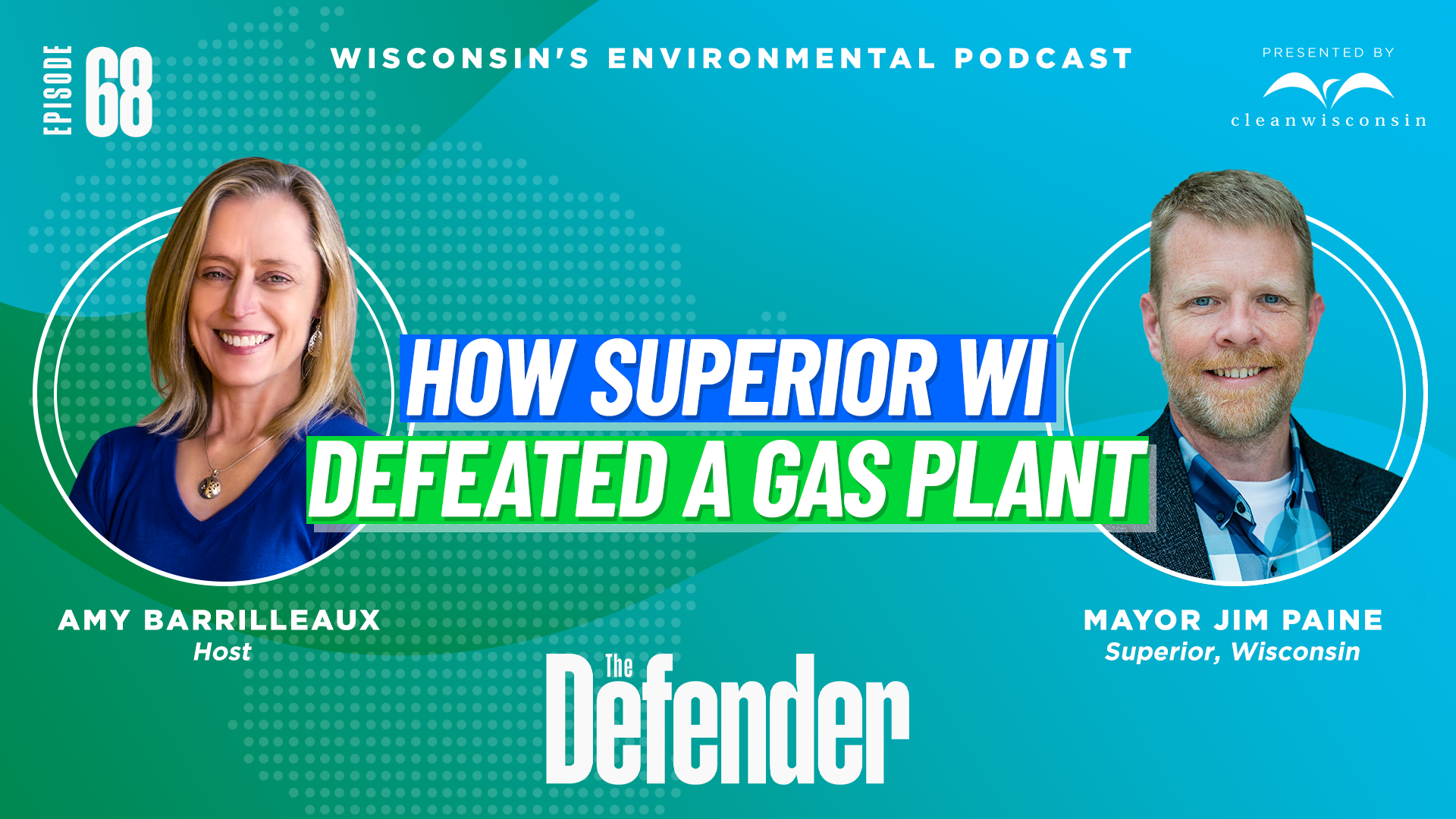
In this episode, Amy talks with the mayor of Superior, Wis., about the city’s long journey to defeat the Nemadji Trail Energy Center—the ugly gas plant with the pretty name.
Host:
Amy Barrilleaux
Guest:
Superior, Wisconsin Mayor Jim Paine.
Resources for You:
Under the Lens: The Truth About Natural Gas
Transcript:
Amy Hi there and welcome to the Defender, Wisconsin’s environmental podcast, I’m Amy Barrilleaux. The Defender is powered by Clean Wisconsin, your environmental voice since 1970. It might go without saying, but it’s not great to live next to a gas-burning power plant. When methane is burned, it releases a pretty long list of bad chemicals including nitrogen oxides, particulate matter, sulfur dioxide, and more. And methane itself has 80 times the climate warming potential of carbon over a 20-year time span, making it an extremely potent greenhouse gas. It’s no wonder communities across Wisconsin are starting to push back when energy utilities come to town with big plans for big gas plants. But how do you turn opposition into victory? Maybe a first step is finding out you’re not alone.
Jim One of the most important moments in my process was when I came and met with the attorneys at Clean Wisconsin, and there were like four of us fighting this gas plant at the time. And we found out that wasn’t true. We weren’t alone. Other people were in this fight.
Amy In this episode, I talk with the Mayor of Superior, Wisconsin, about the long journey to defeat the Nemadji Trail Energy Center against the biggest odds. That’s right now on The Defender. Six years ago, the Public Service Commission of Wisconsin voted to greenlight a major new gas plant in Superior that utilities had named the Nemadji Trail Energy Center. Sounds pretty nice. It would sit on a bluff overlooking the Nemagie River. It would add 3 million tons of carbon emissions every year and 200 tons of other dangerous pollution like nitrogen oxide and volatile organic compounds. It would also threaten nearby wetlands pumping millions of gallons of fresh water every from area aquifers. Later that year, Clean Wisconsin filed a lawsuit to stop the plant, arguing the PSC approved it without adequately considering state environmental standards. But defeating the plant was always an uphill battle, as most environmental fights are, especially since at first, many local lawmakers supported it, until they didn’t. And today, they’re calling it over, saying that the Nemadji Trail Energy Center isn’t gonna happen, not because of one big moment or a decisive battle, but because of growing, continued resistance. Joining me is the mayor of Superior, Jim Paine. Jim, thank you so much for being here.
Jim Yeah, thank you and good afternoon or whenever you listen to this.
Amy I want to start by asking, you know, take me back to when you first heard about this new gas plant that was being proposed in Superior, I guess maybe a decade ago. How did it all kind of start?
Jim So before I was the mayor, I was on the Douglas County board and I had a failed run for mayor in 2015, uh, but that, that helped my community profile and the next year I was elected vice chair of the Douglas county board and we got a new chair. And so he was brought into economic development conversations and first heard about this gas plant that was going to be built, didn’t have a name yet, just a natural gas plant. And he came to me looking for advice. I wasn’t in the meetings and said this was really concerning because it seemed like they were going to turn over all of the revenue to the power company that was building it as an incentive to build it. And he didn’t like that. Uh, and the argument was, Oh, it’s going to make so many jobs. And he was the very first person to say, it doesn’t sound like that many jobs, 25, maybe not even that many full-time jobs were going to give up quite a bit for that. Millions and millions of dollars. He didn’t. Like it. I told him, listen, if you support it, I won’t. Uh, And so he held the line. Well, then I was elected mayor the next year, and it really began the way many of these large projects began, gas plants, data centers, large utility arrays of any kind, start with the word congratulations. We are coming to your community. We have chosen you, and that was the beginning.
Amy Did that make you feel special? Congratulations, we’ve chosen you to build a gas plant in your community.
Jim To be perfectly honest, most of what you feel is fear at that point. And I’ve talked to a lot of elected officials that feel this way. When they sit you down, it’s only them in the room. And they are high powered developers. And especially when you’re new to elected office, all they’re pitching is the advantages. This would be the largest private development in Douglas County. This is gonna bring a million dollars a year in direct revenue to your general fund. And oh, by the way, the construction will be union building trades jobs. Opposition to this is one of the worst political moves you can ever make, but don’t worry. We know you’re an environmentalist. We read your literature. This is part of the environmental movement. This is going to support our development of renewable energy. So you’re really helping make the transition of renewable energy. This. Is the perfect project for environmentalists. And even if not, you’re going to be in trouble if you oppose it. So there is a very big carrot and a very big stick.
Amy How does it feel to kind of sit in a room with people and have them tell you, if you oppose something, it’s going to be a bad political move, and then sort of dangle out these big time money revenue, I mean every community wants revenue, what’s going through your mind as you’re kind of getting pitched and pushed, I guess, to support this big gas plant?
Jim Well, you move really quickly to rationalizing it. And that’s why I don’t really see public officials that support bad projects as the problem. They’re really put in a position to do that because while I said you can feel a lot of fear in that process, that goes away very quickly. You rationalize that very, very quickly and you start looking at it as an opportunity. I even thought like, imagine what great parks or river cleanup projects I could do with a million dollars a year. And this thing’s gonna sail anyways, let’s just go for it. But what comes next is they expect you to do the selling of it. They’re not gonna do that. And so then you get this like almost prepackaged list of environmental arguments and then you find yourself saying. It happens very quickly.
Amy So this project starts getting talked about, you know, about 10 years ago. Um, at some point, Clean Wisconsin got involved and filed suit to stop the gas plant. When did the, the community, I guess, start to think, Hey, maybe this isn’t what we want or, or how did that process kind of play out?
Jim That process was as long as the entire story. So the answer is right away, because this requires approval from the Public Service Commission of Wisconsin, and that means public hearings. So what happens is I did my duty and I went and I testified for it with all the talking points I was given. That’s a little embarrassing to say now, but I think I was doing that in good faith. You know, I was giving information by who I believed were experts and it made sense and I believed it. What was unsettling though is that other folks that were very real environmentalists, part of a movement that I’ve been a part of since I was a child, were arguing pretty vociferously against it. And then it just stops. It gets held up in the permitting process for a long time, enough time for the presidential administration to change. And then a couple of pretty bold staffers at the EPA out of Chicago started objecting, made a formal objection, which really does not happen in the federal process. Uh, and so that’s when I was like, okay, Joe Biden’s EPA has a problem with this. I look around and I see play folks like clean Wisconsin, Sierra club, uh, a number of organizations in Minnesota. And every environmentalist I personally know is opposed to this. And it occurs to me, I haven’t talked to any of them. I haven’t to ask any of those experts. Why.
Amy So when you started thinking, okay, maybe I don’t know enough about what this gas plant means for our environment, how did you start kind of finding out that this was going to be not the great thing, not the environmentally friendly project that developers were claiming.
Jim There was actually one very big movement, and I’m glad it happened because remember, this was a two-state process. This is Minnesota power is building a gas plant in Wisconsin, and it’s in partnership with Darrell and power in Wisconsin. And so they had to get through Minnesota’s approval process as well. And it was really interesting because the argument that environmental groups made in Minnesota was that Minnesota Power does not need this energy. They do not need 500 megawatts of new power. They certainly don’t need fossil fuel power of that magnitude. Minnesota Power is one of the most rapidly developing renewable grids in the country. So that was the argument they made. And obviously the utility was like, absolutely we do, they’re wrong. They don’t know what they’re talking about. And then as soon as they got that approval, Minnesota Power sold most of its stake in the project to Basin Electric out of South Dakota. And that’s where I was like, they lied. They lied about the need for the power. And so then I was, like, what else weren’t they telling the truth about? And if this is power for North Dakota, South Dakota, Montana, possibly as far south as New Mexico, what is this plant really about? And so that’s what led me to, I think Clean Wisconsin was the first call I made. And I was like, “Do you want to just give me an hour and tell me what you think about this and what are the arguments against it?” And then it wasn’t so much that they were not telling the truth about that. They weren’t telling the true about almost any part of the project. It was deeply disturbing how many things were so completely wrong from the actual pitch that I had made. Probably the most egregious, to the point that it’s almost funny, is they’re like, listen, this is the perfect site because it’s already an industrial area. Well, okay, so what do you need from us? We need you to make it an industrial area. We need to change the zoning. What’s the zoning now? It’s residential. And you’re gonna put it in a neighborhood? They’re like it’s not a neighborhood. There’s no neighborhood there. So I went there. I mean, this was my town. I went there. There’s a house across the street. Across the street! It was adjacent to an active cemetery. People were still having funerals there. It was adjacent next to an indigenous mass grave. It was a adjacent to the Nemadji River on an unstable bluff that the EPA had already condemned. The, I’m sorry, FEMA had already been buying houses in this place that was not a neighborhood to remove them because the bluff is so unstable that they’re gonna put a massive gas plant on it. So one by one, every argument started falling apart. If I could backtrack just a bit, the county board chairman that originally helped resist this His first argument was about the water. He said, there’s no way the aquifer could support this. And he ended up being right. They still deny it to this day. But he was right. And it’s the only thing the DNR ever denied in that entire process.
Amy So you went from supporting this project to kind of looking down into the facts, trying to really figure out, okay, what does this project really mean, and then finding out some stuff that was alarming. But I think not everybody would do that. Not everybody would go from supporting something publicly to saying, hey, I was wrong. Um, what made you… I guess, you know, kind of set the pride aside of what you had publicly supported to say, no, I can’t, I cannot do this anymore?
Jim I didn’t, my wife did. My wife served on the city council at the time and represented the district where this would be built. And she had supported it too at the beginning, but she’d done a lot of work in the intervening time. Again, the federal process holding this up bought us the time we needed to convert. So she looked at, we also had a massive oil refinery explosion during that intervening time. These things cause you to ask questions. And so she says things, started saying things like, You know, the highway that rolls from my neighborhood, polluting the neighborhood, and a decrease in safety, I wasn’t here when that was built. I couldn’t stop that. The refinery, I wasn’t here when it was built, I couldn’t stop that, but I’m here now. I can do something about this. And she reminded me of something I often say to candidates, how do you wanna lose your election? We know you wanna win, but how do wanna lose? Do you wanna lose it being somebody else, cause you might, or do you want to loose it being who you are and fighting for what you actually believe? And so then we started having conversations. It’s just worth losing an election over and at the end of the day It seemed like it was so then she started doing much more aggressive research than I was ever able to do and she became one of the leading voices against it But that simple argument and a couple of canoe trips with some old environmentalist friends like you only get this one opportunity to do the right thing and if you do the wrong thing, sometimes the consequences can last for decades.
Amy As I mentioned earlier, Clean Wisconsin filed that lawsuit saying the Public Service Commission should not have approved this plant under state law. And those legal fights can be really hard to win. But they can, as happened here, slow things down, make it harder, I guess, for a project to move forward quickly. Did you feel like when you finally figured out, okay, this is not something I want in my city, did you feel you could stop it, that that would be achievable?
Jim I thought we could win. And so I know there’s folks that that get in these fights all the time and the advice that I have is first obviously develop a strategy but if you fight you can win it requires a team it requires the coalition and requires a strategy look I’m I’m a United States Marine I like to fight that is what we do and we fight to win and we never stop and so the way I looked at this strategy is okay they had some permits already. Um, but those are being contested by folks like Clean Wisconsin, uh, and they were in the courts, there were still appeals process ahead. We had Supreme court elections that seemed to be going the right way. There’s also a whole federal process. There were other agency permits that were still outstanding. I had dozens of calls I could make. I had thousands of battlefields that I could fight on and the gas plant needed to win every single one of those fights. They needed to beat Clean Wisconsin in court. They needed beat them on appeal. They need to beat them in, uh, in the Supreme court. They needed get their Army Corps permit. Uh, they needed to get it today. Uh, not years from now. They, uh had an interconnection agreement that the clock was ticking on. They needed win every fight. I only needed to win one and. So I just fought them off.
Amy So what happened? I mean, because I think that this kind of victory isn’t one where it’s like, okay, a court makes a decision and everything’s over, or this black and white thing happens and then we know, you know, you’ve won this environmental fight. It feels like it’s been a long kind of slow push, I guess, against this gas plant until the point where it’s just not gonna be viable anymore. I mean is that where we’re at, or how do we get there?
Jim It’s like going bankrupt. It’s gradual and then all at once. Uh, so if I, there’s a series of moments, uh, keep in mind, there is a lot that happened behind the scenes because we really did pay attention to every single one of those battles. What was the clock on every single permit? So our goal was not necessarily win, just fight long enough until they were done and, uh which by the way is the, uh argument in On War by Carl von Clausewitz is just fight longer than your opponent wants to. And so that was the strategy. BUT The supporters were fighting pretty hard too. And, uh, one of those people I mentioned earlier that spoke up about this at the very beginning was Nick Ledin who, uh, eventually ran for city council. So he had been opposed since the jump and now he was on the council. And so they, uh a lot of folks targeted him, the supporters targeted him to lose his election. Well, uh the vote was coming, the city vote to rezone the property, to vacate the necessary streets and alleys. To change the comprehensive plan to allow this at the local level. Now, they said they didn’t need our permission, but they were certainly asking for it. So our position was you do need our permit, our permission. So when Nick Ledin wins his election, his reelection, we immediately moved to the vote. We had gone through the plan commission. We had all the public hearings. And the question was, should we rezone it? The next step would have been a new public hearing to allow the rezoning. We simply declined to allow the new public hearing. We voted no. After that, they still collected permits here and there, but everything starts slowing down. Now, there were some other things that they needed that I’m still not really willing to say because we had some trump cards. They probably know what they are, but we had final trump cards that we could deploy, but it became clear that to get through us, they would have to sue us too. Meanwhile, Clean Wisconsin’s lawsuit is ongoing and it’s not looking good for them. And meanwhile, they still don’t have their Army Corps permit. They still don’t have their federal funding. Every battle was getting longer and it was getting harder for them until they pulled the air, now I said it was done when we said no. Then they pulled air permit. I’m like, now it’s really done. And then when Minnesota Power / Elite was bought by Black Rock, they, they suddenly just dropped it all together. They took it off their books. So it just happened very fast when it happened, but our process was about making it harder each day and getting closer to the deadline when it would become impossible. So we just stayed alive long enough to outlive them.
Amy So you’re supposed to, from the, you know, powers that be perspective, you’re supposed to have a gas plant in your community built right now. This thing was supposed to be pretty much by this year. What would it be like to have that gas plant up and running and burning gas in your community?
Jim At the risk of sounding hyperbolic, I think it would have collapsed into the river and exploded. The, so there were a lot of risks here and it would’ve been a serious threat on multiple levels. Let’s start with it’s ugly and it’s uncomfortable to have these things in neighborhoods that are loud, they’re bright and they look really bad in what is otherwise a fairly pristine wooded neighborhood on a river. The risk on that bluff was very real. There are gas plants that do explode during construction. That’s something we lived through on the oil refinery. People are sensitive about that. We would have been worried about that every day. The risk of collapse from that bluff was very real, that was recognized by FEMA. We have ordinances against building on that bluff. But it would have meant that as people were burying their dead in that cemetery, as the indigenous community in Superior was trying to reconcile the very real crime against humanity about the mass grave that was there. They would have now lived next to this massive industrial project. And maybe this is not the point to end on, but our utility rates would have gone up. We have some of the highest utility rates in the state of Wisconsin, because we have the only private water system in the State of Wisconsin. They go up every single cycle. And that was the most offensive part of this entire thing. They expected us to pay for it. They said that they were investing in this community. They weren’t, they were extracting from our community. We had to pay it. They would then sell the product in places that weren’t Superior and take all of the profits and they weren’t gonna return anything to us. The utility reimbursement that comes in the state of Wisconsin comes from the state of Wisconsin, they didn’t pay any taxes. So we would have had, it would have been more expensive for the whole city. It would have be ugly. The neighborhood would have meaningfully declined. Our health would have at serious risk and we would’ve been constantly waiting for the next industrial disaster.
Amy What does it feel like now to be here and say, we won. This gas plant did not get built. All this decade of learning and investigating and working and talking to people has, I guess, paid off or has, you know, ended in a victory. And those things are sometimes really hard to come by.
Jim I should say I was late for this interview because I was watching some of the honest to God neighbors, the citizens from the community that organized to stop this gas plant are now focused on air quality in Superior. And they just did a bang up presentation in front of the DNR to argue that we need better air monitoring in the city. I’m sorry. We need any air monitoring at all in the City of Superior. An oncology nurse, a retired oncology nurse who had no background in the environmental movement whatsoever became an activist because of this and is taking on the DNR down the street in Madison today. There was no way I was bailing on that presentation. That’s what’s happening. So the community is activated and they’re looking for other ways that we can protect our community and make it better. What’s the next threat? But also what’s the opportunity? Now what I should say, my role, a big part of what I do now is I have to be an ambassador. One of the big advocates we got was Brittany Keyes, who fought a gas plant in southern Wisconsin and lost that battle. And so she came right up, traveled across the state to make sure we knew everything that she knew, learned every lesson that she learned so that we could do better. We have that same obligation now for anybody else that’s going to take on these fights, and we’ll be there for them.
Amy That’s an important point because this isn’t the only gas plant that’s ever going to be proposed in Wisconsin. In fact, right now, there are gas plants being proposed all over the place, big ones. And so, you know, I think traditionally gas plants have been painted as they’re not so bad. They’re, you know, they’re, not as bad as coal. So how important is it for you to kind of, I guess, to carry the torch that I’m Brittany brought to Superior to get out there and talk to other communities about what really has to happen to stop one of these things.
Jim To be honest, one of the things I struggled with in this entire fight was I’m not really conditioned to oppose things. I don’t like stopping things. I don’t like tearing things down. I like to build things and I like make the community meaningfully better in a way that you can see it. Preservation of wild spaces is very important, but I also want to improve things. And that includes our energy sector. And so what I learned in this process, one those talking points I mentioned that I carried for the utility. Was that this is about the transition to a renewable grid. Well, when I started looking at all the falsehoods in their arguments, one of them was like, we’ve been transitioning for a very long time. They’ve been using this argument for decades. When have we completed the transition? They’re not building gas plants to be better than coal. They’re building gas plans because they have natural gas and they need to sell it. They need a market for it. And so, and because the way utilities are set up in the United States, most states anyway, including Wisconsin is. They don’t have to pay to build gas plants. We pay, the customers pay for those. It’s all profit for them. In fact, we pay and they add a 10% profit for free. What investment is that locked in? Is that guaranteed? So my next goal, I think the next goal for everybody that’s a part of this movement is we need to recognize that we have transitioned, that we do have the technology, the funding, the capacity, the organizational ability to… power our grid on renewable resources. It’s not like we have a choice. We have to do this. But five years ago, 10 years ago that was challenging. We have come so far in that journey. It’s time to finish the job. We’re moving rapidly. Let’s just finish that work. Let’s build actual, let’s build our communities in a way that they can actually sustain themselves. We now have that opportunity. That’s what I’ve learned. So let’s do it. Let’s do something great.
Amy If you could give advice to a local lawmaker who’s in a room with a developer that’s pushing a gas plant or a data center or something else that could potentially be harmful for the environment, but they’re hearing all these great things and taking in all of this, you know, I think very calculated information that’s coming to them, what would you say? What should they do when a project like this comes to town?
Jim Don’t sit and try and figure this out by yourself. None of us have the courage to do this by ourselves. One of the most important moments in my process was when I came and met with the attorneys at Clean Wisconsin, and there were like four of us fighting this gas plant at the time, and we found out that wasn’t true. We weren’t alone. Other people were in this fight. We needed to meet them. We needed work with them, and Clean Wisconsin was outstanding. I was walking on a cloud when I left this building because smart. Passionate people were in this fight and were with us. In fact, when the tribes joined us in the fight, I was at a State of the Band speech for the Fond du Lac Nation. I said to one of their leaders, like, listen, I really appreciate you supporting us on this and getting in this fight with us, it’s nice to now feel so alone. And his response was, hey, we’re just happy we don’t have to fight you on this anymore. They were there first. Most of the time, if you’re gonna take on something like this. You’re not alone and you weren’t even the first to take it on. You have friends out there, you have allies, meet them, work with them.
Amy I think it’s impossible to win any of these battles alone. So Mayor Paine, thank you so much for taking the time to explain all this and for your great work in Superior. I really appreciate it.
Jim Thanks for all the work that you do. Thanks for your help on this. And we’ll catch you in the next big project we take on.
Amy And thank you for listening to The Defender. For more information on the truth about natural gas, check out the links in the show notes or head to the podcast page on our website, cleanwisconsin.org/podcast. I’m Amy Barrilleaux, talk to you later.
