

Where to Listen:




What does it take to get plastic out of your life? Well, unless you can go back in time 100 years, it’s pretty much impossible. But what about *some* plastic? Just a place to start?
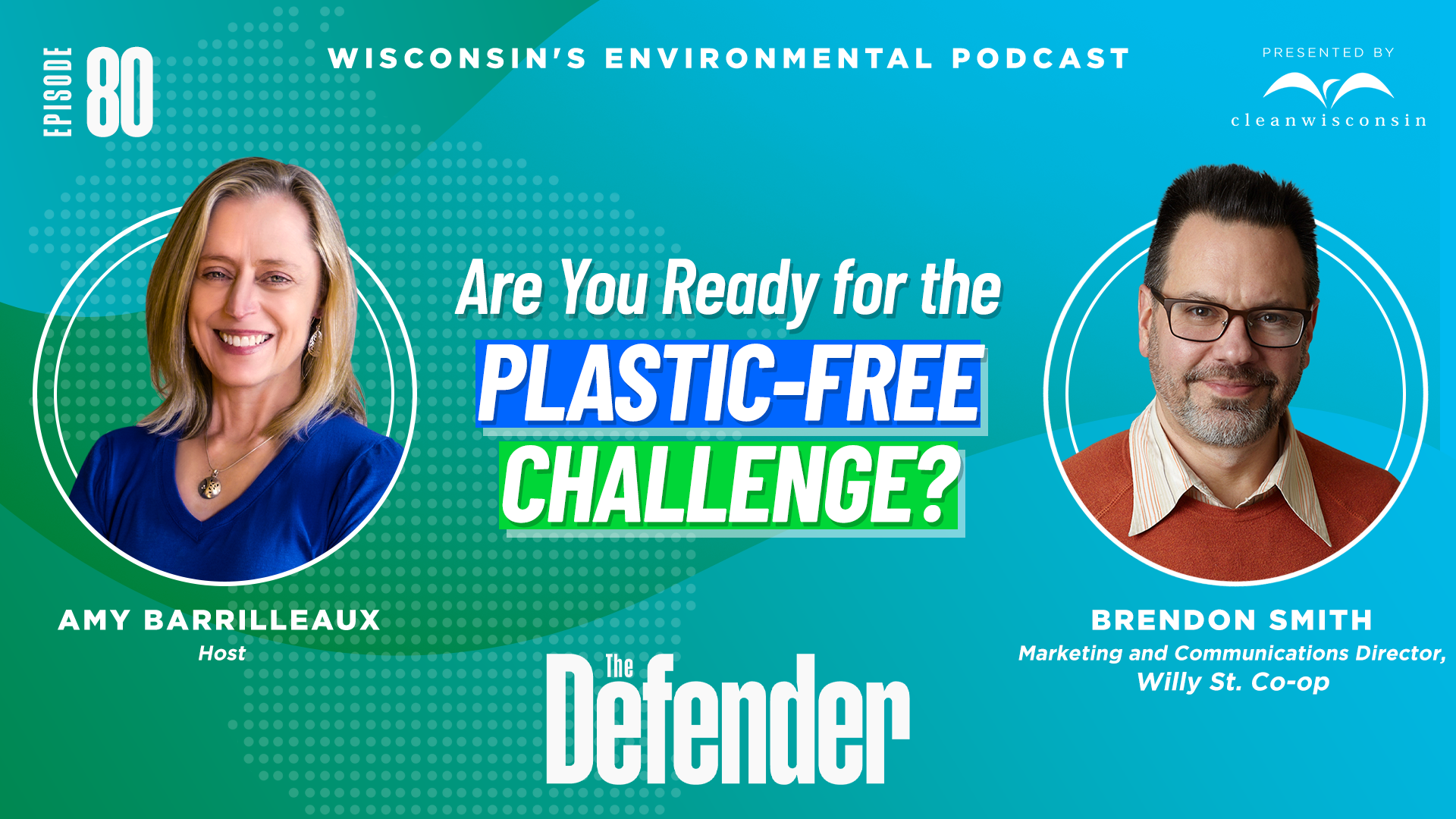
In this episode, we’re talking about plastic waste in the grocery store and how to take control of the plastics that wind up in your shopping cart.
Host:
Amy Barrilleaux
Guest:
Brendon Smith, Marketing and Communications Director, Willy St. Co-op
Resources for You:
Plastic-Free July: 31 days of ideas
How to store produce without the plastic
Microplastics in Our Bodies: Exposure and Potential Health Harms
Transcript:
Amy Hi there and welcome to The Defender, Wisconsin’s environmental podcast. I’m Amy Barrilleaux. The Defender is powered by Clean Wisconsin, your environmental voice since 1970. What does it take to get plastic out of your life? Well, unless you can go back in time a hundred years, it’s pretty much impossible. But what about some plastic, just a place to start? I have some good news. It’s plastic-free July and there is a place start. The challenge? Go a month without single-use plastics. And most of those kinds of plastics come with your food. In this episode, we’re talking about plastic waste in the grocery store and how to try to take control of the plastics that wind up in your shopping cart. That’s right now on The Defender. I don’t want to be too depressing, but plastic is everywhere, even when you don’t see it. It’s in the water we drink, the food we eat, and the air we breathe. Micro and nano plastics have been found throughout the human body, and concentrations in human tissues increased by 50% between 2015 and 2024. So it’s going to take an army of us to push back on this tidal wave of plastic, and that can feel overwhelming. But maybe the first place to start is with your food, and some local grocery stores are trying to help. Joining me. Is Brendon Smith, Marketing and Communications Director with the Willy Street Co-op, one of the largest food co-ops in Wisconsin, which has been promoting Plastic Free July. Brendon, thank you so much for being here, and I guess, how did the idea to start promoting this come about?
Brendon Sure. Well, first, thanks for having me. I would say that sustainability is a big part of what the co-op does every month. And we had heard about a plastic-free July trend, and we thought that was a great time for us to be focusing on the ways we try to avoid plastic in our stores and it easier for our customers to avoid plastic as well.
Amy So when I think about plastic-free July, I guess it’s kind of a challenge to go a month without single-use plastics. But then I looked at my refrigerator, and I was kind of like, what is a single-used plastic? You know, I’m looking at the hummus in plastic, and if I eat that in a couple days, is that kind of single- use? So how are you defining, I guess, this notion of single use plastics?
Brendon Sure. I would say planning to use the plastic once, the container, the utensils, whatever it is, straws once and discard it. Now, if you get food in a plastic container and then reuse it for seedlings, for example, or for other uses, it’s not single use anymore. You’re finding another use for it and you’re extending its life and you are preventing multiple single use plastic uses. So that’s great. Every little bit helps.
Amy So, you work for a grocery store, and as hard as Willy Street Co-op might try to reduce plastic, it feels like there’s more and more plastic. Not in Willy Street co-op specifically, but just when you walk down the aisle of a grocery store, the things that are not in plastic are way outweighed by the things that are in plastic. So, as… part of the grocery industry, do you see that? Do you see the trends are not exactly going in the right direction? Or maybe we’ve turned a corner and now they are going in the wrong direction.
Brendon I think it’s in some ways both. We’ve seen things like some produce plastic containers that are using less plastic or no plastic in some cases. They’re kind of cardboard berry containers and they can be a little bit more expensive and they tend to sell out. Very quickly because people want to support that, at least in our stores. And I know some vendors are trying to move toward glass where possible, or glass jars instead of plastic containers. So there are some areas I think that are moving away from plastic, but plastic does a lot of very helpful things. It can be clear, glass can too, but paper. Not so clear. So I think it’s a struggle, but I think there are, there’s clearly interest from people who are shopping in the stores to avoid it when possible. And it’s not always possible. And I think more and more companies are trying to figure out ways they can do it. They can sell their products without plastic if possible. And like I said, in some cases it just may not be possible.
Amy And the thing that the co-op is doing, which I think is kind of a, kind of a big deal is you are trying not to use on your hot bar, you know, your takeaway food, the plastic or disposable, um, silverware, I call it silverware or, but it’s made up of plastic. It’s plasticware I guess. You’re trying to transition to, um I guess this sort of take and bring back program. Tell me how that’s going to work.
Brendon Sure. Well, for years we had offered compostable cutlery when people would take it to go. The problem is a lot of compost facilities don’t have high enough heat to be able to compost that cutlerly. So even though we had good intentions that cutleri was really just going into the landfill like regular plastic cutlery. And when COVID hit, we used to have bowls and cups and plates and silverware in our stores. And we stopped that early in COVID when it seemed like COVID might be transmitted by touch. And then it took us a while to come back to that. And so we had seen, I think there are at least eight other food co-ops around the country who are doing this bring it back concept where people can take stainless steel cutlery. Home with them and then bring it back. We’ll sanitize, wash it, sanitize it and put it back out. And if some ends up in their silverware drawer, that’s, that’s okay. It’s still, we think it’ll still be cost effective in the long run. It’s really zero waste. And from the eight co-ops that have been doing this so far, they’ve saved over one million pieces of cutlery from the landfill.
Amy Wow, that is great. I mean, are you, does the co-op kind of, um, go through the stores and think, okay, where, where are the places where we can kind of make a shift or make a change and then, and then bring it out and hope that it works? Is that kind of what you’re, what you were trying to do?
Brendon Yeah, I think, um, we’re always kind of interested in ways we can improve. And then two years ago, we had a plastic audit. We looked at everywhere in the stores. We use plastic from plastic wrap on pallets when they come in into the receiving area to things like cutlery, to products on the shelves, um wrap for sandwiches, plastic clamshells for deli products. And we found that there weren’t a lot of materials out there that would make it easy for us to switch yet. Even setting aside cost, a lot the options we found weren’t as durable as plastic, unfortunately, but there’s a lot interest in it and it seems like every few months we’ll see a new thing being tried. And so we’re keeping a close eye on that. I expect we’ll do another audit in the next year or two and see where we can make improvements. And I’d say… Any customers who also share this concern, please feel free to contact your favorite brands and say, would you consider changing your, to packing your product in glass instead of plastic? It’s a lot, it can be more expensive because not only is the material a factor, weight is a factor and glass is definitely heavier than plastic, but if enough people who purchase the product. Really requested, I think the brands will have to look at that option and consider making some changes too.
Amy And I think if people are worried about their health in plastic and microplastics and nanoplastics, maybe they can start with the places where exposure is more likely, like tea bags, because when you heat up a tea bag and steep it, and if there’s plastic in there, then that’ll get into your body, or honey, because it sits in that plastic container for so long, because, you know, if you have everything in your cabinet is plastic, you can at least prioritize a little bit, Like, okay. Maybe tea, maybe honey, maybe I can reach those folks. Did you feel like after COVID, because you mentioned that you went from bowls and plates and silverware to kind of disposable stuff during COVID that we saw a lot more plastic? I know some grocery stores started wrapping produce in more plastic and now it seems to have stayed. Is that kind of what you’re seeing in the grocery world?
Brendon Yeah, I think it took us a lot longer. Even once COVID moved on, I think a lot of the habits stayed and we’re starting to see that kind of break up. Yeah, it’s just taken a while for people to make changes kind of back to the way things used to be. And I think some things won’t be going back that way. But yeah, I, I Thank you. Packaging really changed. For a while, we needed to shut down our hot bar and our bulk bins. We have about 500 products in bulk where people can get as much or as little as they want. And people can bring in sanitized containers, their own sanitized container, and fill them that way. And we had to shut that down because you have to either use a scoop or pull the bin handle if it’s a gravity bin. And again, when we thought it was transmitted by touch, can’t have a bunch of people touching these surfaces over and over. So we saw it take a while for bulk purchases to pick back up and people to kind of get back into that habit. So I do think it had some long-term disruption for people’s habits and we’re still seeing some of that coming back.
Amy So it’s kind of a challenge, right? July, Plastic Free July, don’t use any single use plastics or try not to during this month. And so I saw that in the Willy Street Reader like right at the beginning of July and I thought, oh, I think I need a month to prepare to get plastic out of my, like I need to like start cooking and like get things ready. So my Plastic-Free is probably gonna be August, but are you doing Plastic free July yourself or trying to? Thank you.
Brendon I’m not quite that committed. I do try to make, to give some extra attention to what I’m using and ways I can shift it. It does remind me a little bit of when we, we have an Eat Local Month. And it originally started as an Eat local challenge where we asked people to eat as much local, locally produced food as possible during that month. And I had people saying, what about salt? You know, salt, salt isn’t local. What am I supposed to do? And I said, it’s not so much about being perfect. It’s about being more sensitive and kind of considering these things. And I think even if you can make one change this month, that’s an improvement. It’s, and it’s, I also see it kind of like being a news resolution. I’m going to eat better. Oh, no, I cheated and it’s all ruined. No, it’s not. Little changes can make a huge impact. So if you can just swap out one thing this month or a couple things and then do that each July, that is an improvement. So I think, I really hope people don’t get too hung up on the perfection part of it or, oh, I messed up and I really had to do this. That’s fine. Any change is an improvements.
Amy And then like you said, also maybe this is a good month to think about, okay, what product would I like to see not in plastic anymore or packaged differently so that it’s more sustainable. So it’s not just like all on you to change the world. Also the places you buy from can, can help with that.
Brendon That’s right. Yeah. Yeah, I think also spending money with coffee shops and grocery stores and other places that pay attention to this kind of stuff sends the message that you value their work in this area and letting stores and organizations know that you are paying attention to this and that they should consider this will help them make different may help them to make different decisions in the future.
Amy Now, I do have one plastic-free idea that I want to pitch since you’re here. All right, yes. So long ago, my very first job in high school was working at a grocery store. And at that time, there were no labels on the produce, mostly. You had to just memorize what the produce was or look up the number on a sheet. And that was it. And then I think we transitioned at some point to like maybe sometimes paper. Kind of like price tag type labels where there’d be a number. But now it feels like every time I get produce and I compost, like an avocado or whatever, I have to peel this plastic label off of every single thing. And I’m going, is this really necessary? Like why is there plastic attached to every piece of produce I have? So is that something that can easily change in your perspective back to the old school way?
Brendon I don’t think so. I don t think easily. Those are I would say mostly put on unless it’s kind of comes from a price gun and it’s a little like white slip. If it’s got graphics on it then it’s definitely from the vendor but I know that there are I know there’s work on making sure that those materials are compostable at least and designed to be compostable, not just they’ll eventually break down. And then also I know that there was one company that was working on produce stickers that I think under hot water turn into soap, which you can use to wash the produce.
Amy Whoa.
Brendon Yeah. Again, I think it’s probably pretty expensive and they will need more work to figure out how to do it so that it will be widely adopted. But there are those kinds of really innovative ideas being worked on now, which I think is great.
Amy Well, if you’re ever talking to any produce vendors, just let them know. I don’t think labels are necessary, but I’m not in the grocery store world anymore. But based on my expertise when I was 16, I learned a lot about the different kinds of pears because I had to memorize it and it’s now a life skill. But I’m sure that it’s just hard. I think when you can look back at the world that we had before plastics were in everything and think… Why did this change happen? Because as a world, we’re producing more plastics, not less every year, even though there is this big concern. I guess at least I think Plastic Free July gives people that kind of moment to think about it. Are you getting feedback from customers right now on Plastic free July on, you know, this is great, I’m glad to do it, or now you’ve got me overwhelmed, or what kind of feedback does the co-op get on this?
Brendon I I haven’t heard much specifically about this, but we do consistently get requests to continue to reduce the amount of plastic we’re using now. We still do use some plastic in our deli foods for clamshell containers and clear wrap for sandwiches, and we do offer compostable plastic bags and produce. But I think there’s… We, our shoppers are really interested generally in reducing plastic and they’d like us to do even more and we’re working on that. So I think they view this, a lot of them view this as, well of course the co-op would publish this, this is exactly why I’m shopping there. And they may find some, I’m sure some of the things they see on the calendar we included in our newsletter. They would say, yep, do this already, already, already, but we’re hoping even a few things on there come up and they say, oh yeah, I guess I haven’t thought about that. And we also have, we posted on social media, we have a plastic free produce guide so how you can extend the life of produce products and try to avoid plastic.
Amy Yeah, I think that’s one of the areas where the consumer has a lot of power over the plastic is in the produce aisle. You know, you can try to store your vegetables in a different way in the crisper or whatever. You don’t need that plastic necessarily. I can’t remember the last time I’ve used a, like a plastic produce bag.
Speaker 3 Yeah.
Amy I just, sometimes my stuff gets kind of wilted and I eat it anyway, I’m doing my best. But I will say, you know, back when the co-op first started, the kind of eat local September idea, that really kind of did change my perspective. I was like, well, can I eat local for a month? Like, what would that even mean? And maybe this will be the same for plastic. You know, people start thinking, is this even possible for me? I’m gonna have to, like, for me, I’m gonna have to make my granola bars now because that’s what I bring in plastic. Maybe I can make that every week and that’ll be a new habit.
Brendon Yeah, exactly. I think with the Eat Local Month, I heard from people who had never really realized there are certain things that we can’t grow locally or produce locally. Yes, we have local coffee roasters, but we’re not growing the coffee locally. And there is a lot of produce that we kind of take for granted that we can’t grow locally as well. So it was really interesting and I remember somebody coming in and during the flooding a couple, about a decade ago, the flooding in southwestern portion of Wisconsin, somebody came in and said, I can’t believe you have melons from out of state. You should have them from in-state. And we said that flooding in Wisconsin took out the local melons. So I think it can help people see more how. It’s all connected and these things that are happening, quote unquote, out there really can affect us locally. It’s tied together.
Amy Yeah. And so when we think about food and sustainability, eating local, reducing our plastic, those are all kind of interrelated issues. So I really appreciate your time to talk about all this. And I may not make plastic-free July, but I’m going to try for a plastic- free August. That’s my goal.
Brendon I’m glad to hear it.
Amy All right, thank you so much, I appreciate it.
Brendon Thank you, Amy, have a good one.
Amy You too.
Amy And thank you for listening to The Defender. We’ve got all those tips for going plastic free and for how to store your produce without plastic linked in the show notes, or you can find this episode and the links at cleanwisconsin.org slash podcast. And I gotta say, I’m already kicking myself that I forgot to mention those plastic spouts that have been added to milk cartons for some reason. I feel like those can go away too, along with those stickers on like every single banana, but that’s a conversation for next time. I’ve got Brendon on. Anyway, if you have something you want me to talk about or comment on the show, just send me an email, podcastatcleanwisconsin.org. I’m Amy Barrilleaux, talk to you later.
