

How AI data center energy use harms our water resources
The Wisconsin Department of Natural Resources (DNR) recently released its 2024 Water Withdrawal Report. The annual report contains data from all water users in the state with the capacity to pump 100,000 gallons or more per day. One of the highlights of the report was a 9% decrease in the average annual water use in 2024 compared to the prior ten years. The DNR attributes lower water use to power plant closures and improved process efficiency. But without stronger regulations for the largest water users, including energy-intensive AI data centers and the thermoelectric power plants that support them, this could be the last report noting a downward trend for the foreseeable future.
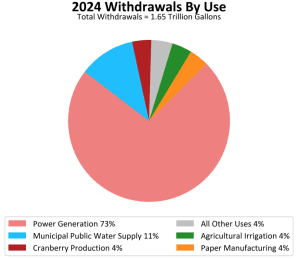
Power generation is by far the largest water-using sector in the state, withdrawing 1.2 trillion gallons and accounting for 73% of the total water withdrawals in 2024. For comparison, the second largest sector is municipal public water supplies, withdrawing 11%, or 186 billion gallons, of water in the same year. That is a six-and-a-half-fold difference between the largest and second largest water users in the state. As AI data centers are built in Wisconsin, water withdrawals in both sectors will rise from increased power generation and greater demand on municipal public water supplies.
Large, or hyperscale, data centers used to train AI applications require immense amounts of power, often using more energy than an entire city. This drives the need for additional power generation and associated water use. For example, the Port Washington natural gas power plant withdrew 178 billion gallons of water and lost 1.8 billion gallons of the total to evaporation in 2024. Increased power demand from the approved 1.3- to 3.5-gigawatt Vantage data center in development in Port Washington will add to the power plant’s water withdrawal and consumption. New power plants are being built to support AI data centers, too, like We Energies’ two new gas-fired power plants in Oak Creek and Paris, sited at least in part due to Microsoft’s presence in southeastern Wisconsin. And because of onsite water needs at AI data center campuses—predominately for cooling but also for general facility needs—municipal public water supply withdrawals are also likely to increase.
Additionally, water withdrawals to support AI data center needs could be compounded by environmental changes. For instance, the DNR notes that higher temperatures and/or lower precipitation greatly influence withdrawal rates because power plants need more water for cooling processes when it is hot and dry. Similarly, municipal public water systems and agricultural production require more water to support plant and animal needs in these conditions. In 2024, Wisconsin experienced the state’s hottest year on record and received four inches less precipitation than the ten-year average. The hot, dry conditions Wisconsin is increasingly experiencing will further drive the rise in water use.
Just from the top ten power plants that used the most water (nine fossil fuel and one nuclear), we lost 9.7 million gallons of water to evaporation in 2024. And that’s not including the 45 other power plants or other water-using sectors.
More thermoelectric power plants mean more water withdrawals, and hotter and drier conditions mean even more water is needed at these and other facilities. The water-energy nexus must be centered in water use conversations. While it is important to consider direct, on-site water use, more than 70% of AI data center water use stems from indirect, off-site use at power plants. Focusing on the former while disregarding the latter is greenwashing.
As they are currently being developed, AI data centers pose risks to Wisconsin’s surface and groundwater resources because of their combined direct and indirect water needs—resources we rely on for drinking water, crop irrigation, and recreation. Wisconsinites deserve more public transparency through the development processes and binding commitments from developers to implement water conservation and efficiency practices. We deserve clarity on proposed and actual water and energy use and more water-efficient renewable energy. Without a better understanding of the state’s ability to sustainably host AI data centers and protect our environment, economy, and public health, it is irresponsible to move forward with unregulated development. We cannot continue to prioritize the wants of tech giants over the needs of our state’s residents and environment.
