


State approves mining companies’ request for more drilling in northern Wisconsin
Clean Wisconsin is no stranger to the environmental risks of sulfide mining. Our support of a statewide mining moratorium in the late 90’s helped lay the foundation to prevent future projects — including the Crandon and Gogebic Taconite mines — from doing irreparable harm to some of our state’s most precious natural areas. In the years since the statewide mining moratorium was repealed in 2017, resource extraction companies have expressed renewed interest in Wisconsin’s Northwoods as a promising source for precious metals.
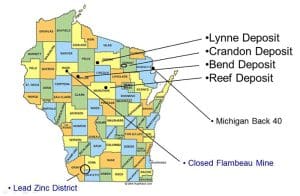
On January 29th, the Wisconsin Department of Natural Resources (DNR) granted a mining company, Greenlight Wisconsin (GLW)–a subsidiary of the Canadian-owned Greenlight Metals–conditional approval to drill for metals in the Bend Deposit of the Chequamegon-Nicolet National Forest in Taylor County, WI. The deposit is believed to contain approximately 4.2 million tons of ore, including gold and silver. Drilling began the week of February 9, 2026.
This marks the second stage of GLW’s exploratory drilling project targeting the Bend’s 40-acre Soo Line Mineral Parcel, with the first stage taking place between June and August 2025. The company plans to use the results from this exploration to determine whether full-scale mining is economically viable.
The Bend deposit has attracted occasional interest from mining companies over the years but was deemed uneconomical each time due to low mineral output. Steve Donohue, a director on GLW’s board, claims that rising demand for copper, driven in part by modern technologies like artificial intelligence and electric vehicles, has renewed mining companies’ perceived value of the site.
Any potential mine development would be years away. However, GLW reported a successful first phase of drilling, which helped them secure an additional $11 million in funding from investors. If GLW finds substantial ore deposits, the project could reintroduce sulfide mining—the primary method of extracting these materials—to Wisconsin for the first time in almost 30 years.
Sulfide Mining and Flambeau
Wisconsin’s last sulfide mine, the now-closed Flambeau mine in Rusk County, ended operations in 1997 after hundreds of thousands of tons of copper, gold, and silver were extracted. GLW and other mining companies often point to Flambeau as a success story for environmental reclamation, noting that the site has been restored to a natural appearance.
Sulfide mining involves extracting metals like gold, copper, and nickel from sulfide-rich water bodies. The ore in the Bend Deposit is estimated to be less than 2% copper, meaning around 98% of the material removed would be waste. When the sulfides in the leftover mine site materials and waste are exposed to water and air, sulfuric acid is formed. This acid causes harmful metals in the mine waste like mercury, lead, and arsenic to leach into the groundwater and surface water.
Advocacy and Environmental Concerns
In 2011, several environmental groups—including the Wisconsin Resources Protection Council, the Center for Biological Diversity, and environmental advocate Laura Gauger — filed a Clean Water Act civil suit against Flambeau Mining Co. They alleged that runoff from the site leaked toxic metals into a nearby stream flowing into the Flambeau River. The plaintiffs initially prevailed in U.S. District Court, but the decision was overturned on appeal in 2013 on a technicality, which also shielded the company from liability.
More than 15 years later, the stream remains on the state’s impaired waters list with elevated levels of zinc and copper. Advocates have also reported arsenic plumes near the site in recent years. The former mine is located about 35 miles from the Bend deposit.
Water pollution is central to concerns about the Bend project. The Bend deposit lies beneath the Chequamegon-Nicolet National Forest and is only a few hundred yards away from the Yellow River. Echoes of the Flambeau stream contamination ring in the ears of those concerned about new mining operations. The risk of downstream impacts on drinking water, wildlife, and agriculture could be significant.
The Lac Du Flambeau Tribe of Lake Superior Chippewa filed suit against the DNR last summer, claiming that GLW’s drilling could cause irreparable harm to the environment, as well as cultural and historic sites. This pattern of repeated litigation against mining in Wisconsin suggests an ongoing tension between state leadership that allows for extractive development by multinational corporations and communities that depend on local environmental health for their livelihoods.
For now, exploratory drilling continues as communities and industry watch closely to see whether the Bend deposit proves worth developing, and at what cost. As plans develop, we’re keeping a close eye on proposals that would put our environment at risk. We’ll keep you updated in the Defender and on cleanwisconsin.org.
