

Where to Listen:




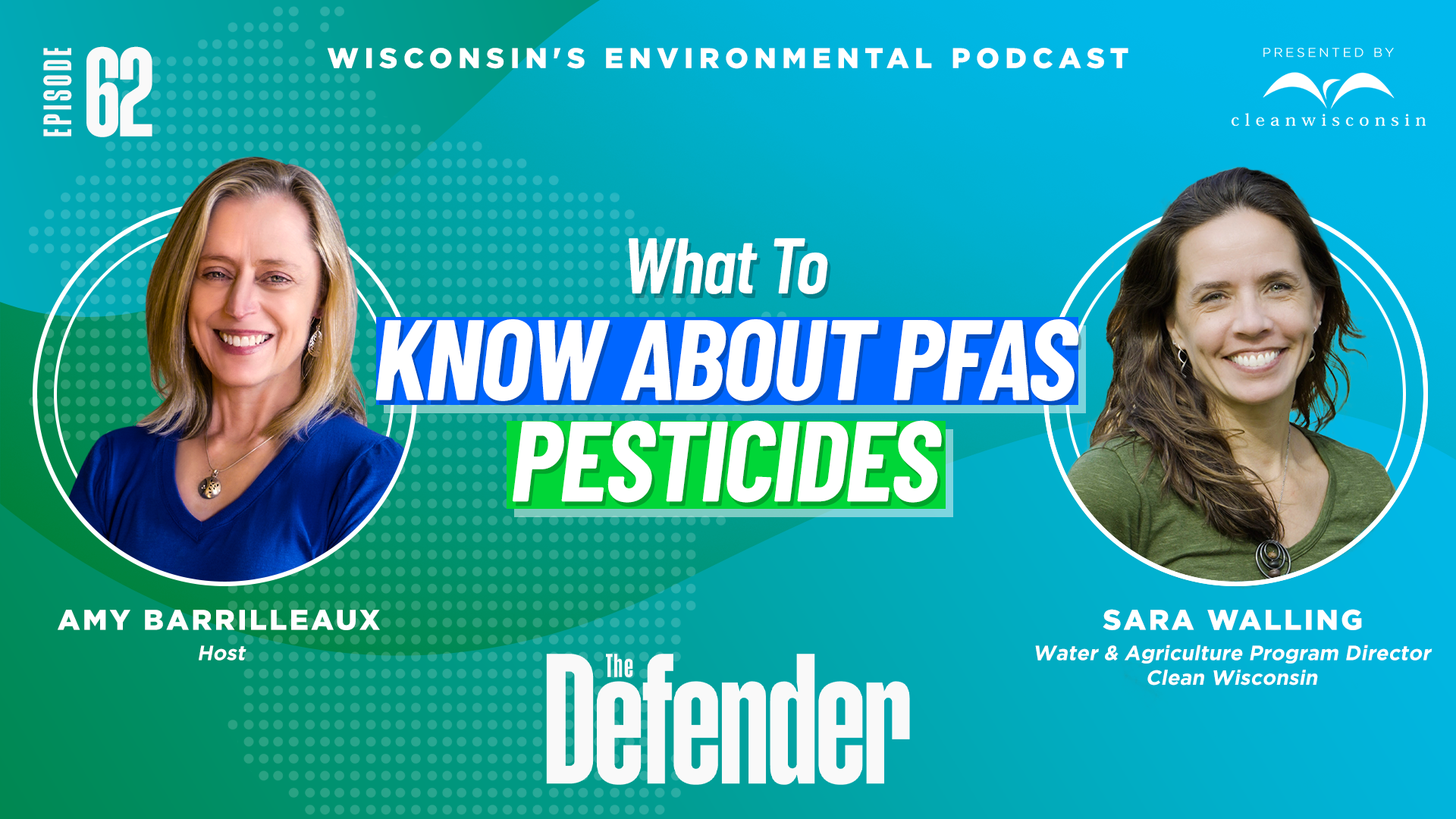
On this episode a look what could soon be sprayed on food and farm fields all around us — plus a bit of Wisconsin history that offers some hope as we confront a new batch of toxic chemicals.
Host:
Amy Barrilleaux
Guest:
Sara Walling, Clean Wisconsin Water & Agriculture Program Manager
Resources for You:
Under the Lens: What we know about PFAS in Wisconsin’s Water
Nitrate pollution’s impact on Wisconsn’s health and economy
Neonicotinoid pesticides and their impact
Episode 43: The pesticides that could be lurking in your pollinator garden
Episode 33: Wisconsin’s bees are acting weird. Here’s why.
Episode 29: Trump’s Threat to Safe Water (and how WI can fight back!)
Transcript:
Amy Hi there and welcome to the Defender Podcast. I’m Amy Barrilleaux. The Defender is powered by Clean Wisconsin, your environmental voice since 1970. The EPA made headlines recently, not for protecting the environment, as its name might imply, but for approving a new group of pesticides containing the toxic forever chemicals, PFAS. The move sparked outrage almost immediately, forcing the EPA to call it fake news, and claim the chemicals aren’t really PFAS at all. On this episode, a look at what could be sprayed on food and farm fields all around us, plus a bit of Wisconsin history that offers some hope as we confront a new batch of toxic chemicals. That’s right now on the Defender. Fifty-five years ago, Wisconsin became the first state to ban DDT. The toxic pesticide was killing birds, threatening to drive the peregrine falcon, bald eagle, and countless other species to extinction. But Wisconsinites like activist Lori Otto and UW Madison researcher Joseph Hickey sounded the alarm, pushed hard for a ban, and they got it from the legislature, a full two years before the federal government would finally act. Fast forward to today and another battle is here. Joining me is Clean Wisconsin Water and Agriculture Program Director, Sara Walling. Sarah, thank you so much for being here.
Sara My pleasure.
Amy So I want to start with those chemicals that were just approved by the EPA. Are they PFAS? Are they not PFAS? Or or what are are they? Are they fake news? I don’t know.
Sara That’s a really it’s a really good question and a hard one to answer. It really depends on who you ask. The majority of the scientific community still does consider the single fluorinated compounds, which are the five that were included in these pesticides that have been approved since the beginning of 2025, that those pesticide types would be included in the PFAS definition. Unfortunately, though, the EPA, actually under the Biden administration, had redefined what incl is included as a PFaS chemical and excluded these ones. So there is this loophole that was generated where the EPA has a different definition of what PFAS chemicals are than a lot of the r other scientific community.
Amy And I guess they’re the EPA was looking at it as like these are these are tiny. So we’re just gonna consider them a totally different thing.
Sara That’s true. And certainly our vantage point is that that’s the wrong direction to go. I think, you know, we’ve been doing as a as a world but a lot more investigations into what are PFAS, what are their potential impacts to human health, to ecological health, all of those things. And so now does not seem like the right time to be approving additional chemicals to be used broadly and widely in our agricultural settings until we can really get a firmer handle on the science around PFAS, PFOS degradation chemicals, and how long they persist in our environment.
Amy I know there’s like a a a real I think public outrage when this announcement happened that the EPA had approved these chemicals, but the reality is I think that maybe people don’t realize is PFAS are already being spread through pesticides. Like this is not the first time PFAS have shown up in pesticides.
Sara That’s very true. We’ve known that PFAS have a part to play within pesticides for a number of years. It both leaches out of some of the fluorinated plastic containers that pesticides live in and when they aren’t being used, as well as pesticide compounds are found in the inert ingredients of a pesticide. So pesticides have active ingredients, which are the chemicals that are designed and in there to impact that bug or that that weed or whatnot, kill those, kill those unwanted pests. But the inert ingredients are actually usually more of the co the concentration. They take up more of that pesticide chemical composition, but they’re labeled as inert, and there’s a lot fewer regulations around both reporting what those inert ingredients are, not to mention taking a closer look at what the potential health and ecological implications might be.
Amy So, you know, when you hear, okay, toxic PFAS are being sprayed basically on our foods, so the most recent batch that was approved that gets sprayed on all kinds of food like tomatoes, corn, cotton, broccoli, spinach, soybeans, all the things. I I think that brings up two worries. First off is, you know, the stuff I’m gonna eat. So if I try to be healthy and eat a lot of fruits and vegetables, maybe there’s gonna be PFAS on those now. And then secondly, if you live near a farm and this is Wisconsin, should you be worried that PFAS and potentially other kind of toxic chemicals are all around you?
Sara Well, you know, pesticides are being applied, you know, ubiquitously in in all agriculture settings. Like you mentioned, we in the state right now have over thirteen thousand pesticide chemicals that
Amy Wait, thirteen thousand? I mean how — that’s how do you even get your head around that? I you know, or let alone regulate but just kind of even understand what’s happening. Well
Sara Well, as a state, you know, we rely heavily on the federal government and our EPA to really do a lot of that watchdocking for us. They, in theory, should be conducting long, you know, term rigorous studies to understand what the human health and ecological impacts of these chemicals are before they release them and approve them for s for use. So Wisconsin is no different than many other states that rely fully on the EPA’s process to understand those health implications. So our state isn’t even in a position right now to be able to deny the use of these pesticides because they were already pre-approved by the EPA. We don’t have a system in place by which we can do an independent assessment of the ecological or human health implications of these chemicals that are approved for use.
Amy So potentially thirteen thousand chemicals could be being used basically all around us on our food, on our landscapes. I think everybody feels kinda worried when they hear that. So then how is it that we don’t have any mechanisms to do anything about it?
Sara Well, there’s certainly a lot of restrictions and there’s certifications that pesticide applicators m most more often than not need to align with. So there’s training and a lot of education and other requirements that limit the ability for certain chemicals to be applied by people who don’t receive those trainings. So there’s there are some sidebars for those 13,000 pesticide products and where they’re used, how much they’re used. The labels in theory on each of these chemicals are also intended to be this prescription for how much you can apply to a landscape, my backyard, or an agricultural field for that matter, and ideally really reduce the risk of potential human health or ecological implications. Now that requires people to read the label and follow directions, and that isn’t necessarily always going to be the case.
Amy I do want to say, you know, I I talked about farms just now, but pesticides and herbicides are kind of used everywhere. I’ve seen, you know, people spraying the cracks in the sidewalk to you know, sp spraying all of our lawns and golf courses and places like that. So I think it kind of brings a shared blame, I guess, or shared responsibility to to deal with these things. When you say we look at the EPA t for guidance, it feels like the EPA, you know, Environmental Protection Agency has changed a lot here under the Trump administration. I know Lee Zeldin, the EPA director, listed some priorities and among them were like, you know, unleashing the power of AI, which is not exactly what we think of environmental protection or having anything to do with that. So what is happening at the EPA, the agency that we look to to protect us, as these thirteen thousand chemicals are kind of out there, that’s making it I think maybe a little bit harder to feel safe.
Sara You’re right. I think this last year has really demonstrated a change in the power structure that the federal government does or doesn’t have when it comes to overseeing our public health and welfare when it comes to the environment and environmental chemicals like this. You know, the administration that we have in place now has appointed mainly individuals that have led chemical companies in the past, and the exact companies that produce a lot of these chemicals that we’re talking about and these pesticides. So, you know, there’s inher they’re inherently stacking the deck in their favor to be able to have some of these move through. Similarly, while the rest of the government was shut down, and while the EPA’s science divisions were really decimated with the reductions in force that has taken have taken place over the last several months, the pesticide registry division within EPA has remained strong and intact. So it really just demonstrates, I think, where the current administration is placing its energy and continuing to put people in place to make sure that those engines and those cogs continue to turn while the science components of the people that would be doing a lot of these evaluations and really digging into animal, ecological and human health studies to understand the potential risks of exposure and whatnot, you know, those organiz those groups have really been cut way back. And so It’s really an imbalance in the focus on our public health and chemical approvals.
Amy As I mentioned at the top of the show, you know, Wisconsin was once a leader here. You know, we were the first state to ban DDT famously. And DDT had taken us to the brink of some real ecological disaster. And here we are, we’ve recovered from that. You know, we can see bald eagles and peregrine falcons around Wisconsin and that’s a true like success story. So what needs to happen now, I guess, to to get that success back? I mean, and if you think back to 1970, you know, that was before the EP, that was like the year the EPA was created. So it was before we had the EPA to look to for guidance. It was in fact the first year that Clean Wisconsin ever started under the name Environmental Decade. So a long time ago, like the birth of the environmental movement and you had just regular old people coming out and saying we need to do something about this. How do we kind of get to that place again?
Sara Well, I don’t think that Wisconsin has lost its conservation or environmental legacy. I think we really do have that built into our DNA as Wisconsinites. And I look to, you know, the people that we interact with through my role here at Clean Wisconsin, all of the people who call us with concerns, that we’re able to, you know, have discussions with about all of these risks. There’s a lot of those individuals out there that really care a lot about certainly their own personal and families’ health, but our environment and it really does that’s what it took back in the nineteen seventies was a really strong outcry by the public to say enough is enough. We need to do more to protect our public health and our environments for generations to come so that we have these lakes that we feel comfortable swimming in, so that we have water that we feel confident in drinking, that we have air that we feel like we, you know, can breathe without masks on all the time. But it really does take every one of us taking both an individual step at our homes. So your mention of, you know, how can you reduce pesticide use within your own environments, your own choices, and then taking that a step level step further by contacting your local units of government. What is your county or your city doing to reduce use of pesticides in public properties, you know, m publicly managed properties? Same idea at the state. Contact your legislators and let them know that pesticides are a concern for you and that you’d like to see them doing more to protect you as their constituent from The potential risks.
Amy Sometimes I think this gets painted as environmentalists versus farmers, right? Because a lot of these chemicals are used in farming. But what is the system that we’re in where farmers may feel like they don’t have a choice or that they can’t get out of this cycle? Is it gonna take, I guess, environmentalists and farmers and everybody else to say, hey, we need to figure out a way so that farming can be profitable, but yet not dangerous, not just to the people near the farm, but to the farmers farmers themselves who are spreading these things.
Sara I you know, I think you you’re right. I d I don’t think it needs to be there should not be an us versus them in this situation. Farmers and everyone, you know, working in the ag industry are equally as exposed, if not more exposed to a lot of these potential pesticide chemicals than we are as everyday citizens that aren’t in that field. So I and I’ve I’ve talked with a lot of farmers who are equally, you know, concerned and and curious about what is being what they’re applying. A lot of them might not even have a full appreciation for the suite of chemicals that are in some of these products that they’re buying from the co-ops. So when I talk to farmers and farm groups, it’s a lot about, you know, just informing yourself as well, understanding what you’re putting on. There also, you know, is certainly an opportunity to use more of an integrated pest management approach, making sure that you actually have the disease, the or the weed or the insect of concern that you’re worried about impacting your yields before you you go out and make an application. There’s, you know, way there’s some mentality around there about, you know, put doing a band-aid ahead of time, you know, that insurance by putting it out there so that you don’t have those insect. But there’s a lot of farmers who are really taking this a lot more seriously and are working harder. It it does take more effort to be able to do the scouting to identify if you have concerns before applying pesticides. But there’s a number out there who are interested in doing exactly that.
Amy I know, you know, when we look at solutions for these things, we look to our state government potentially, like the it was the state legislature back in nineteen seventy that passed that ban. And it’s hard to sitting here right now in twenty twenty-five think of our state thinking of our state legislature to imagine them agreeing on much of anything, especially when it comes to passing a chemical ban. How important is it that farmers become a voice in this kind of concern? Because I think you know, most lawmakers will listen to farmers. They are kind of like the iconic Wisconsin rural folks, you know, people who are who you think about when you think about Wisconsin. How important is it for those voices to kind of start coming together like that?
Sara You know, it’s gonna be really important for the entirety of the ag community to come together to decide what’s best for their industry and what we need to be doing to protect ourselves and them as well as you know, just as citizens in the state. So I think you know that there’s a real opportunity for agricultural producers to you know, come together to identify what are their priorities, how can they rise to the moment to just you know, recognize that there are a lot more people concerned out there about what’s in their food, what’s being applied to it, and what they’re therefore consuming, and just take that consumer demand more seriously. I think the markets are driving that too. There’s just a lot more interest by food producers, food production companies to understand where their, you know, where their food is grown, how it’s being grown, and supporting more sustainable agricultural systems that reduce the amount of inputs. We’re never gonna get to a position where pesticides aren’t needed. I mean, there will always be a need for some level of pesticide out there if we’re going to continue to grow the volumes of food that are necessary today and will continue to be to feed the world. So I, you know, I’m not Pollyanna about that recognition, but I think that there is an opportunity to strike the right balance. And there’s also a number of studies going on right now in our state and in our region to really take a closer look at the correlation between exposure to pesticides and other agricultural chemicals like nitrates. And health implications based on the degree of exposure. So I also think that over the next several years, as some of this science is ongoing but then released, there’ll just be a lot more information out there to inform our policies and and and help inform us as citizens so that we can be asking the the right things of our legislature to be able to create that right balance between what’s needed for a you know a productive agricultural industry in the state while balancing that with public health.
Amy I know Clean Wisconsin’s going to be doing some of that research ourselves too, especially when it comes to nitrates in drinking water. So I think when you think about all this, the sort of like mixture of toxic pest pesticides that could be on our food, what’s the and it is eating season, by the way, you know, holidays. So if we people are just like, Well, I just wanna protect myself, what can they do both in terms of their fruits and vegetables and also in terms of their drinking water?
Sara Sure. Well, when it comes to fruits and vegetables, if you if you want to, you know, get away from the potential for chemicals for the most part all entirely, you know, organic produce and organic food options are really the way to go. There is a rigorous certification program around organic production that is required to demonstrate that your your crop is free of those kinds of chemical inputs. So, you know, if you want it all the way out, good that’s where you need to go. Certainly buying local, buying from your community supported agriculture has other great options because they’re also very transparent about what they’re using on the food that they’re producing for you. So looking local is always a great idea there as well. If you’re interested in you know, doing a little bit more proactively to protect yourself. The Department of Agriculture Trade and Consumer Protection has a program called driftwatch and bee watch. So if you’re a beehive owner and you’re concerned about pesticides that are being applied in and around your beehives, you can sign up for that program to understand what is being applied near near you at least. So it’s an inf it’s an information opportunity. Driftwatch is the same thing. So if you are an organic agriculture producer, you want to be more informed about what’s being applied in and around the the non-organic fields around you, you can sign up for that. As homeowners, we can sign up for the landscape registry at DACCAP. And that is an ability for you to be informed about what other what lawn care services might be applying to neighboring properties and that kind of thing. So it’s Again, there’s not it’s not entirely proactive. You can’t stop those applications from happening, but it is a great tool to really have a better understanding of what’s happening in and around your your area that you might not otherwise be aware of and just be more informed.
Amy Well, I as we say knowledge is power, so that’s like really the first step. I know Clean Wisconsin’s doing a lot. You’re always meeting with farmers, you’re always working on these issues. What is happening right now that we should be paying attention to?
Sara Well, there’s a lot of potential, there’s a lot of bills out there right now. They’re floating this legislative session. One is on water testing, you know, that would allow a grant program so that we can all test public or excuse me, private well owners can have a cost savings on testing their water to understand what you know what contaminants may be in their groundwater system. There’s also a bill right now that’s being proposed to ban the use of a certain type of pesticide in household uses. There’s a group of pesticides called Neonics that I know we’ve also done some podcasts on. And that bill has a a little benefit around that. However, recognizing agriculture uses of neonics is is the biggest component. It’s hard to tell exactly how effective that would be. But it is really I’m I’m optimistic seeing that there is more attention being paid to a lot of these agricultural chemical related air areas. Similarly, there’s a pollinator package of bills out there that would allow s local units of government from banning certain types of pesticide uses and just allow for more authority that doesn’t currently exist now for local decision making on the use of pesticides.
Amy So some a lot of work happening and I think maybe some opportunities for people who are concerned about these issues to to be a part of some of the solutions.
Sara That’s very true. There’s one more bill I neglected to include that is called the Water Pollution Notification Act. And this is a bill that would require the Department of Natural Resources to inform county health departments and county land conservation departments when a groundwater standard is exceeded. So when a c when a contaminant is found in a groundwater sample that exceeds the health-based standard, this information chain would be initiated. And so by county health departments and county land conservation departments knowing more about where groundwater exceedances are happening, there’s an opportunity there to do a better job at the local level of informing other potential contaminated well owners and that and doing more proactively to address the source of that contamination.
Amy So when the time is right, we’ll have action alerts and other pieces of information on our website related to some of these things. Sara Walling, Water and Agriculture Program Director at Clean Wisconsin, thank you so much for taking the time to talk about all this. And you know, we shouldn’t lose hope, I would say. You have to kind of fight for what you want.
Sara Absolutely. Thanks for bringing this to the attention of all of our listeners.
Amy And thank you for listening to the Defender podcast. We have lots of resources about pesticides and PFAS and the health impacts of nitrates and more. These are issues Clean Wisconsin has been working on for a long, long time. So check out the show notes or head to cleanwisconsin.org. I’m Amy Barrilleaux. Talk to you later.
