

Where to Listen:




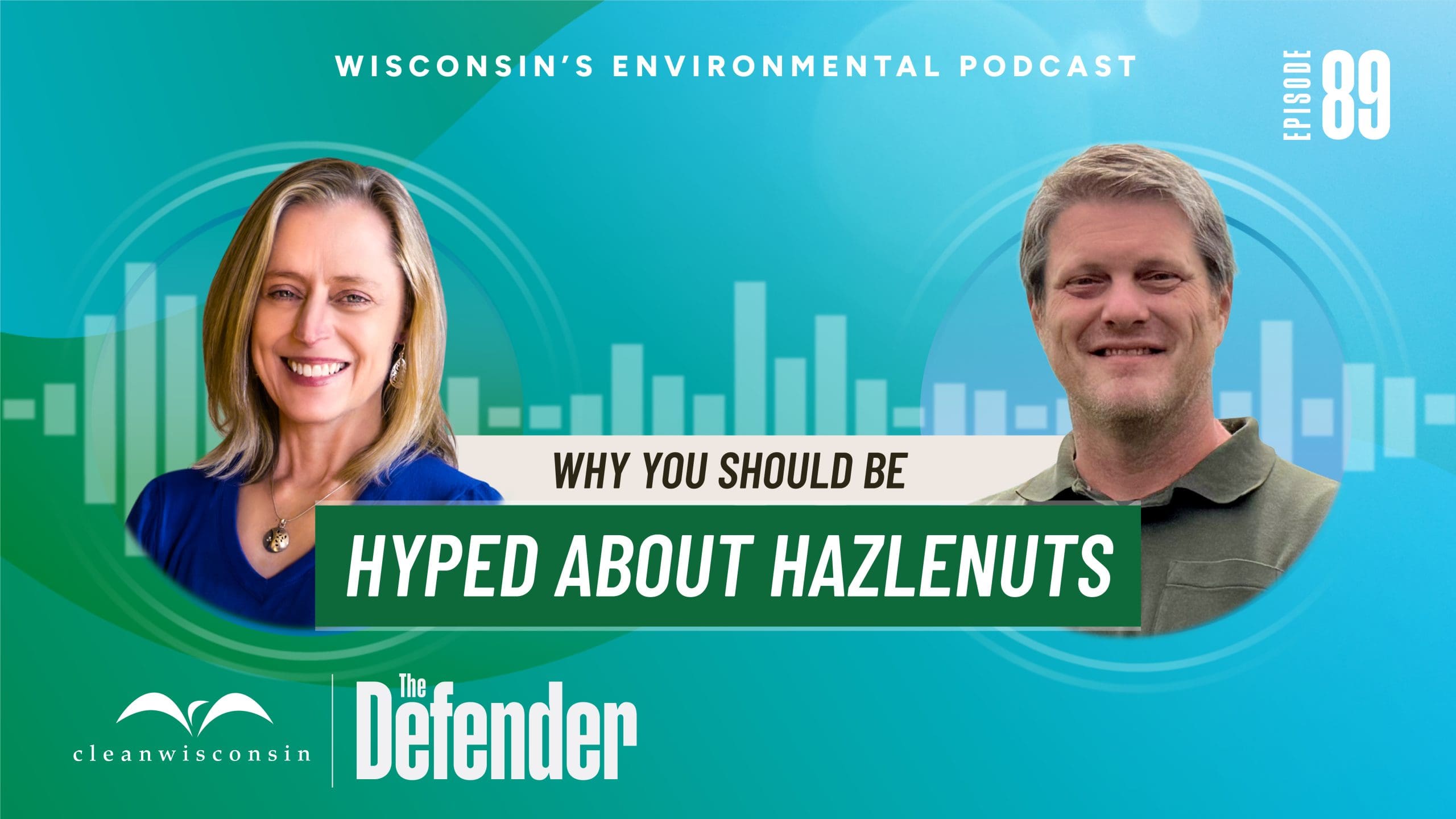
If you think growing hazelnuts is just for Europe or the West Coast, think again. Turns out, we’ve got a wild, native variety right here in Wisconsin, and people are getting excited pretty excited about it.
In this episode Amy heads out to Sheboygan County to find out why farmers and environmental advocates are so hyped about Wisconsin’s hazelnuts.
Host:
Amy Barrilleaux
Guests:
Aaron Kolste, Wisconsin Hazelnut Farmer
Resources for You:
Upper Midwest Hazelnut Development Initiative
Halelnuts Could Help Reshape Wisconsin’s Agriculture (video)
Transcript:
Amy Hi there and welcome. This is the Defender, Wisconsin’s environmental podcast. I’m your host, Amy Barrilleaux. You can listen to The Defender at cleanwisconsin.org, on Apple Podcasts, or your favorite podcast streaming app. The Defender is powered by Clean Wisconsin, your environmental voice since 1970. When you think about food crops that we grow here in Wisconsin, what comes to mind? Maybe corn, even though almost all of what we grow is actually not human food, it’s for ethanol or animal feed. Maybe cranberries or county cherries. But what about hazelnuts? If you thought growing hazelnuts was just for Europe or the West Coast, think again. Turns out we’ve got a wild native variety right here in Wisconsin, and people are getting pretty excited about it. In this episode, I head out to Sheboygan County to find out why farmers and environmental advocates are so hyped about Wisconsin’s hazelnuts. That’s right now on The Defender.
How do you make a living as a new farmer on a relatively small amount of land? The truth is it’s getting next to impossible when farming is increasingly run by huge agribusinesses operating on thousands of acres. But there is hope emerging for small family farms and it all centers on a tiny nut. I recently traveled to Adell, Wisconsin to meet Aaron Kolste, who’s growing a hybrid of our native hazelnut to find out why this crop is getting so much attention. OK, so let’s go ahead and start moseying toward hazelnuts. Thank you so much for letting me come out here and talk with you today.
Aaron Absolutely, enjoy having you here.
Amy So, what brought you here? How long have you been farming or how did you get started in this whole thing?
Aaron Well, um, I guess there was always a desire, uh, part of my family to live in the country, you know, the country life is peaceful and, and, uh everything. And, uh it’s a good thing, but we also wanted to sort of participate in the country rather than just live here as sort of a tourist. So we have, we said, we should get, we shouldn’t get into farming. I was driving somewhere with my wife one day and said, you know, honey, um I’m not an expert on anything, but I’m, I know a little bit about a lot of things. I said. I bet you we’d be really good at farming. And then so we started looking into it. And, you know, that must have been, I don’t know, seven, eight years ago now. And then about five years ago, this property came into the market and we purchased it. And then, well, what do you do with it? And that’s where we started looking into, well what do do with a small farm? You know, we knew we couldn’t afford 200 acres and that’s really not even enough to have a real farm these days if you’re doing just regular, you know row crops, right? So… We started looking into what are some of the things people do with small acreage? And, uh, one of the, uh we found a USDA report ages ago. That was like the top 10 small acreaged farms. And one of those, I think number nine on the list was nuts, nut farmer. And we started, okay, well, what kind of nuts grow in Wisconsin. And that led us to the UMHDI website, which is, um, upper Midwest hazelnut development initiative, I think is what that stands for. It’s a big acronym, so I always forget the details. But that’s a UW Extension and University of Minnesota joint program to get a nut crop started in the upper Midwest, that being hazelnuts. And we started reading about that, started reading agroforestry and kind of fell in love with the idea that if you want to call each crop an enterprise, you could have multiple enterprises on the same land. And in so doing that, you can really expand what you’re doing. Um, you can ha you can increase your, your revenue per acre or whatever. And maybe just maybe, uh, a family can make a living on a small acreage, right? Um, so that was one of the motivations is how, how can a family make a go on a smaller acreage because there’s, there’s nobody out there who can say, Hey, you know what, I’d really like to get into farming and can buy hundreds of acres of land. Now that leads into some of the clean Wisconsin stuff, um, and, and and stewardship, and that was another thing that really appealed to us. The idea that the agroforestry, uh, helps with, uh you know, absorbing, uh, well basically groundwater health, it helps with absorbing runoff. It helps capturing more nutrients so they don’t get into the groundwater. Um, there’s a, there’re a lot of advantages. For a long-term stewardship, which is what we’re looking for as a family. When I look out on this land, I don’t see it in 2026. I see it 20, you know, 52, you know, 20, 2076. My son or grandson or granddaughter or daughter, for that matter, we’ll be running this land. That’s the hope. And I can plan now for her to have success then. And she can, he or she can inherit a, um, healthy soil, healthy land, productive land, uh, and all those things that you wouldn’t necessarily get. From a tenant farmer, and there’s no knock on tenant farmers, but if you think of it this way, to make it on a farm, what do you need to run these days? 2,000 acres, say something like that. And I’m just one farmer, trying to run my equipment on 2,00 acres. How much time do I spend on each acre of that land? A few minutes a year. I just don’t have enough time to really say, well, what is that fungus growing in my windrow? Or what is this hive of flying insects I’ve never seen before? And take care of that before it gets to be a problem for the local. You know, the local environment, whereas if you’re a family working on making your living, a decent living on 40, 50 acres, or maybe a hundred, whatever, then you have a lot more time per acre to be looking around, to be stewarding the land, to making sure that it’s healthy, productive, doing what you want it to do, doing it needs to do for that long-term health. So it has so many advantages. It really just the idea of agroforestry and the idea of hazelnuts specifically. Uh, which is, there’s just too much there not to grab it. So we grabbed it.
Amy Now, I want to back up a little bit to what you said right in the beginning, which was you were thinking, hey, I’m pretty good at a lot of things. Why don’t we get a farm? It feels like that’s a little of a gamble, because as you pointed out, you need a couple thousand acres these days to have a productive farm. I mean, I guess what was your wife’s reaction to that? We’re kind of good at stuff. Let’s get a far.
Aaron Uh, she clenched up in fear, actually. Uh, no, I’m just joking. Uh, well, you know, it’s, it, it it’s a great question. I think she loved the idea of the country too. And she liked the idea of being a part of the country, not just, not, like I said, not just being a tourist here. So we had, we had a land to offer, uh, the UMHDI, um group, uh and, and clean Wisconsin and all this, uh had some enthusiasm, you know, some interest to. To help us to develop this and to get the word out on what this kind of farming is like. So we haven’t had to invest a lot of money in equipment or anything like that so far because, you know, I mean, for one, you’re just planting a tree. Everybody can plant a tree, right? That’s not, you don’t need $250,000 combine to do that, right. So we did that, you now, times 2000.
Amy Yeah, that’s a little rough, right?
Aaron Yeah, it took some time. It took some, but you know, we got, we, uh, we had great people at the point I was trying to get at with clean Wisconsin and with the UMHDI group is it’s a great community. They’re always trying to support and, um, and, uh give advice where they, where they know where to give it. You know, I mean, a lot of this is ground floor. I mean we don’t, we’re setting up on current recommendations from the upper Midwest hazelnuts group. But we may find through five, 10 years of, of work here. That the way we set it up isn’t the most efficient, right? So that was kind of part of the deal. We signed up with Jason Fischbach and his outfit was that this is a bit of a farm, but it’s also a bit of a laboratory to learn how to do this right, do this efficiently. And the whole community is behind us in terms of, you know. Whatever they can help us with there, they’re helping us with, including just yesterday, we were picking up some more plants for planting next week and I was gonna have to drive up to Ashland and they found out a way that I only had to drive basically to Jefferson, that’s a lot closer than Ashland, so that saved me 500 miles of driving, that was great.
Amy So what we’re standing here looking at is I guess, rows and rows, maybe about, I don’t know how many this is, like a half dozen or 10, maybe long rows of smallish baby trees. And I think, so you’ve been saying the term agroforestry a lot, and that is just basically planting trees as a farm crop, is that right?
Aaron Uh, yeah, uh, that’s, that, you know, I, I wouldn’t be, yeah. I’d ask like the Savannah Institute to give the professional answer, but for me, uh I think of agroforestry as sort of a hybrid approach. It’s like a orchard plus a farm on the same land. Um, where, while you are planting trees for revenue, for crops, you also have, uh what they call alleys in between, uh particularly when the crops are young or the trees rather are young, um, that you can continue to grow. You know, standard annual row crops out of, we happen to be planted in alfalfa. That’s what we had access to in terms of equipment. And, but it could be potentially anything from potatoes. I think the Savannah Institute did that one year to, um, you know, just veggies. I think you could do anything in between, which, which. You know? I think a lot of the concern or maybe the fear about going into this agroforestry type model is why I lose my land, I lose my revenue, but you don’t, you lose something. Uh, you’re definitely losing like the strips you can see, uh, well, for, for the listener, there’s about a six foot wide strip, uh where the trees are planted, but in between those six foot white strips are the alleys and you’re still getting, um, you know, I’m thinking about 15 feet of good, of, of regular crop for every six feet you’re losing. So, uh it works out to be, you still get a lot of revenue out of your field, you’ll still get lot of productivity on your field, even though you’re, you are not getting anything for the trees. To answer your question, I might want to go a little bit.
Amy Yeah. No, no, that’s good. Yes. I wasn’t sure what was in the middle in between these trees because it all looked like the same thing. But now that you say alfalfa, I’m like, of course that’s what it is. And we’ll of course have some photos that we can post at cleanwisconsin.org slash podcast that show what we’re talking about here. Now I do want to talk about these trees because they’re tiny nut trees. What did you feel like when you first discovered, hay, I can grow hazelnuts. On a farm in Wisconsin.
Aaron Uh, well, uh, it definitely felt kind of, um, like you don’t think of when you think of Wisconsin agriculture, everybody’s thinking of Holstein cows and everything related to that. So, uh you know, there are dozens of little community apple orchards all over the place. So I started thinking, well that’s yeah, okay, that makes sense. There are the, the, economy here has taken advantage of small acreage fields here and there to plant, you know 1500, 2000 apple trees or whatever. So why can’t we do the same thing with nuts? Um, one of the wonderful things about hazelnuts is that they’re, they’re a, what was you call it, a, a natural species. Like, like they grow on their own, just in the wilds, uh, more in Northern Wisconsin, but definitely here as well. And, uh which means they’re pretty hardy. They’re pretty tough to be able to grow with all that competition here. We’re, we’re making them a, you know, Ritz hotel for them to grow up in, but you know they can grow out in the bush and out compete other. Other plants in the woods of Wisconsin. So they’re pretty tough trees. And we did not lose that many. There’s always a die-off every time you transfer plants. You know, there’s always the risk that the tree gets shocked and it doesn’t recover. We lost about a dozen out of a thousand trees. So that’s a very low percentage. I’m very proud of that anyway. But the idea… For as a beginning farmer, because we’re just, I mean, we’re literally April is when we planted these. That’s when we started being farmers. As a beginning, farmer, I can’t kill these things. They’re invincible. So as long as they’re getting daylight, they’re gettin’ their water when they need their water, they are pretty tough little cookies. And that gives me a kind of insurance that I’m not gonna foul things up too bad.
Amy So I’m looking at these trees and they look good. They look maybe far from producing a hazelnut. How long until they start giving you hazelnuts?
Aaron That’s a great question. Um, the modeling is that you should expect, UMHDI’s modeling right now is that you expect a pretty substantial crop after about, at the end of the fifth season, you know, um, but you’ll see you nuts in the fourth season. Um, I think the idea is like maybe 15% of the, of the. The plantings capacity after the, at, you the fourth season and maybe 80% after the fifth. But there are,.. They’re, they’re starting to see that with setting up a Ritz Hotel, uh, like some of the university plantings around the state, that you can get a fairly a noticeable crop at the end of the third season. But, uh for the most part, the, the substantial output is after the fifth growing season and then peaking around the ninth growing season is what the, I think the literature would say.
Amy Now, some people might be listening to this and be wondering, well, this is a nice discussion about farming and trees, but why is Clean Wisconsin talking about hazelnuts? And so when you think about growing hazelnut on the land here in Wisconsin and what that kind of does for our environment, what do you think?
Aaron Well, I think so strictly by the metrics environmental, you’re gonna be talking a lot about groundwater and, you know, protecting the quality of water in Wisconsin. So the roots of hazelnut bushes are gonna go deeper than the roots of your regular row crops. So you’re going to be able to absorb more of the fertilizers and things. They’re gonna to be intercepted, if you will, before they drain. Into the groundwater, so that’s just that much healthier groundwater. When you’re getting rain, um, you know, we had just a, a fantastic storm a week ago, we must’ve got three inches of rain in three hours. The roots, because they penetrate so deep into the ground, they helped that absorption too, so it’s going to cut down, run off. Um, I’m sure if there’s a Savannah person standing right next to me, they’d talk about riparian qualities that you could plant these to help prevent these. Bad nutrients or algae blooming type nutrients from getting into the rivers and thus the lakes. I don’t know how well I can do that from this location. I think typically you’re talking more like within a few hundred feet of a river or stream, but that’s definitely, you know, those are sometimes difficult fields to farm conventionally. So why not put in something that’s going to be good for the environment and it’s going produce you. Potentially more money per acre than a regular cash crop.
Amy Yeah, you talk about runoff, and I think one thing people may not realize is that Wisconsin’s actually losing soil because of intensive agriculture. So the things that run off aren’t just, you know, maybe chemicals that are used on the farm, but also the topsoil that we kind of need. So when you think about those big picture problems and your piece in trying to help solve that. But I guess this will make you feel pretty good.
Aaron Yeah, I mean, who doesn’t win, right? The farmers are getting more revenue per acre. You’re getting a beautiful farm field to look at. I mean when these are all hedgerows, it’s gonna be gorgeous in the fall. Everything turns bright crimson red. The environment benefits from, like a great point to point out the soil runoff. I mean why wouldn’t we wanna keep our top soil where it is, right. I mean doesn’t that help everybody? So everybody wins. I think it’s a great solution for a lot of problems that we’re facing for long term. Farm health in Wisconsin and let’s go for it.
Amy Now let’s talk about these hazelnuts. So this is not exactly the hazelnut that’s in your Nutella or all the other kinds of European products that we might buy with hazelnets. How would you describe these hazel nuts, which I’ve had them, I’m not gonna color the listener’s response, although they are quite tasty. But how would you described them?
Aaron Well, you can trust me as being totally unbiased about hazelnuts for sure. But yeah, I think Nutella and in the Ferrero Rocher and the other types of environments, most of those are gonna be harvested out of the European varieties of hazelnut. I think that’s Avalana, but I’m not sure on that. Don’t quote me on that, but these are Curliss Americana. These are American hazelnutes, so very patriotic. And they’re a product that they’re developing in the Midwest in a whole system. These hedgerows is not how, for example, the Oregon farmers set up their orchards for harvesting hazelnuts. So it’s a whole different infrastructure ecosystem, if you will, in Wisconsin around this bushy style rather than tree style of hazelnut. And one of the… prime advantages is, um, it’s much more winter hardy. Um, there is naturally growing, uh, hazelnuts in USDA zone three, which is pretty cool. It’s called that’s the coldest zone in Wisconsin. I think Minnesota might get down to two, but, uh we know they can naturally grow in zone three. So that opens up a lot of possibilities for what you might think of as marginal producing farmland. Um, so that’s, that’s a great thing to, to increase our agricultural horsepower. But also they are resistant to the Eastern filbert blight, which has been a problem for the European farmers of hazelnuts, there is, and I’m not an expert on it, but there are some, let’s call it, moderately resistant European varieties. They’re doing okay, but they are starting to see that their resistance to filbert bite break down. And that’s not something we are seeing yet in the. American hazelnut because it has co-evolved with the the the filbert blight since since whenever they discovered them both I guess
Amy So there’s a lot of, I would say, excitement around Wisconsin or American hazelnuts. And you can buy, if folks are interested in trying them, there are stores like Metcalfe’s and also online where you can by and try these hazelnut and they are tasty. They’re a little bit smaller, but to me that’s a good thing. So I think there’s lot of excitement in Wisconsin among folks who really care about the some of the farm issues we talked about and also supporting. Farmers with crops that really help, uh, you know, with staying on the farm and these and small farmers, um, you have been a stop on some tours where people just want to come and I guess they’re coming to look at your hazelnuts. Is that basically right?
Aaron Oh yeah, we’ve had a couple of public events now to show people what an establishment looks like, that it’s not a scary, you know, $100,000 per acre type investment that you can do this economically and practically with a small workforce, you don’t need to hire 30 people to help you put the stuff in. So yeah, both in the spring and this August, we had some people come out and kind of did the walk on the land, show people what we can do and how easy it can be to put these crops in your own fields.
Amy So in a couple years, you’re thinking maybe two, three years, you’re going to start to see a return on this investment.
Aaron Oh yeah. Yeah, for sure. Um, we, uh, we built, we print when we first got the property in 21, we did put a little test planting of a few dozen plants in just to see how it would do. And it turns out deer really like eating hazelnut bushes. We found that out, but, um, hence the reason for the fence in front of us. Um. But, uh. We did start seeing nuts after a couple, three years. So, um. I think after the third growing season, we saw a nut here and there. We didn’t get to. Some animal got it before we were able to harvest it, but that was only one. When you got a million, I think we’re gonna beat them to some of them.
Amy Yeah, you know, the deer and the rabbits are always rough. So what can people listening to this do to support small farmers like you who are investing in crops that are good for the soil, good for keeping runoff out of our waterways? I mean, is it as simple as, hey, get some Midwestern or American hazelnuts and serve them at Thanksgiving? Or what are the things?
Aaron Well, I think that’s a great starting place. You know, one of the great things about, another thing about this whole infrastructure I was talking about in the upper Midwest is that there is a company called the American Hazelnut Company that does buy all the hazelnuts that are produced in Wisconsin. They can buy everything that we make and 10 years from now, they’ll still be able to buy everything we make. They do have products that they make directly. At some point we’re going to want to, I think the industry is going to convert over to supplying like larger scale, um, you know, like all natural granola bar people or something like that, or all natural snack trail mix type folks. Right now we just, we, we have a certain amount of output we can produce every year. Um, so if we can sell it all, that’s great. I think, I don’t have a problem selling it all. But the more people who are interested in those products and, and Hey, you know you stick at Doritos, try this, you know, and see no offense to Doritos. They’re delicious. But, you know. It’s a healthier snack. I mean, hazelnuts are kind of a super food from what I understand. So like, why not like recharge your batteries with your snacks and, and, uh, and support Wisconsin, small Wisconsin farmers.
Amy Well, Aaron, again, thank you so much for having me out here, for really taking a chance on American hazelnuts. You know, it takes a bit of bravery and confidence and really desire to connect with the land and care for it. So I really appreciate it.
Aaron Yeah, no problem. Thanks for having, uh, thanks for coming out and I appreciate you getting the word out.
Amy And thank you for listening to the Defender. Remember, if you have something you want me to talk about or comment on the show, send me an email again. It’s podcast at cleanwisconsin.org. And remember to like and review the show on your favorite podcast app. It helps other people find us. I’m Amy Barilleaux. Talk to you later.
