

Where to Listen:




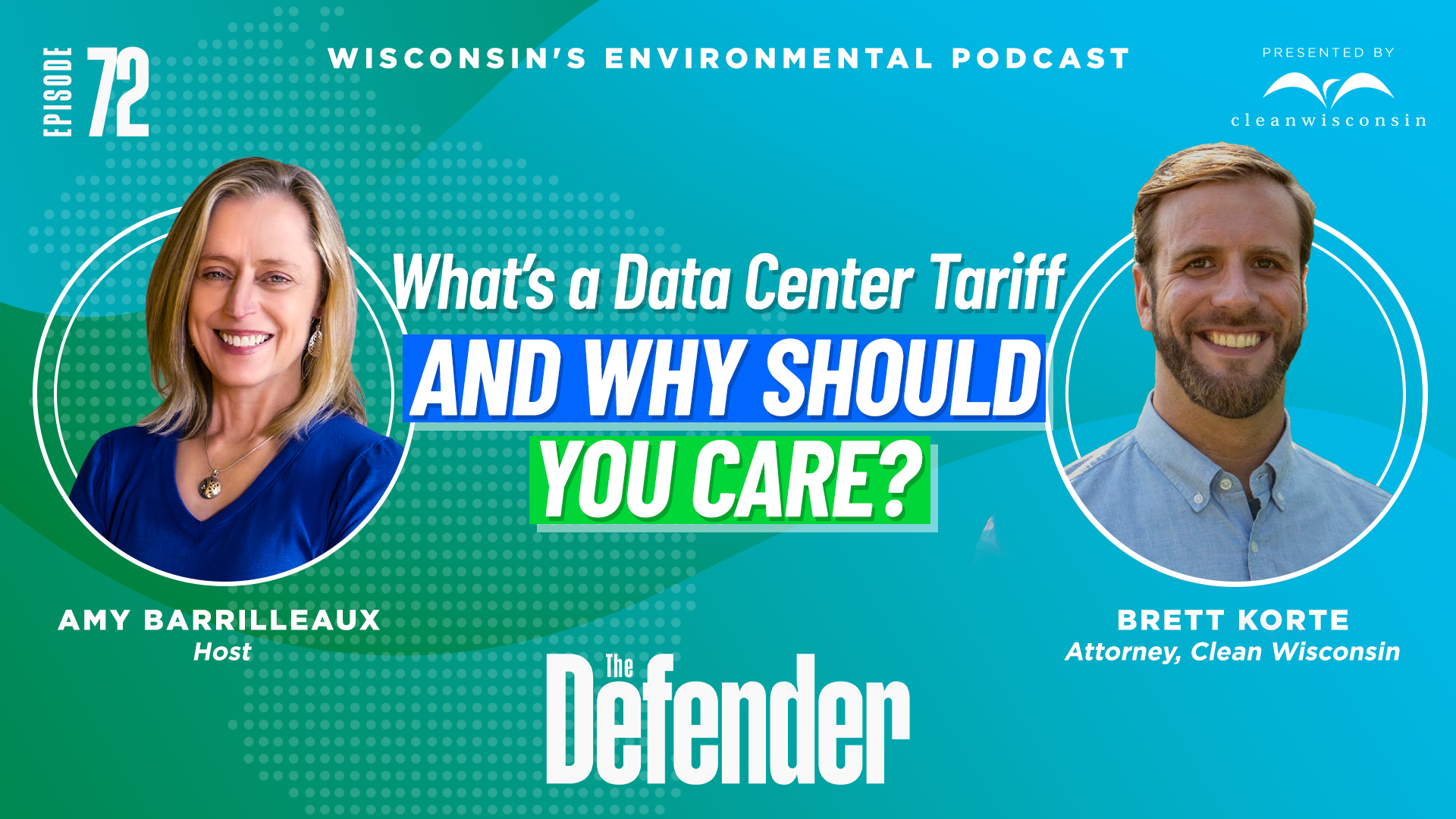
Right now there are three AI data centers under construction in Wisconsin. So how can we minimize the toll they will take on our environment and our energy bills?
Host:
Amy Barrilleaux
Guests:
Brett Korte, Attorney, Clean Wisconsin
Resources for You:
Petition: Stop Unchecked AI Data Center Devlopment
Related Episodes:
Episode 56: Data Center Secrets
Episode 59: Who’s Paying for Data Centers?
Episode 60: Hey tech companies, your gas is showing!
Episode 63: How Caledonia, WI Defeated a Date Center
Episode 67: The Nuclear Option
Transcript:
Amy Hello and welcome to the Defender, Wisconsin’s environmental podcast, I’m Amy Barrileaux. The Defender is powered by Clean Wisconsin, your environmental voice since 1970. A lot of people are worried right now about the environmental harms of AI data centers. Not to mention the impact on their power bills. Thousands of people have signed Clean Wisconsin’s petition calling for a pause in unchecked AI data center development in the state. If you want to add your name, you can find the petition at CleanWisconsin.org or check the show notes. But the reality is there are already AI data centers that are being built in Wisconsin right now. One in Port Washington, one in Mount Pleasant, and one in Beaver Dam. So how do you minimize the harms of these massive projects that are moving forward, whether folks like it or not? In a lot of ways, that starts at the Public Service Commission of Wisconsin, where there are two cases being decided right now that could help determine everything from how much you pay in your energy for data centers. To how much fossil fuel is gonna be burned in our communities to power them. On this episode, a deep dive into data center tariffs at the PSC and what they mean for you. That’s right now on The Defender. Clean Wisconsin recently intervened in two cases brought by energy utilities at the Public Service Commission that will have a big impact on energy costs and environmental harms from AI data centers. One has to do with the approved Microsoft Advantage AI data center’s under construction in the We Energies service territory. The other, the Meta AI data Center that’s being built in Alliant Energy’s service territory. Joining me to sort it all out is Clean Wisconsin attorney Brett Korte, who’s been leading our involvement in the cases. Brett, thanks for being here.
Brett Absolutely happy to be here.
Amy Let’s start with that first case where We Energies is seeking a special tariff for the big AI data centers in its service territory. Basic question, what is a tariff? What are we talking about here?
Brett Sure. So every utility customer, uh, take service from the utility under a tariff or almost all of them do. And I’ll get to that in a minute. Um, so every household is typically on a residential tariff. Maybe you’re on a time of use tariff, or a tarif that, uh, contemplates you having solar panels. So you’ll get, you know, special provisions that allow you to receive money for your solar panels. So everybody’s on a tariff. And then beyond residential, there are different classes of customers within each utility. So commercial, industrial, and sometimes like a large industrial. And the data centers are going to be bigger than those, even those classes of consumers, you know, much bigger than a typical customer in those classes. So what Wepco, what We Energies has proposed here is a new tariff structure for large load customers, which means data centers.
Amy So this case, this one with We Energies is really important because what gets decided could be kind of a template for other utilities as potentially more data centers get approved in Wisconsin if they do.
Brett Yeah, it’s the first large load customer tariff we’ve seen proposed to serve data centers. And initially, We Energies wanted to cap the threshold at 500 megawatts. So that’s the smallest a customer could be to be in that tariff. And that’s really, really huge. Throughout the case, they changed their position a little bit to allow most customers over 250 megawats to be it. Uh, but clean Wisconsin and some of the other advocates are arguing that that threshold should be even lower because what we want to do is make sure that all these hyper skilled data centers are under that tariff if they’re in web coast territory. So, um, yeah, that that’s basically what the case was about was determining the way that the data centers you’re going to pay for their service and what the interveners like clean Wisconsin were most interested in is making sure that these data centers coming into webco’s service territory aren’t shifting costs onto other customers. So the idea is in the perfect world, every household in Wepco’s territory, other small businesses wouldn’t see their rates change at all because of the data center. So that’s what most of the interveners were focused on. Clean Wisconsin was also really interested in fighting to make sure that the tariff enables as much clean or renewable energy to be used to power these data centers. So there were several specific recommendations that we made that we hope the commission that will adopt. And I can get into some of those. If you’d like to hear more about kind of what we’re pushing for.
Amy First, I have a couple of questions about what you just said. Why would We Energies want to limit the tariff to just applying to data centers that are 500 megawatts or more? And I don’t think we totally, day to day, understand what megawats is, but Clean Wisconsin’s calculation in terms of home energy needs, it would be about 500,000 homes worth of energy demand, that 500 megawatts. So what’s the advantage to We Energies of letting AI data centers that are under 500 megawatts not have to deal with this tariff?
Brett I’m not sure really what the advantage for them, for the utility is. I think, you know, I wasn’t in the negotiations between the data center customers and We Energies. That’s the number that they came up with. It would keep out a lot of smaller, quote unquote, smaller data centers, but you know still pretty big ones, like Meta’s in Beaverdam is gonna be 220 megawatts. So, you that’s a – it’s in a different utilities territory. We’ll talk more about that, but, you know, so that under Wepco’s proposal, that data center wouldn’t even be in tariff. Like I said, we’re arguing that it should be much lower. We want any hyperscale data centers to take under this tariff. But the reason that it is such a high threshold, even we’re proposing 100 megawatts, that’s still huge. And it’s because the way the tariff is set up is that the data centers are gonna have what is being referred to as a bespoke resource. So, We Energies is going to say, Okay. Vantage, Microsoft, these generation assets, and I’m not talking about specifics here, this is just in general, you know, these gas plants or these solar farms are gonna be the ones that serve this data center. So that’s all kind of, that’s why they needed, wanted it to be so big because those generating assets are big and they want, you to kind of match up the size of the generating asset with the size the customer. And you could, you can add multiple. Bespoke resources, several hundred-ish megawatts solar, for example, could be bespoke resources for one data center.
Amy Let’s say that the data center gets its bespoke resources are wind and solar, which are the cheapest ways to produce energy, and then everybody else gets, let’s say, coal and gas, which are more expensive, then is that still kind of harming customers to some extent?
Brett Yeah, it very well could. And, and, you know, we agree that a tariff is the right way to go about this, to go, about serving data centers. So, you, we’re encouraging the PSC to approve the tariff with some modifications, but we do think that the premise of the tarif is probably the best tool that we have right now to make sure that the costs that data centers are causing to the utility are actually being paid by the data centers and not socialized, so. I understand your concern, but it’s really about what is the overall generating fleet of the utility and what is MISO or grid operator going to call upon, right? Because the assets are still going to be dispatched by MISo.
Amy Okay, I think I got that. So, okay. So, and this is why it’s so complicated because I know when Microsoft first came here, they said, we’re gonna pay for all of this. No one’s gonna have to pay for anything, we are gonna pay our own way. But that turns out to be like a really complicated thing, right?
Brett Yeah, exactly. And kind of getting a follow up to what we were just talking about is one of our main concerns is that just the fact that a utility’s load is going to grow so much to serve data centers, even if those data centers are fully paying for new generating assets, it’s still going to drive up the cost of energy on the market. Because there’s more energy being used, right? So that’s what we’re talking about where we really don’t wanna see a cost shift due to these data centers. Because again, even if they pay for the entire power plant that’s gonna serve them, say, in a hypothetical. That still means that the market is tighter for the rest of that utility’s customers and for everyone in MISO really. So that’s what we’re really trying to prevent here and make sure that those market impacts are taken into account.
Amy So I think about this and all the complex work that Clean Wisconsin is doing, and a lot of partners, too, on these tariff cases as minimizing harm, right? So we’ve got these data centers. It’s not like, and I got asked this question not too long ago, it’s not something’s going to happen in the tariff cases that means that these data centers are not going to be built. These data centers, they’re under construction. They’re coming onto the grid. And so what it sounds to me like is that groups like Clean Wisconsin are trying to figure out, well, hey, how do we make sure that we have fewer gas plants or try to minimize the number of gas plants or fossil fuels that are going to be leaned on for this? How do we try to make sure that customers are protected from what’s coming? How we make sure that We Energies really does what’s right here? And so when you talk about especially the We Energies wanting to stuff to meet the demand within their own zone. I mean, is there just more money on the table for them if they build something new and fresh in their zone rather than saying, oh, existing wind energy will take that?
Brett Yeah, there’s more money for a utility if they’re building the stuff, right? But I mean, there is the grid doesn’t have enough to support the demand that we’re supposedly going to see here. So there’s going to be new stuff built no matter what. And that’s why we want to see load flexibility, demand response, anything that can mitigate that, come in. We want them to be able to consider building wind or buying wind from, you know, but it would need to be new because we don’t have the energy to support what’s coming right now. So there’s gonna be a new generation and part, you know I, yeah, we’ve got steel in the ground, right? In Mount Pleasant and in Beaver Dam. But another thing that we’re trying to do in these cases is make sure that if this, AI bubble pops that there’s protections in place for that too. So I think there’s quite a bit of a, um, you know, race to market with these companies, and I think it’s an open question of whether all the proposals that we’ve seen around the state are actually going to come to fruition. We’ve seen some get canceled. So we know it’s not all going to happen. We know some of them are definitely going to. But we’re also trying to make sure that the tariff, for example, is as protective as possible so that if, you know, the bubble doesn’t burst and there’s a bunch more of these, that they’re all playing by the same rules, basically.
Amy OK, so there’s this tariff case, and it’s a big deal, right? Because it really could be kind of a blueprint for, because this just only applies to We Energies’ territory. So as some other energy utilities try to attract AI data centers here, if they are successful, then this could be a blueprint of how those tech companies pay for their data centers.
Brett Yeah, exactly. And the other case that we were working on at the same time as the WepCo tariff case is an Alliant contract case for that Meta Beaverdam data center. So, Alliant kind of went a different route. There’s provisions in Wisconsin law that allow for individual contracts to be executed between large users typically and utilities. So that’s what Alliant is doing here. We think that Alliance should go ahead and propose a tariff, even if Meta is the only data center that’s far along in their territory. We think it’s worth having a tarif. It allows for more regulatory efficiency, more transparency to some extent, and it means we’re not going to have to, us, alliance customers, are going to have to come back every single time that they you want to propose a contract with a data center. Will know that they’re gonna take under that tariff. And it’s just easier to fix issues within a tariff because the commission could reopen the tariff, make a change and it would apply to all the data centers at once instead of having to go through the individual contracts and make changes. So, Aliyah is saying right now they don’t need to build anything new to serve Metta. So that’s a benefit to us as far as we’re not worried about them building gas to do that right now. So in that case, we’re mostly focused on the, you know, number one, the commission, we want the commission to just say, no, come back with a proposed tariff so we can do this, you know, more efficiently and hopefully better. And two, um, you know, pointing out ways that we don’t think the contract is sufficiently protective of other customers. Um, so we’ll see where that goes, but yeah, we we’re typically in favor of some kind of large load tariff, uh, for all the utilities and I would think that WEC, having gone down that road, would… Show the way for others, I guess.
Amy I mean, because Alliant Energy, it’s not like, oh, they just want this one Beaver Dam data center, and they’re done. I mean they were pushing a data center that they had attracted here, a tech company, to build a data center in DeForest that would use twice as much energy as the entire county of Dane County. So if they did these things by contract by contract per data center does that make things really difficult to even know of people where our customers are going to be protected.
Brett Yeah, exactly. So that’s why we’re saying let’s do a tariff, none of this individual contract stuff, um, let’s get it all out there. Let’s have every, you know, and, and I think it would provide more certainty for, uh, Alliant long-term and also perspective data center customers in their territory to be able to look up the tariff. Right. And here’s, okay, here’s what the regulators in Wisconsin are going to expect of us if we want to come to Alliance territory. So yeah, I, I think that’s what makes the most sense. And that’s what we want to see happen.
Amy One thing that happened in the Alliant Energy contract case was there was some things that happened about transparency. So there had been, and you’ve been in these cases and you basically look at stuff that is being shielded from the public all the time that’s in these cases. So what happened with the Allient Energy case? What was shielded from the public that now is out.
Brett So at the hearing a few weeks ago, the commission staff and the administrative law judge raised the issue of what they considered to be over redactions in alliance application materials. And we’re still working through that process. So we don’t know all of everything that’s going to be newly public. But for example, one big thing is the size of the facility. I mentioned it earlier, 220 megawatts. For most of the case, that was not public information. And now it is, so that’s really good. The rest of it is basically certain parts of the contract, so different provisions. Some of them were entirely redacted. You can, you know, just blocks of black on a page. So the commission is working right now and Alliance working with the commission to uh, minimize that to the greatest extent possible, which I think is a good sign. It’s just kind of unfortunate that it didn’t happen from the outset of the case.
Amy I mean, people are starting to get really mad about the non-disclosure agreements and the secrecy and the shell companies. I mean we couldn’t even say it was meta. That was, you know, under wraps for months. And so, I mean were you surprised when you first started getting into these cases that so much has been hidden from the public?
Brett Yes and no. I mean, the reason for all the confidentiality, you know, at least if you take it at face value is to not reveal stuff to their competitors, to these tech companies competitors and you know the, like I mentioned, it’s a race to market right now. So I do believe that they are pretty sensitive about this information. I don’t know that it’s to hide it from the public, right? I think it is to keep it from their competitors, but when you’re talking about such a massive change to a local community of a data center coming in or to the state as a whole and the utilities and all this, it just doesn’t sit very well with the public. And I fully understand that. I mean, there’s been critiques and problems with NDAs, with local governments. It’s true, a lot of zoning board might sign an NDA because a new car wash is coming in. That could happen, right? But when it’s this scale and the impacts could be this significant for everybody, I think it’s a good sign that the PSC wanted to get more of that information into the public’s hands. And I would hope that local governments going forward and the tech companies themselves are a little more open to being more transparent. I don’t think it served them very well to hide stuff so far. So, you know, maybe they’ve learned their lesson.
Amy When you think about the scale of the change that we’re going to be seeing in terms of our energy production in Wisconsin, I mean, We Energies has said it’s going to double its electricity sales in the next five years. So that should be eye-opening. And you’re working on these cases and trying to, I think, minimize the harm that’s going happen from the ones that have already been approved. I mean how does it feel to sit there and be looking at, Well, that’s. That’s going to need a gigawatt and that’s gonna need a gigawat. I mean, these are huge demands from these facilities.
Brett Yeah. You’re asking how I feel. Um, it’s a little bit like drinking from the fire hose right now. Uh, this stuff happened pretty quickly as far, you know, government regulation doesn’t typically move all that fast. And, uh, we saw kind of an onslaught of data centers all coming at once. Um, You know, in these cases, like you mentioned, we are working to mitigate the harm. I think ultimately the solution to this, the solution, to data centers and making sure that they don’t basically fast forward the climate crisis, it needs, it’s bigger than, you know, any one case in front of the PSC. We need statewide action. We need probably national action. And, you know, things like. Stronger climate laws help, right? I mean, I would rather see a data center get built in California or Michigan or Minnesota than here. And that’s not because I’m NIMBY about it. It’s because they have stronger climate laws and more of their electricity has to be from renewables. So, um, ultimately I think that’s what Wisconsin needs to do. And until that happens, you know, we’ll be in the cases.
Amy I thought you were going to be nimby for a second!
Brett No, I mean that because, you know, if, if a state’s getting 40, 60% of their energy from renewables, then obviously that’s a better place to power a data center when it comes to climate impacts. And you know right now, I don’t know what we’re at, you know, exactly, but we still get like 40% of our energy from coal or something like that. So that’s no good.
Amy Yeah, and We Energies has had a large hand in that. And now they’re wanting to have these huge data centers come. How vulnerable is Wisconsin compared to some of our neighbors? Because I always say we don’t have this thing called integrated resource planning. That means we don’t really have any kind of plan that looks at our energy resources as a whole. Does that make it kind of a great place for AI data to come, because they can… Utilities can say, come on over here and we’ll build you whatever we need to. And there’s no kind of like a rule or structure in place to make sure that everybody’s protected.
Brett Yeah, you know, I would think that the tech companies would want to see something like IRP in the state, because you hear businesses want certainty, right? And that’s what an IRP would give you. Um, they can be changed if circumstances change, but an IRP basically requires utility to tell the commission, tell the public, here’s what we’re planning in five years, 10 years, 15 years, whatever, and here’s how we’re going get there. And what we see so often in Wisconsin is In my view, utilities kind of waiting until their backs up against the wall, quote unquote, and then coming in and saying, we need gas because it’s the only thing that can do what we need to happen right now. But if you have a longer planning term and you have to show that you’re thinking far out like that 10, 12 years, whatever, then it’s easier to say, all right, here’s the growth we’re expecting and here’s how we could meet that with cheaper and cleaner alternatives by building solar. And, you know building one solar farm is faster than building a gas plant, but building enough solar may not be, right? So when you think about it that way, and it also gives an opportunity to get more of the energy efficiency and demand response and energy conservation things built into the utility system. If you have a bigger outlook that’s more holistic, you can say, okay, where do we think there’s room to increase the savings we’re getting from non-generating energy sources, right?
Amy I think it’s interesting how this is all playing out in Wisconsin, because we went from sort of, oh, yay, Microsoft is here, kind of, as a state, to this kind of extreme pushback against AI data centers. People are not happy. They are worried about our resources. They’re worried about their bills. They’ve worried about pollution. Are you concerned? And I do think there’s some kind of lik,. We don’t want anything associated with data centers. We don’t want it. But we do have data centers that are being built right now. Are you concerned that there is going to be a rejection of things that are needed for these data centers that will help them not hurt people like wind and solar and battery storage just because they are associated with powering a data center. Are those things going to be kind of like rejected by Wisconsinites?
Brett I think it’s a valid worry. You know, not every solar farm that’s been built in the last few years has been entirely welcomed by all the neighbors, right? There’s people who would rather not see those in in their community. The thing is we needed a bunch of that stuff anyway. We need a bunch wind. We need bunch of solar. We need of bunch of transmission lines just to meet the growth that we were expecting before data centers. I mean, one of the ways that we’re gonna get to carbon neutral 2050 is through electrifying transport, electrifying more industrial processes. And that means that there’s gonna need to be more electricity on the grid, right? In a few years ago, kind of pre data center boom, we did a roadmap that said, I think it was something like 177% load growth expected just from kind of business as usual electrification to get to a net zero economy. So this is kind of pushing that timeframe up and obviously making the load a lot bigger. So I do think it’s a real question of how are we gonna get there? And to the extent that data centers coming makes it harder to get wind and solar in the ground in Wisconsin, that’s gonna hurt too.
Amy I’m thinking of a good wrap-up question here. OK, so these tariff cases are before, well, a tariff case and a contract case are before the Public Service Commission. And Clean Wisconsin has intervened in both of those cases. And these will not have a determination on whether or not projects get built, right? The projects are already being built. So what would you characterize as a win in these cases? Or is it just kind of like a sliding scale of different kinds of winds, I guess.
Brett Yeah, our case included in both the cases included a lot of recommendations that we’d like to see implemented. On the Alliant contract case, we’d rather see the commission reject that and have Alliant propose a tariff. Like I said, even if they approve the contract in some form, there’s some tweaks that we think need to be made. And I would expect Hopefully even if the commission approves the contract, they would still require Alliant to propose a tariff going forward and that would help. Wepco, in the Wepco tariff case, we have a long list of things we want to see. Any one of those helps. Adopting all of our recommendations is obviously what I’d like to see, but the commission has a lot of authority. They can modify things. They can condition approval on things. I want to see them use their regulatory authority to protect the public interest in these cases. And I trust that they will. And it’s important to know also that no matter what happens, it’s not going to be the end of the story. Like I said, the commission can relook at tariffs at any point. There’s rate cases that are going to look at are the costs accurately being accounted for, so it’s going to be an ongoing regulatory process to make sure that the utilities’ other customers aren’t being harmed. And we’ll be along for the ride and do what we can and also work on some of those bigger solutions that myself and others at Clean Wisconsin and advocates across the state are looking towards. Can we have a stronger climate law in the near future? Can we have protections for the environment that then would trickle down and impact the way that data centers are coming to our state.
Amy So let’s hope Wisconsin gets it together because these things are coming so fast. Brett, thank you so much for being here and explaining all this. It is so complicated, but of course really important. So I appreciate it.
Brett Yeah, happy to be here and sorry if I gave anybody a headache.
Amy And thank you for listening to The Defender. We have a lot of related episodes on data centers, so be sure to check show notes or head to cleanwisconsin.org slash podcast. And if you have something you want me to talk about or just a comment on the show, send me an email, podcast at cleanwisconson.org. I’m Amy Barrilleaux, talk to you later.
