


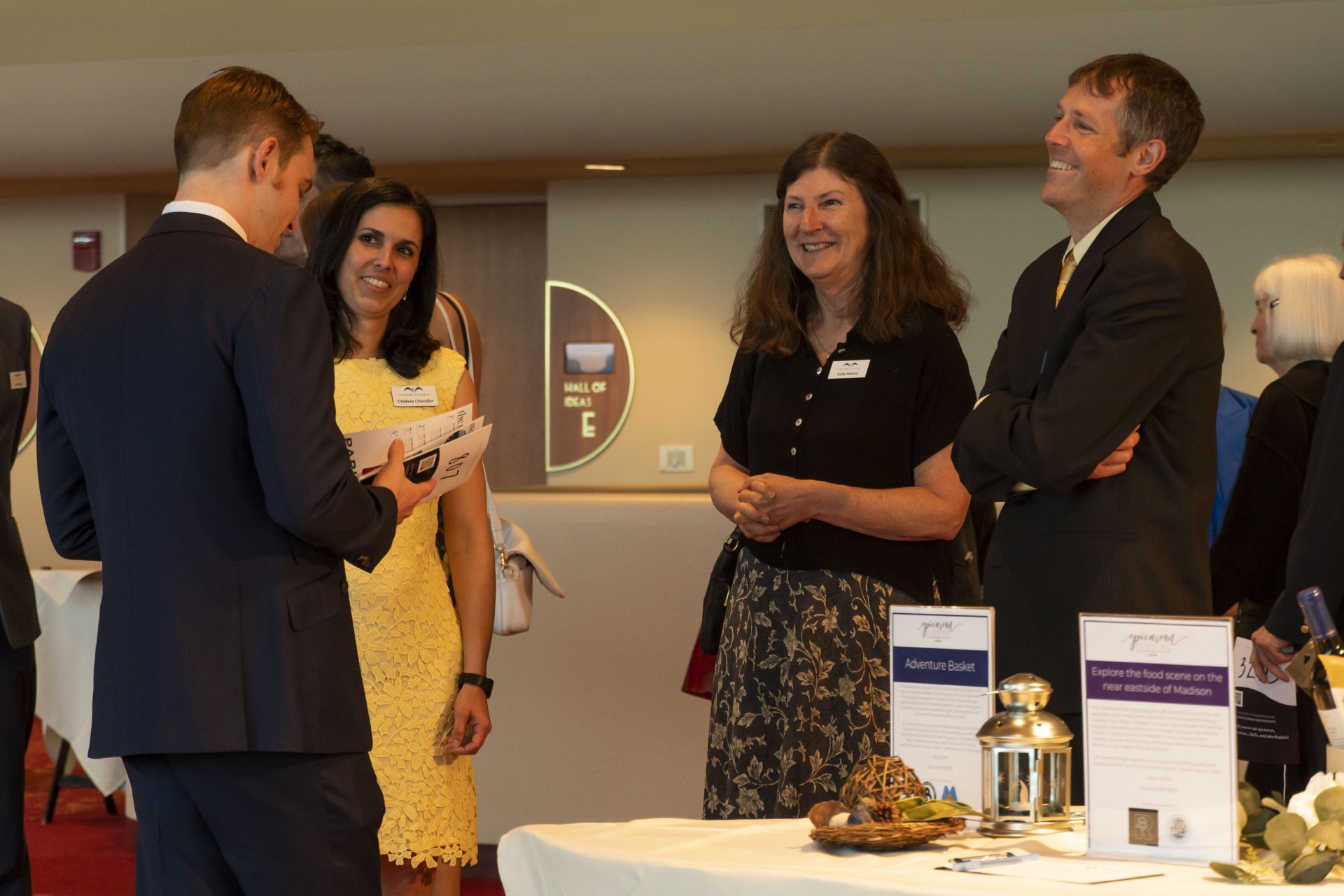
If you’ve ever met Katie Nekola, you probably won’t be surprised to learn that she announced her retirement almost as an afterthought. We were in a staff meeting talking about ongoing work when she casually mentioned that some of her renewable energy cases would be handed over to Clean Wisconsin staff attorney Brett Korte because she was retiring.
That was her announcement. No fanfare. Just a brief, matter-of-fact comment delivered in the understated way that has defined Katie’s approach to her work for more than two decades. It was classic Katie.
She has never sought attention or recognition and is never the loudest voice in the room. Instead, she spent the last 22 years solving difficult problems, finding practical solutions, and helping make Wisconsin a better place.
And while her retirement announcement may have lasted all of 10 seconds, the impact of her career will be felt for decades.
It’s impossible for me to think about Clean Wisconsin without thinking about Katie. She was the first person I hired, and my close colleague through two decades, two office moves, four governors, countless lawsuits, and more Public Service Commission proceedings than either of us could probably count.
At the time she joined us, Clean Wisconsin was a much smaller organization than it is today, and the legal program was essentially Katie Nekola alone. Somehow, I managed to convince her that a single grant worth about $40,000 was enough to guarantee stable employment and a bright future at Clean Wisconsin. Looking back, that was a pretty audacious sales pitch.
Fortunately for all of us, Katie took the leap.
One of the things Katie understood early was that some of the biggest environmental decisions in Wisconsin weren’t being made at the Capitol. They were being made in hearing rooms at the Public Service Commission (PSC).
Most people would rather do just about anything else than sit through a PSC hearing. But Katie understood that decisions about power plants, transmission lines, utility investments, and long-term energy planning would shape Wisconsin’s environmental future for generations.
She became a fixture before the PSC, representing Clean Wisconsin members in proceedings that often involved billions of dollars and consequences that would last for decades.
When Katie started this work, organized resistance to large fossil-fuel infrastructure projects was far more limited than it is today. Utilities proposed projects, regulators reviewed them, and environmental concerns were often treated as secondary considerations. Katie helped change that. She read the filings, dug into the assumptions, hired experts, challenged the analyses, and earned a reputation as one of the most credible public-interest advocates before the Commission.
When Katie started at Clean Wisconsin, Wisconsin’s energy future looked very different than it does today. Coal was still king. Over the next two decades, she found herself at the center of many of Wisconsin’s most consequential utility proceedings, including cases involving WEPCO’s Elm Road Generating Station and Valley Power Plant, Wisconsin Public Service Corporation’s Pulliam Power Plant, MG&E and Alliant Energy’s Columbia Power Plant, and Alliant’s proposed Cassville coal plant.
Long before terms like stranded assets, energy burden, and decarbonization became commonplace, Katie was helping advance arguments about the long-term costs of coal and gas dependence—not only to the environment, but to Wisconsin families and utility customers.
Not every battle ended the way she or Clean Wisconsin hoped. Elm Road ultimately became the last coal plant built in Wisconsin. But Katie was never the kind of lawyer who measured success only by whether she won or lost a case. She looked for lessons learned and what needed to be done differently the next time.
That approach helped produce some of Clean Wisconsin’s most lasting victories. When litigation involving Elm Road’s once-through cooling system reached a point where a courtroom victory was far from certain, Katie helped chart a different course and was part of the settlement that created the Fund for Lake Michigan, which has since invested nearly $100 million in restoration, conservation, and water quality projects throughout the Lake Michigan watershed.
Likewise, Clean Wisconsin’s efforts involving opacity violations at the Pulliam Power Plant produced settlements that funded energy-efficiency initiatives and environmental improvements long after the litigation ended.
And then there was Cassville. For years, Clean Wisconsin fought Alliant Energy’s proposal to build a new coal-fired power plant along the Mississippi River. When the project was ultimately voted down by the PSC, it marked one of the most significant environmental victories of its era and helped signal a broader shift away from coal-fired generation in Wisconsin.
The energy landscape was changing. And Katie changed with it.
As the cost of wind and solar power plummeted, Katie helped guide Clean Wisconsin into a new chapter of its energy work. She understood that environmental advocacy could not simply be about opposing bad projects. It also had to be about helping build better ones.
In recent years, Katie helped shape and defend some of Wisconsin’s most significant renewable energy projects. Among them was the 118-megawatt Badger Hollow Wind Project, the first major wind project approved in Wisconsin in 14 years.
Perhaps no project better reflects the evolution of her work than Vista Sands Solar in Portage County. At 1,300 megawatts, Vista Sands will be one of the largest solar projects in the country. By converting thousands of acres of cropland to solar farming, it will not only produce carbon-free electricity, but dramatically reduce the need for fertilizers, pesticides, and high-capacity groundwater withdrawals in Wisconsin’s Central Sands region. That means healthier communities, cleaner lakes and rivers, and a win for the planet.
While Katie’s accomplishments before the PSC are significant, her legacy extends well beyond any single case or settlement.
As her legal colleagues will tell you, Katie helped build a legal department defined by excellence, trust, and mutual respect. In recent years, that was perhaps most evident in her work with Senior Staff Attorneys, Brett Korte and Evan Feinauer. The lawyers developed a close-knit department that genuinely enjoyed working together and shared a commitment to advancing Clean Wisconsin’s mission through thoughtful and effective legal work.
Katie led in much the same way she practiced law—without drama, without ego, and without a need for recognition. She created space for other attorneys to grow, trusted them with meaningful responsibility, and was always available when guidance was needed.
That guidance was often served alongside a needed and healthy dose of perspective and humor. Katie understood that taking our work seriously did not mean taking ourselves seriously. The sound of laughter and hummed guitar riffs emanating from Katie’s office will be sorely missed.
Many law students received their first exposure to environmental law through Clean Wisconsin’s internship and clerkship program, another area where Katie left her mark. Over the years she helped recruit, mentor, and develop young lawyers who went on to careers in environmental law, public service, advocacy, and government.
Looking back, it somehow seems fitting that Katie announced her retirement with a single understated sentence during a staff meeting. Because for 22 years she never made the work about herself. When Katie arrived, Clean Wisconsin’s legal program was one lawyer supported by a $40,000 grant and a lot of optimism. Today, she leaves behind a respected legal department, a generation of attorneys she helped mentor, and a body of work that has shaped Wisconsin’s environmental future for more than two decades.
That is a remarkable legacy.
