

Where to Listen:




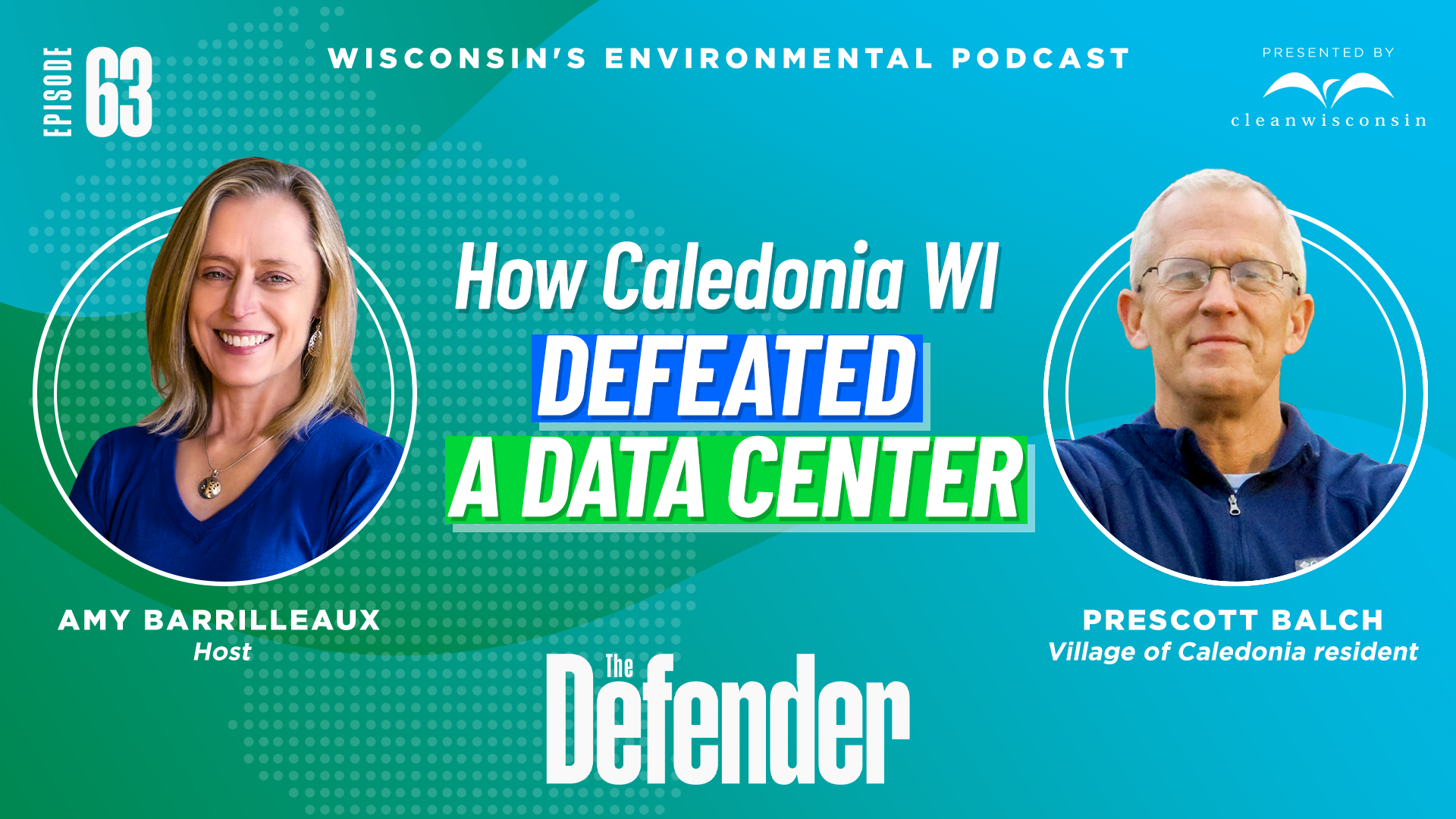
On this episode: how a small Wisconsin community stood up to one of the most powerful companies in the world… and won. And what we can all learn from their fight.
Host:
Amy Barrilleaux
Guest:
Prescott Balch, Village of Caledonia resident
Resources for You:
Stop Unchecked Data Center Development (petition)
AI Data Center Energy Demand Analysis
AI Data Center Offsite Water Withdrawals
Transcript:
Amy Welcome to the Defender, Wisconsin’s environmental podcast. I’m Amy Barrilleaux. The Defender is powered by Clean Wisconsin, your environmental voice, since 1970. It’s hard to talk about the environment right now without talking about AI data centers. Tech companies are barreling their way into Wisconsin, pushing projects across the state right now. To put this issue in perspective, just two of the AI data center that have been approved so far in Wisconsin are going to need more energy than all the homes in the state combined by far. New gas burning power plants are already being built in Wisconsin and more are being fast tracked in the rush to meet this unprecedented spike in energy demand that AI data centers are going cause. And then there’s the water, not just the water and the mix of toxic chemicals used on site to cool these enormous facilities, but the billions of gallons of water used to cool the power plants that will serve them. It all adds up to a threat to our environment, our way of life, unlike anything we’ve seen before. But the future has not been written yet. In this episode, how a small Wisconsin community stood up to one of the most powerful companies in the world and won, and what we can all learn from their fight. That’s right now on The Defender. It started, like so many AI data center projects, with a lot of secrecy. In July, a company called Dewberry and its undisclosed client requested a new kind of zoning district in a small village of Caledonia in Racine County. Before long, villagers discovered the rezoning would be for an AI data center called Project Nova. In September, Microsoft finally stepped from the shadows and officially announced Project Nova, complete with a project area map. Concept plans, renderings, and a pretty slick marketing brochure and website. It seemed like a done deal, but it wasn’t. One month later, in the face of strong and organized opposition, Microsoft walked away from Caledonia. Joining me is one of the residents who was instrumental in building opposition to the data center, Prescott Balch. Prescott, thank you so much for being here.
Prescott My pleasure.
Amy Before we get into the data center and your experiences having a data center proposal come to your village, what’s your background? I mean, I think you have an expertise that maybe not everybody has when an AI data center gets proposed.
Prescott It, it’s sure, it sure was convenient. Um, I, I had been until early 2014, a technology professional. I, I was in the software development business. I worked in large corporations most recently for us bank. Uh, so I knew, I know a lot about technology. I know about software development. I know lot about running software and data centers. Uh, I knew pretty much everything about the industry. And I had 40 years worth of experience to know its history as well, which was very important to the discussion and we can get into as I go through the Caledonia story. But knowing about current state is one thing, knowing about history is also really important in this context. But yeah, I came to this as what I described to everyone that I talked to, the last person on paper that you would expect to have concerns over building more data centers. I do think we need them and we need to find the right place for them and the right controls and so on. But yeah, I’m a technology professional by trade and brought all that experience to bear on the challenges that we had in the placement in our community.
Amy So you’ve been a pretty vocal opponent of the village of the Caledonia proposal that Microsoft had. Tell me how you first kind of learned about what was going on.
Prescott Yeah, so we had someone, a person or two, maybe see a sign in tall grass on a lonely road that is relatively undeveloped. The notification requirements that the state imposes on rezoning are broken. So the village, and this is the first misstep that they made. The village towed exactly the lines of those state requirements. We got lucky that somebody saw them early and somebody and they’re vague they just say there’s a rezoning request for more information call whatever. Okay. So somebody actually called to try to find out what was going on and learned that there was a data center proposal but if the old saying you can change your life by missing a bus like this village could have changed its life if nobody had seen that sign and called. The story would have played all together differently. But we saw it, somebody saw it. Somebody called, I got a call from a friend saying, hey, somebody’s trying to build a data center over in that big empty lot over there. And then the rest is kind of history. But that was what happened initially. Couple of letters in the mail to people within 300 feet, which is about three people and signs in the tall grass on a road no one drives on.
Amy So they basically put the sign where the rezoning is proposed, but not in a whole lot of different places.
Prescott Right. They put it exactly where state law said they had to. You have to post it on the property, and whether they did it on purpose or not, they chose the road that the least traveled. There was a choice they could have made to put it on a part of the property that was on a more traveled road, but they did not. Was that intentional? I don’t know. But it didn’t help the village’s cause if somebody really wanted to push this thing, they should have done it openly and transparently and brought people along on the decision. And instead they, they took the sneaky way to try to make it go fast and it blew up in their face.
Amy Do you think villages are under pressure to make it go fast?
Prescott Oh, yeah. And right now, villages have a really tough decision to make when a new one comes along, because the data center issue has turned into this third rail topic. And if you’re a new village or county or whomever that’s negotiating one of these deals, you say to yourselves, well, if I publicize it, I know I’m going to get a lot of blowback. I know, I’m gonna have to do this. A long road to get to approval. A lot of work, a lot of people yelling at me, or I can try to take the quick and dirty route, hide as much information as possible, hope nobody notices, and then have people yell at me after it’s approved and we’re doing it, which is what’s happening in a couple of different communities in Wisconsin right now who did not get engaged early enough.
Amy So you happened to find out that there was a sign that some rezoning request had been made. Then what happened? I mean, I guess, you know, why weren’t you kind of like, okay, this is great. You know, it’s gonna mean more tax revenue or it’s gonna mean maybe some good things for the village.
Prescott I pride myself on being reasonably objective. I have the technology background and like I led with it, we need these things somewhere. So let’s look at the thing as objectively as possible, well aware of my immediate bias that it’s pretty close to my home and I don’t really want that construction in my backyard for a long time. But I looked at it as objective as I could and there were several issues that just leaped off the page. That you wouldn’t otherwise know were risks unless you were in the technology business and knew what they were. As an example, today’s data centers, these hyperscale data centers which is a fancy word for really darn big. That’s really all it means by the way. They are very purpose built, meaning they’re designed very specifically for the functioning of a data center that no one has any idea because we haven’t had to do it yet. Well, what are you gonna do when that building is no longer viable as a data Center? And are you going to turn it into a bowling alley? Are you going sell it as it can be general purpose commercial real estate? Because it’s purpose built, the reuse opportunities look really limited. Then if you couple that with the choice of the parcel that they made, which was very convenient to a data center because it was across the street from a power plant, but it’s very inconvenient to any other commercial use. And it’s been a non-commercial parcel for forever. Uh, so here you have purpose built building, you have a lack of reuse opportunity long-term, and then take the third thing, which I brought to the table and said, Hey, over the last 40 years, the average lifespan of a data center is 15 to 25 years. Well, that might sound like a long time away to a technology professional, but to somebody who’s trying to manage the future of the village, that’s a big deal. And I said, what’s your plan? Like, what are you going to do in 25 years if this thing is just an eyesore on the landscape? It’ll be a permanent reminder that you made a mistake. And nobody had an answer because nobody thought, well, gee, maybe the lifespan of a data center is actually pretty finite and we need to concern ourselves with that topic. So that was my. Probably the number one reason to resist. Number two reason, almost tied for number one, is these data centers are so big and they produce so much tax revenue that they create what’s called in financial circles a financial concentration risk. You would never put all of your retirement savings in one volatile stock. You’d be crazy, right? You, you, you don’t, you don’t concentrate your risk on one taxpayer if you’re a village. Port Washington is an example that’s gonna double their total real estate valuation. They’re gonna have up to half of their revenue coming from one customer, one taxpayer. That’s a really bad place to be. So in our case, same thing, maybe not quite as stark as Port Washington, but it was still going to be a big, big number. And we said, you’re gonna get attached to this tax revenue? It could go away. They could sell the building. It could be not viable anymore. Whatever you have to have a plan. You have to, you can’t just sign up for that concentration risk and then tell the future residents you guys can figure it out later. That’s too big of a problem. That has to get covered by the current residents. When you get in that bind, the current taxpayers are gonna take it on the chin to make up for any lost tax revenue because the guy left the building in. And whatever other scenario there is.
Amy This, I mean, I think the perspective that you’re bringing probably does a lot to move, you know, village board folks and people who are worried about the economic interests of their municipality. But, you now, this is an environmental podcast. Yeah, uh-huh. And that’s, Clean Wisconsin’s interest is very much along the lines of, you when I hear you talking about kind of putting all your eggs in one basket, it feels kind of like we’re putting all of our eggs in terms of power generation into one basket, like building power plants to serve these data centers that use as much energy as a million Wisconsin homes. At what point did you realize that there would be environmental costs potentially or likely with these AI data centers?
Prescott Yeah, so a word on how we approach the arguments. Yes, a lot of our arguments were focused on the financials. Because frankly, city officials, village officials, they think they’re doing the right thing long term fiscally for the village. Talk them off that point and you win. And so yes, that was our primary motivation. We did say to people, look, we have primary and secondary arguments. The secondary arguments can be perfectly legitimate. They just might not move the needle. So we wanted everybody to keep pushing their issues. We just wanted to make sure that we were telling the story in a way that prioritized those items that we’re gonna convince the seven people we needed to convince. And one other thing I’ll mention is when these tech companies go find places to build these, they’re not going to places that are being run by rabid environmentalists. They do their homework ahead of time. And if everyone is a member of Clean Wisconsin, they’re going to stay away. So maybe there’s a strategy there that you sign everybody up for Clean Wisconsin on the board and then they’ll stay away, but in all seriousness, like all of the arguments matter. How you present them and in what order and so on can also matter a lot in terms of winning or losing. The energy one though, to get to your question, is a really interesting one. Tactically, it is a very legitimate issue. There is anecdotal evidence that everywhere these data centers are being built, that energy prices are rising. And you, and you actually now hear this from across political spectrums, people, people saying, Hey, wait, here’s a problem here. It’s, it’s unfortunately there’s two unfortunate parts of it. One is it’s anecdotal. You can’t say, here is my magic algorithm, plug in the numbers, take the data center out and look the, your rates would have been different. You, there’s no way to do that. So it’s part of it, part of the problem is it, it just opinion and the anecdotes are great, but they’re anecdotes. But there’s a second part of this that is an organizational and how do we fight this thing that’s really problematic. And that is the energy decision, the developer agreement that happens for the energy portion and the developer agreements that happens for the building on the property. Those are two different agreements signed by two different people. And so if you’re trying to get the village to say no, and you push hard on the energy problem, they’re going to look at you and say, that’s not my job. I don’t know energy from a hole in the ground. I can’t make this decision based on your energy argument, because that’s the argument that the energy people should be making. And on the flip side of that, the energy, people aren’t approving or rejecting the rezoning and the building and all of the setbacks and stuff like that. They’re assuming, okay, if you want to do this deal, here’s the cost of the energy infrastructure build and generation build. These are the best terms that we can come up with. So the energy argument has this weird reality to it that, yeah, you can use it to try to help sow doubt in the minds of the people that are voting in your village, yes or no. But at the end of the day, You have to be careful not to put too much weight on it as a strategy, because the people who just really want to do the deal are going to just say, not my, not my problem. Talk to the energy experts.
Amy When you, I guess when word started getting out in the village of Caledonia that there could be an AI data center coming, did you hear people concerned about maybe not just energy use, but about water use, about the land, those kinds of things?
Prescott Absolutely. And there was a history to this property that was very important along those lines. So it’s right across the street from the Oak Creek Power Plant. Very convenient for a data center. It takes hundreds of millions of costs out of their build. But the power plant property has a big ash pile. And there was a controversy for years on end about this parcel across the street where people were complaining that their wells were being polluted. And nobody ever admitted it. Nobody ever proved it in a court of law. And essentially the power company said, look, we’ll buy all the parcels and as a buffer, a legal buffer. Um, and then we thought, okay, we’re done as a community. That’s great. You guys have this legal buffer. We’re going to get a nice open 240 acres and it’ll be beautiful. And, and it was detente for a while until somebody in their real estate group decided, wow, this thing is going to be worth a gold mine if we can turn it into a data center parcel. Um, but that whole thread, you guys ruin this property. We’re not going to, we are not going make you rich over having ruined a piece of property. It’s a buffer for us from the power plant. So why would we put something on it that itself needed a buffer and other thread? You guys polluted those wells and now you’re gonna go bust up all the ground. Prove to us that you’re going to do it in a way that is safe. So I don’t remember the name of the chemical that was found in the water, but there was a lot of controversy there and that was a distinct thread. Um, that was important to our village because it was such a hot topic for so long, um, over the last decade and a half.
Amy So I think what we’re finding with data centers or AI data centers is that there is this sort of meeting of a lot of issues, economic issues, jobs, future jobs, energy, water, land. I mean, it’s kind of all the things. And then layered on top of that is climate change, making progress for the future 50, 60 years from now. And then there’s this sort of David and Goliath theme that comes out, you know, village of Caledonia, town of Viana, all of these small communities, poor Washington, that are kind of coming toe to toe with some of the most powerful companies in the world. So what was your experience after you started kind of building this group of folks who, for whatever reason, were opposed to this data center? Maybe it was because they just didn’t want us. Stare at a big building, or maybe it was because they were worried about the water, or worried about the climate, or all this host of reasons, what kind of happened from there?
Prescott Yeah, so we got your traditional Facebook group going early on, we got as many people engaged as possible. I think the most important thing, the most move that we made early on besides just getting people engaged and gathering opinions and was saying, this is a really practical exercise, we’re trying to change seven votes. Four out of seven. That’s all we that’s it. That is the goal. And know who the seven people are, know what makes them tick. Know what arguments will move them and then we’re gonna go attack that. So that’s what we did. We knew exactly who the seven were. We had odds on each one of who we could convince and how we reached out and met with them if they would be so willing. I think we reasonably quickly got three people on our side and then the fourth was on the fence and flipped over the fence really late and caused Microsoft to back out. But. Our my advice to all communities is find out what you’re what is what you what are you trying to do are you’re trying to stop something are you try to if it’s already approved are you trying to just protect residents or whatever but define your goals and and do those things that directly or indirectly support those goals for us it was we want a no vote that was it It was really simple and we put a strategy together. Communication strategy together that supported that directly or indirectly with every step of the way. And it worked great. We won. We didn’t do anything special, so to speak. I mean, we got. Ever-increasing numbers of people at Village Hall for meetings. We had guard signs, we had Facebook groups, we have in-person meetings to rally the troops, and we did all the normal community organizing stuff, and we did it pretty well, I think. Um, but I think the key to our strategy was just thinking about this as an exercise in how do you do the hardest thing in the world, which has changed someone’s mind and, and I just, uh, really practical laser focus on that helped us spend the right time on the right people with the right statements and helped us create doubt in four people’s minds that this was a good idea.
Amy You know, this is a, for an environmental podcast, kind of a tricky conversation, because I think it can be easy to be painted as anti-economic development, or anti-technology of the future, or any of these things, or to play into that kind of like, not in my backyard, I don’t want anything here, because you know, from the environmental perspective, we know we do need windmills, and we do needs solar panels, And we need that infrastructure to kind of change the course of where we’re headed in terms of the climate crisis that we’re in and in the health crisis from burning fossil fuels, so I think it’s a difficult conversation for us to have because we don’t want to appear to be against a certain kind of economic development or technology or anything like that, but we just want to kind of try to do things in the right way if possible. In your perspective, is there a possible a way to have AI data centers without harming the places where they’re located, without harming potentially the economy, without harping the environment because of their intensive energy demands? Or is this, from your perspective, kind of like we need to stop this right now until maybe there’s a better way to build a data center?
Prescott So you mentioned that for Clean Wisconsin, sort of an awkward conversation because you don’t, you’re, I have the same exact experience as a technology professional. This is a really awkward experience for me. I think we need them someplace. So I’ve, I’ve been trying to put my finger on, well, where would they make sense? Before I answer that question though, I’ll say at the end of the day my friends that I’ve gained that are of the environmental persuasion on this topic and I will ultimately, if we push hard enough, we’ll ultimately find a source of disagreement on the topic of the environment impact. So yes, there should be controls. Yes, if there’s probably a way to do the energy right. By the way, there’s no way you can run these things without fossil fuels unless you’re building more nuclear plants to support them. But windmills and solar panels aren’t going to cut it for 24 by 7 power load that’s needed for these things. So I think if you take that upside and say the strange bedfellows that I’ve managed to meet along the way here on this, like we’ll ultimately disagree on that part. I can’t solve that problem. But is there a place to do this right? Is there a framework in which they can make sense and they can do maybe everything but the fossil fuel discussion? Yes, I think there is a way to get there for me, probably because my focus is primarily on the financial and technological risks. There, I’ve come up with two use cases, I guess, where I think that makes sense. One is a community that’s large enough to absorb the loss of the tax taxes if that falls apart. Like if they go bankrupt or goes empty or whatever, if you’re in, if your building is in Dallas, Texas, it’s gonna be a lot easier to handle that tax loss than Caledonia. So. Build them under large tax or on top of large tax bases that can manage their loss if they go away. The second use case is there are a handful of communities across the country that have decided to go all in on data centers and just keep building. And they’re going to enjoy the economic benefit of the construction there for as long as they keep constructing and then they have a problem. If you’re so distressed as an economy that you’re a step away from bull weevils running down the street, or tumbleweed rolling down the streets, sorry, then maybe it makes sense to as a Hail Mary pass to save the town, okay, we’re going to do a bunch up and go move someplace else, but those are the only two scenarios I can think of where it makes sense. They can’t, they’re going to overwhelm. That they’re in and they’re creating such long-term risk. But there has to be some place for them because we’re doing a podcast over Zoom with technology. We can’t say, like, no more technology. People are voting with their pocketbooks on the use of technology, so we’ve got to figure out a way to accommodate them. That said, let me ask one more thing. The technology business is always pushing to make itself more efficient, and they’re going to do that with AI, and that’s actually one of the risks. We’re one software change away from not needing nearly as many data centers.
Amy I do want to push back a little bit on a couple of things you just said. First, yes, we are on Zoom and that does use data, but that’s not the same thing as AI. I actually disabled an AI feature as soon as I entered this Zoom room. I have no idea what it would have offered me. So this technology that we’re using right now doesn’t need the kind of hyper-scale data center that we are talking about. And I think people are asking whether AI is worth all of this demand and all of this risk that we’re taking on and you know to your thought about not being able to power data centers with wind and solar and battery storage I mean I certainly know experts on our staff who would strongly disagree with that but if we don’t find out a way to do that then we certainly are in a lot of trouble because of the intense energy demands of AI. You know, you’re talking… The data center proposed in the town of Iana and DeForest, using twice as much energy as the entire Dane County, all of Madison and everything else in Dane county. And it’s just one data center, so. The question is how can we do this without destroying ourselves, I think is basically where we kind of are.
Prescott Yeah, no, I will agree with that. It is an irresponsibly large usage of energy. Economically, it will destroy itself if there is no way to pay for it. The cost of AI right now is exorbitant, and if companies don’t figure out how to find paying customers, then the same thing is going to happen to it that happened in the business models. Nobody could make a plug nickel on selling their services over the internet. And we overbuilt and companies collapsed in March of 2000. And, and then we found the steady state that allowed the internet to be this, this normal thing. Like the same thing will happen with AI, but we’re, we’re up at the top of the crazy curve. And energy is one of those factors that’s going to actually kill them. And we’re overbuilding because the technology is too expensive. And if the industry doesn’t fix that problem, that problem will fix itself because those companies just simply can’t afford it. We can’t build $3 trillion worth of data centers if there’s not any new revenue associated with it, it’ll just blow up, it will implode.
Amy Well, that’s kind of like the doomsday scenario, I think, at least for the financial markets right now.
Prescott Absolutely.
Amy It seems like every day we keep hearing about new AI data center projects. I just heard of one up in Northeastern Wisconsin yesterday. So where do you think we are in this bubble or whatever? Are we still in Wisconsin and going to be seeing more and more tech companies trying to come here?
Prescott Thought until maybe last week that the number of new proposals was waning and we were finally getting to the peak of insanity. And then I heard, you just told me about one I hadn’t heard of. So I’d be curious to know where that is, but there’s another one in Southwest Wisconsin, uh, in Grant County that I just heard about, uh earlier this week. Um, so I, I don’t think it’s over yet. Um, there’s, there is the perfect storm of in incentives in Wisconsin to drive them here that is legislature. Um and the legislative data centers i don’t know maybe both they don’t realize what they did and they want them but as long as those incentives are in place to keep attracting Um, they’re going to keep coming, uh, or until the bubble bursts, we’re getting close to that peak though. I did a little two scale graph for a presentation I did in Janesville where you can compare the current size of the data center industry with the proposed data center build out. And it’s, it’s like five to one. The new proposals are five times the size of a current entire data center. It’s unsustainable. Like the money’s going to dry up. The profits aren’t going to be there and it’s going blow up and companies are going to go bankrupt. They’re going to abandon buildings. It has to happen because nobody’s making any money on it.
Amy You make me feel like I should put my money under my mattress for the next five years.
Prescott Put it in long term government bonds or something. Yeah.
Amy Yeah, or I don’t know. OK, well, I mean, I think there’s so much to talk about and discuss. You, I, think in the village of Caledonia, one of the rare places where there was a proposal, and then people kind of stood up, and then the tech company said, well we’re going to walk away. But you still have that really attractive piece of land right across from a power plant, contaminated or not. Do you think this is the last you’re going to hear from a tech company?
Prescott I think it will be for a while, assuming that we get a change to the makeup of our village board in the April election. This event really radicalized people here to local politics. And has encouraged some different blood running for village board. And assuming that goes the way we think it will go, then yes, I think it’s the last we will hear. Because as I said before, tech companies do their homework, and they’re not going to go someplace where they know they’re going to get a no. So that’s our strategy right now. Um, but I also think, yeah, they’re going to move on and they’re going to go focus on some, some other place. I think they’ve got a site in Kenosha that they’re looking at right now. Um, But I think Caledonia is off the hook, but, but Wisconsin is not off the hook until those incentives are gone, they are going to be, we’re going to plan whack-a-mole to try to push back.
Amy This is probably my third or fourth episode devoted to data centers, and more and more, if you’re interested in the environment or the economy or anything else, you’re gonna be talking about data centers. So thank you so much for coming on and taking us through the journey of the village of Caledonia. I really appreciate it.
Prescott Yeah, my pleasure. Thanks for having me.
Amy And thank you for listening to The Defender. If you want to sign on to Clean Wisconsin’s petition, calling for a pause in data center approvals, you can find a link in the show notes or log on to cleanwisconsin.org. And there are links to a lot of other information, studies, looking at the environmental harms that AI data centers pose to our communities in our state. Remember, if you listen to the show, give it a good rating and review on your favorite streaming app. It helps other people find us. And you can send me an email with your comments and ideas. Podcast at cleanwisconsin.org I would love to hear from you. I’m Amy Barrilleaux. Talk to you later.
