

Where to Listen:




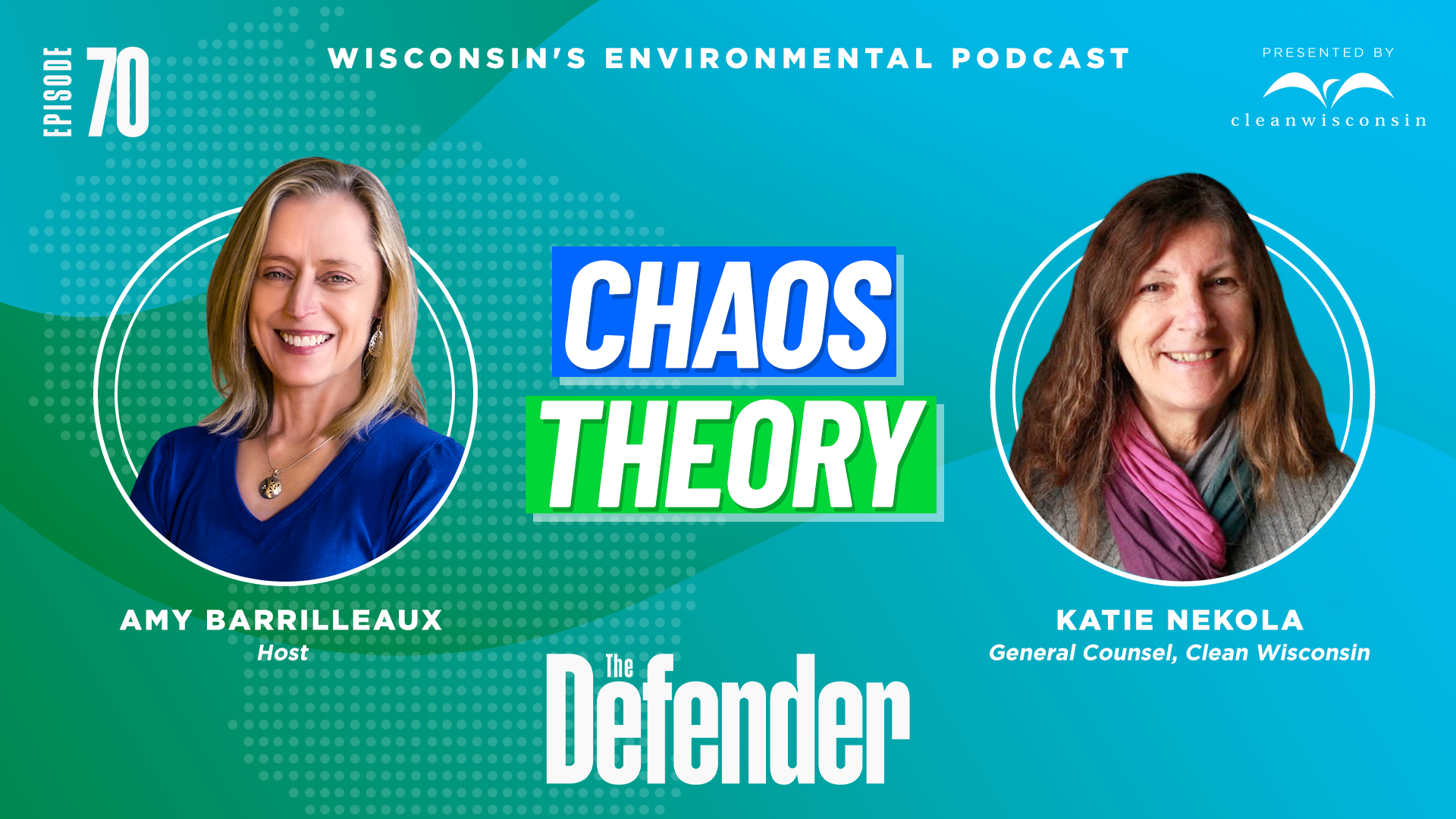
On this episode, a look at the fallout from a rapid-fire dismantling of environmental protections, and what groups like Clean Wisconsin and so many others are doing to keep people safe.
Host:
Amy Barrilleaux
Guests:
Katie Nekola, Clean Wisconsin General Counsel
Resources for You:
Transcript:
Amy Hi there and welcome, this is the Defender, Wisconsin’s environmental podcast. I’m Amy Barrilleaux. The Defender is powered by Clean Wisconsin, your environmental voice since 1970. Okay, so some clarification on the title of this episode. We are not talking about physics today, but we are talking about chaos. The kind of chaos that happens when the EPA decides it’s not really into the whole environmental protection thing anymore. The chaos that happen when the federal government rips up the biggest law to fight climate change in U.S. History. And replaces it with a long list of giveaways to big oil, gas, and coal, and the kind of chaos we’re all feeling when we open our energy bills right now. On this episode, the fallout from a rapid-fire dismantling of environmental protections and what groups like Clean Wisconsin and so many others are doing to keep people safe. That’s right now on The Defender. A new analysis shows Wisconsin is paying big time for the big beautiful bill. That’s the budget law passed not even a year ago that reversed investments in clean energy to give $40 billion in additional tax breaks and incentives to fossil fuel interests and allow more logging, drilling, fracking, and mining on public lands. Turns out, cutting federal investments in wind and solar projects and getting rid of energy tax credits not only cost us more than 8,000 jobs in Wisconsin It means our energy bills are projected to go up by $300 a year by 2035. And that doesn’t count increases from a natural gas shortage this winter and new war in the Middle East and all those new AI data centers. Speaking of AI data center, the Environmental Protection Agency is now claiming its mission is to make the United States the AI capital of the world and is tossing out the endangerment finding, its own key finding that gave the agency the authority to regulate greenhouse gasses. If your head is spinning, you’re not alone. The effort to dismantle long-standing core protections is coming at us so fast. But there is a lot of work happening to fight back, including a lawsuit from Clean Wisconsin against the EPA. Joining me is Clean Wisconsin General Counsel, Katie Nekola. Katie, thank you for being here. And I just want to note that when you’re on, we always come up with a cool, pithy episode title.
Katie Thank you very much. I want to be known for that.
Amy You know, nuclear option, chaos theory. So is that an appropriate word though to describe what’s happening right now as we see all these environmental regulations and protections get dismantled?
Katie I do think it is, because it seems chaotic, because it’s all happening so fast, and it’s really hard to keep up with all the changes that are being made. But I think, at the same time, there’s sort of an underlying organization to all of it, and I think what that looks like is that this administration, the Trump administration, is doing whatever it can to pander to big oil and gas and the coal industries. I think the execution’s a little chaotic, however.
Amy What does this big shift, I think, at least on the federal level, from supporting clean wind and solar and electric vehicles and supporting people to make energy-saving improvements to their homes, what does that do in terms of all the things, not just the way we’re feeling, like the chaos that we’re feeling, but to our energy bills and to our car manufacturers and all of this? It feels very uncertain right now.
Katie You know, it’s interesting how Trump’s policies are playing out in the real world. And I think here’s where we get back to the chaos. For example, he says he wants to increase oil drilling, but there’s been 15% less oil drilling in the last year, and some people attribute that to his tariffs. Fracking for oil is reaching its geologic limits. Coal has been uneconomic for years, and that has nothing to do with federal policy. It’s just because they’ve already mined the most productive and least expensive. Sites. So you kind of have to wonder how much all of this arm waving about coal and oil and gas is is just for show. It’s not playing out, you know, it’s not playing
Amy I do still see kind of when people are worried about energy prices, gas prices, heating bills, this sort of, well, drill baby drill, like that’s the answer. But I guess you’re saying that’s not the answer to high bills and that’s not what we’re seeing as being helpful right now.
Katie It’s really hard to predict what’s going to happen, but so far none of his policies have resulted in lower energy prices. They haven’t resulted in more energy security, certainly. I think that what we’re seeing is increased prices, and that’s the result of a chaotic approach to planning, or just a lack of planning.
Amy So we’ve got, of course, all of the stuff in the “big, beautiful bill” that’s kind of like, I mean, I think you could call it a big giveaway to big oil, gas, and even coal, which, again, it feels kind of, like, that’s a throwback, even just saying it. I think that was kind of the start, the start of getting rid of environmental protections. And then suddenly now you mentioned that they’re coming one after another. I mean it is a long list. I wouldn’t have time to list them all here. One of the ones I think has gotten a good bit of attention is the rolling back of the Endangerment Finding. I don’t think a lot of people go around every day thinking about what the endangerman finding is or was. So explain to me first what was the endangermen finding and then what’s going on with it.
Katie In order to regulate anything, the Environmental Protection Agency has to make a finding based on science that what they want to regulate has the potential to have harm of some sort, human harm or harm to the environment. And so the previous EPA found that greenhouse gasses endanger human health and the environment, and that was based on really solid science and really not. Questioned at the time, right? But now the new EPA administrator, Lee Zeldin, has changed the entire mission of the agency and it’s no longer to protect human health and the environment, but rather to, I think he said, lower the price of buying a car or heating a home or doing business.
Amy I want to stop you there, because isn’t the mission of the EPA kind of set forth in statute? I mean, this is an agency that was created that has legal and statutory obligations. So what we’re seeing is, I mean it feels like the whole mission of the agency has been turned on its head here. Not just a, oh, we want to protect public health in a different way, but where it’s like public health isn’t even kind of coming into the equation anymore.
Katie Absolutely, and you know, not only does it turn the mission on its head, but the premise behind what he’s saying their mission now is, is erroneous, it’s wrong. I mean, clean air and clean water improve human health and save people money. So for example, the vehicle emission standards, which have recently been repealed, along with the endangerment finding. Would save people, it was calculated by the previous EPA that those rules would save drivers, individual drivers, up to $6,000 over the life of their vehicles thanks to lower fuel and maintenance costs. So these rules save money.
Amy And I guess health dollars too, which the EPA doesn’t consider anymore, right? The health dollars that are saved.
Katie That’s right, they don’t consider the cost of pollution in their calculations in terms of human health. Another, yet another rule that they are repealing is the emissions rules for power plants. And those rules were estimated, again, by the previous EPA to deliver billions of dollars, 390 billion to be exact in their modeling in health and climate benefits. And so there’s a cost, you know, to letting. Polluters just pollute, and the cost in terms of climate is increased weather events that cause natural disasters, which are very costly, both in terms of human life and in terms clean up and emergency services, and the health costs I think we’re all very familiar with, which are the cost of asthma treatment and other respiratory illnesses that are affected by all these pollutants, premature death.
Amy So that brings us back to the, I guess, the Endangerment Finding. So the EPA found in 2009 that, yep, greenhouse gasses, they’re dangerous, right? Climate change is dangerous. These are all threats to human health. And now, is the EPA saying, like, no, it’s not dangerous? Or are they saying, it is not our job to care if it’s dangerous?
Katie I think both. I think they’re saying that their science is better than the previous endangerment finding science, which isn’t true, clearly. And I think their legal arguments that they overstepped, that the previous EPA overstepped and did not even have the authority to make this endangerment find is clearly not true.
Amy Because that was the Supreme Court in 2007 said you have a responsibility to find this stuff out.
Katie Correct.
Amy Okay. So here we are. We’ve got the EPA saying, we don’t want to do this endangerment finding thing anymore. We know better. Climate change and greenhouse gasses are fine, I guess. Clean Wisconsin is one of the organizations that is filing suit against the EPA. And we’re joined by some pretty big health organizations like the American Lung Association. So why Isn’t it important to a group, to health organizations to push back against the EPA on this?
Katie Yeah, we’re working with the American Public Health Association and the American Lung Association and the nurses, all of whom know what they’re talking about. They’ve been in the trenches. They’ve seen the impacts of unhealthy air on their patients and clearly know that when we see these, for example, ozone alerts that are happening more and more often in Wisconsin, where DNR is advising people to stay indoors in the summertime, because the air isn’t healthy to breathe. You know, they know what the long-term impacts of those alerts are. And you know, I think in this country we’ve got the resources, we’ve got the knowledge, we got the science to work against that kind of pollution and those kinds of health harms. And we have a responsibility to do it, but this administration is just abdicating that responsibility.
Amy We always see, I’ve heard this described as kind of a pendulum, right, when it comes to safeguards against pollution, where when you might have a Democrat in office, then you get some stronger safeguard that get put in place, and then you might a Republican in office like George W. Bush or somebody who’s trying to dismantle those. And so it’s kind of like more of an incremental change in terms of tightening regulations and pollution standards than being able to do things all at once. So we’re in the pendulum swinging. Pretty far to the deregulation, to getting rid of all kinds of protections. Have you ever seen it happen this much this fast? Like how much of a different situation is this than maybe under George W or some of the previous administrations that loosened protections?
Katie Oh, I think this is orders of magnitude more serious than anything we’ve seen in the past. I think since the Clean Air Act and the Clean Water Act were enacted back in the 70s, we haven’t seen this kind of a pendulum swing. And it’s gonna take a lot to rebuild after this administration leaves office.
Amy We talked a little bit about some of the stuff in the big, beautiful bill, which is kind of if I had to summarize, let’s do more drilling. Let’s get more timber from protected lands. Let’s, get more incentives for big coal, oil, and gas to drill and frack and all those things, and let’s, do what we can to support AI and things like that. And then you’ve got all of the stuff under the Clean Air Act, the Clean Water Act, the Safe Drinking Water Act. All of those standards. And those are kind of being picked off one at a time over and over and again. Does it feel like, when you talk about chaos, does it feel it’s hard to know which target to try to protect first? Because they’re kind of all of these protections are being targeted all at once.
Katie I think we have to protect them all. I don’t think we can’t choose. I think that we have fight back now, today, against everything. And to the extent that we can, as much as we have the ability to. I don’t know how you prioritize among all of the bad things that are happening right now. It’s crazy. I mean, they’re The Trump administration has relaxed the safety regulations around nuclear power. I mean, if that doesn’t give anyone pause, I don’t know what would, you know, because it’s radioactive. And it just tells me that there’s nothing that they won’t do. And I think that anybody who is paying attention has to consider speaking up and working with us to help us speak up, because I think we’re under siege right now, and it really is a fire hose of deregulation of the things that matter to all of us. I mean, we all wanna go swimming in our lakes. We all wanna be able to be outside on a summer day, and I think that we just have to fight.
Amy Do you think that it’s been a success? Like, are we truly in a chaotic moment in terms of not just environmental protections, but also just environmental priorities or energy priorities or, you know, I keep thinking of the example of the coal plant that was totally closed and there was no coal there and no employees. And everybody was just, you now, the utility and the state, this was in Michigan, were just moving on with their lives. And then suddenly it’s like, no, you gotta open that back up. Get the coal on site, it’s going to cost millions of dollars, which, by the way, people in Wisconsin are paying part of that bill. When you think of moments like that, how chaotic is it right now?
Katie On a scale of what to what? (laughs)
Amy On a scale of being able to sleep at night to, what’s going on?
Katie I think, you know, a lot of people have said this, that this administration sort of thrives and prospers on chaos and keeping all of us off balance and not knowing what’s going to happen next. And so by the time we know something and react to it, we’re on to the next thing, right? I think that the task in front of all of right now is not to let that stop us and not to that confuse us. So yeah, there’s a an effort to keep old coal plants running, which means we need to not think that coal is dead, but continue to fight coal. We thought that fight was over. It’s too bad it’s not, but I think, you know, it sort of gives us our marching orders as advocates.
Katie Bringing it back to our lawsuit against the EPA. This is not the first time we sued the EPA, right? We sued the E.P.A. Under the previous Trump administration and won about air pollution protections here in Wisconsin. So what is next for this lawsuit against the EPA because sometimes it feels very big to be suing the Environmental Protection Agency and like a very difficult thing to win. But. But I guess it is possible.
Katie I think it’s very possible in the case of the endangerment finding, because they have neither the law or the science in their favor. So I think, you know, I do think the courts are going to be hard pressed to find in their favor for this one. Could be wrong, but I’m hopeful.
Amy Because this was already decided by the Supreme Court.
Katie Right, correct. I mean, again, you know, to the chaos point, we’re already getting ready to file, you now, three more lawsuits against the EPA, so we’re getting used to it.
Amy So you’re gonna be busy.
Katie Yeah, we’re gonna be busy and we’re going to win.
Amy It’s hard to have these kinds of conversations, I think, because once you start listing all of the things that are going on just about the environment, about human health protections and what the EPA should be doing and what they federal government should be doing to protect us, it gets overwhelming. So how do you come in here every day with the pipeline of lawsuits that we’re facing to not feel? Thank you very much. Overwhelmed and not let that chaos kind of get to you and to the work here at Clean Wisconsin.
Katie I’m very angry. It energizes me. No, actually there’s some truth to that. I do think that a lot of this is so outrageous that it’s energizing in a sense, because you can’t be complacent. You can’t expect the government, right now anyway, to protect us from environmental harm or health harms. And so we’ve got to step up and we’ve be energetic and fight back. And I think that’s what keeps me going.
Katie Do you think we’re going to get back to a time when the EPA is back in its mission of protecting public health and the environment?
Katie Yes, I do. We have some great partners and allies all across the country who we work with on these issues. And they’re very talented and very smart people. And they are dedicated. And they aren’t going to stop. And we’ve won before and we’re going to continue to fight back and win. This can’t, this isn’t going continue.
Amy Wisconsin’s Katie Nekola. Thank you so much for taking the time to talk to me about this and leaving us on a hopeful note. So I appreciate it.
Katie Thank you, Amy, as always.
Amy And thank you for listening to the Defender Podcast for a link to that study about the ugly impacts of the big beautiful bill in Wisconsin. Check out the show notes or log on to cleanwisconsin.org slash podcast. We’ll also include more information about our lawsuit against the EPA over its rescission of the endangerment finding. I’m Amy Barrio. Talk to you later.
