


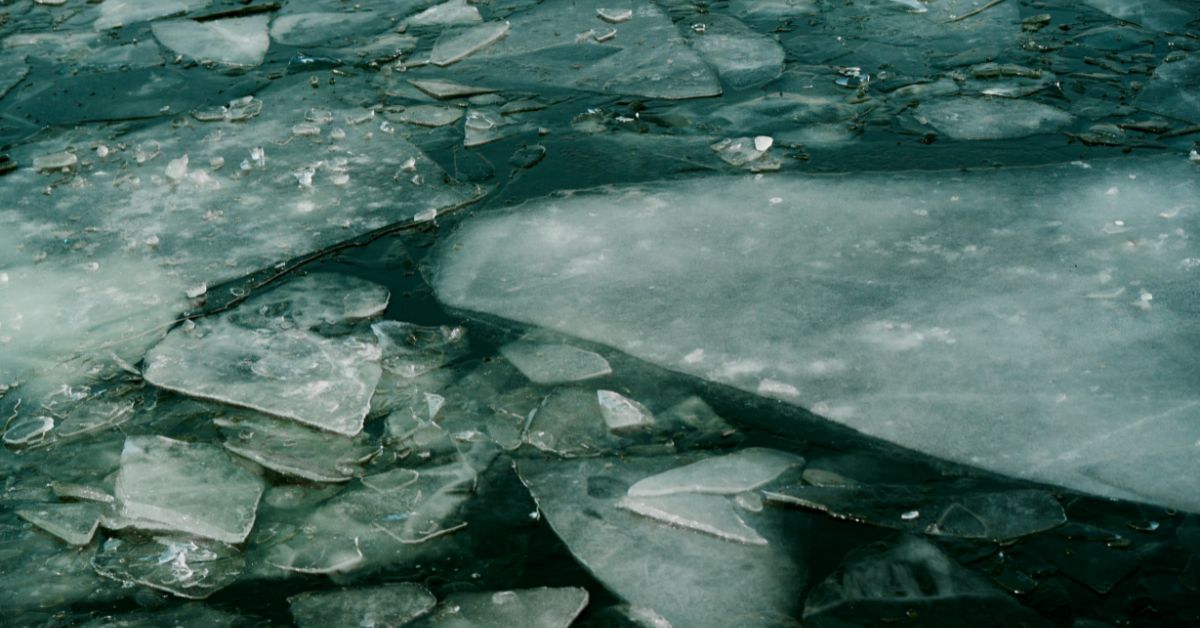
One way of chronicling climate change in cooler regions like Wisconsin is to look at trends in ice on waterbodies. Tracking things like freezing and thawing dates or total duration of ice cover provides insight into the changing climate. Importantly, records of waterbody ice coverage can extend further back than reliable records of air temperature, providing a longer record to examine.
Madison’s Lake Mendota has one of the longest continuous records of ice coverage in North America, dating back to the 1850s, making it a globally important indicator of climate change.
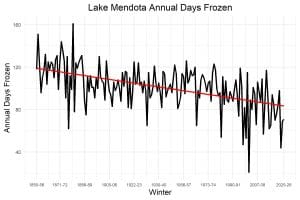
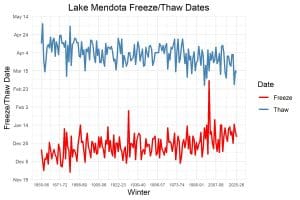
Looking at duration of ice coverage on Lake Mendota provides a clear record for a warming climate in Wisconsin, with later freeze dates, earlier thaw dates, and fewer total days of ice cover (Figs. 1, 2).
Compared to the first 50 years of the ice record (spanning 1855-1905), total days of ice coverage have declined from an average of 113 days over the first 50 years of the ice record to an average of 81 days in the past 30 years. This represents a nearly 30% reduction in the total time the lake is frozen and means that the lake is frozen for over a month less than it historically had been.
The average date the lake has frozen over comes 18 days later, moving from mid-December to early January, while the average date the lake thaws has moved up 15 days, moving from April 9th to March 24th.
While shorter winters may seem like a good thing, there are reasons to want to preserve our winters. Winter recreation like snowmobiling, skiing, skating, and ice-fishing is culturally and economically important to many in Wisconsin. Shorter winters impact outdoor recreation, and its associated tourism industry like restaurants and lodging, threatening the nearly $100 million that snow-related outdoor recreation adds to Wisconsin’s economy every year. And this doesn’t include those who rely on snow removal service income.
There are also direct impacts to our health. Shorter winters can lead to longer pollen seasons, affecting those with seasonal allergies and exacerbating asthma. Shorter and milder winters also mean more mosquitoes and ticks surviving the winter and having longer active seasons to spread diseases they carry like Lyme Disease.
Similarly, warmer winters allow more agricultural pests to survive and emerge earlier. This can lead to either increased crop damage or increased use of pesticides, neither of which is a good outcome.
Finally, there are significant ecosystem disruptions with habitat alterations (e.g., less insulating snow cover to protect small animals) and changes in the timing of plant and animal lifecycle events like plant blooming, pollinator emergence, and bird migrations.
The ice on Lake Mendota provides an important record of this warming to make an abstract concept more concrete locally here in Wisconsin. The ice (or lack thereof) on our lakes, just like smoky summer skies, serve as a tangible reminder of how important it is to make the transition to a cleaner future.
