

Where to Listen:




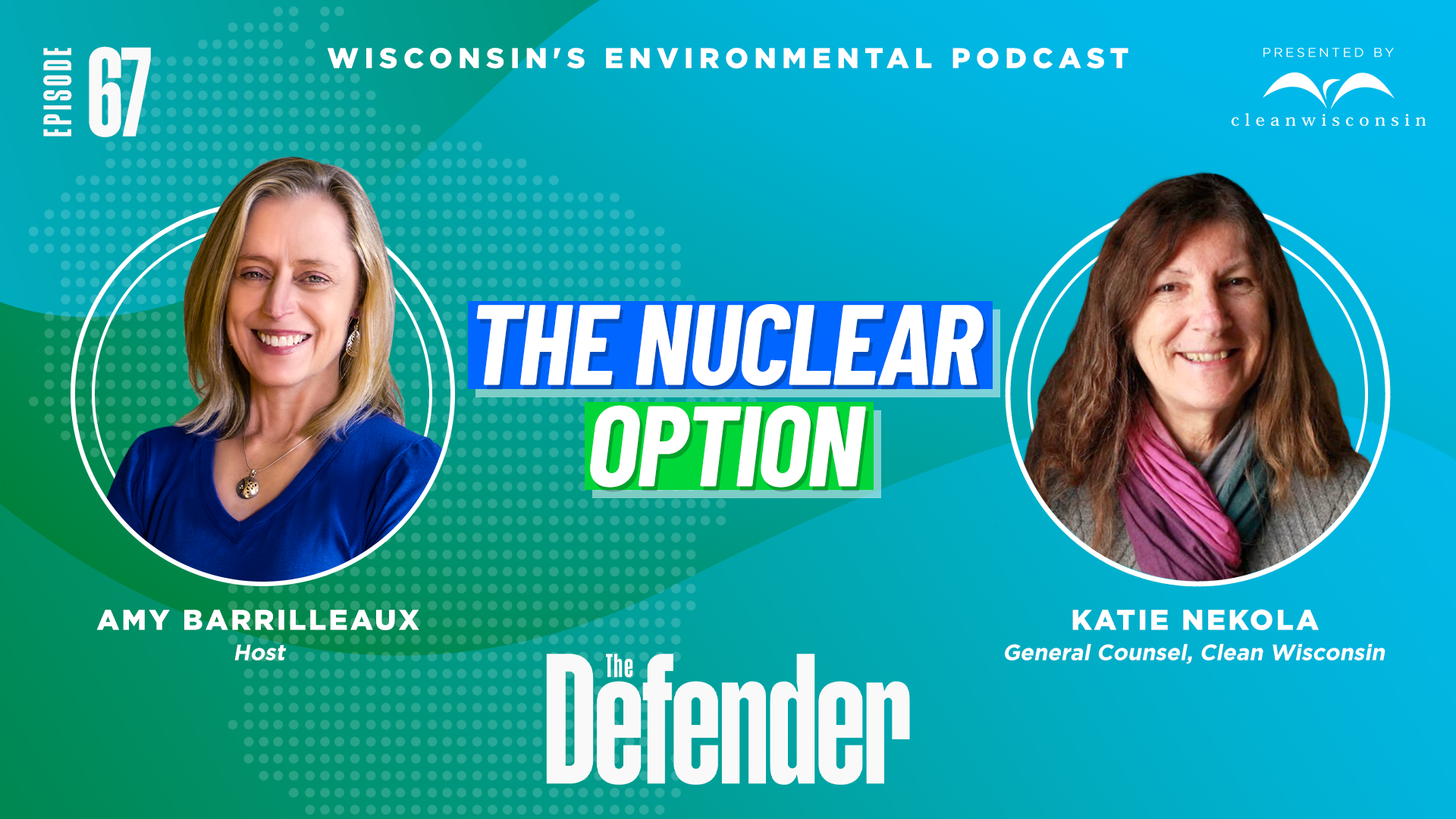
There is a lot of new excitement around nuclear energy these days, and no coincidence, it comes as we face staggering energy demands from AI data centers. Now, the Trump Administration is relaxing environmental and safety regulations for new nuclear reactors. In this episode, a look at what would happen to our environment – and our energy bills – if utilities race to meet AI demand by building more nuclear reactors.
Host:
Amy Barrilleaux
Guest:
Katie Nekola, General Counsel, Clean Wisconsin
Resources for You:
Stop Unchecked Data Center Development (petition)
AI Data Center Energy Demand Analysis
AI Data Center Offsite Water Withdrawals
Transcript:
Amy Hello and welcome to the Defender Podcast. I’m Amy Barrilleaux. The Defender is powered by Clean Wisconsin, your environmental voice, since 1970. Eleven years ago, the owner of the Kewaunee nuclear power plant announced it would shut the plant down because it was quote, uneconomic to continue operations. Nuclear power is notoriously expensive. The most expensive way to produce electricity in Wisconsin by far… Flash forward to today, though, and WeEnergies is proposing to build a new nuclear reactor on the same site amid ballooning demand as AI data centers try to push their way into the state. We Energies has said its total electricity sales in Wisconsin will likely double in just the next five years, and that’s thanks to AI data center projects being built by Microsoft in Racine County and Vantage in Port Washington. And while nuclear power plants cost tens of billions of dollars to build, WeEnergies is quick to point out nuclear energy is carbon free. So why aren’t environmental groups celebrating? In this episode, a look at what would happen if utilities raced to meet AI demand by building more nuclear reactors. That’s right now on The Defender. There is a lot of new excitement around nuclear energy these days, and no coincidence, it comes as we face staggering energy demands of AI data centers. In fact, the EPA, under the Trump administration, in its excitement to quote, make the US the global leader of AI, is relaxing environmental and safety regulations for new nuclear reactors. But experts say nuclear energy is not the magic fix for power hungry data centers that some people are claiming. Joining me is Katie Nekola, General Counsel for Clean Wisconsin, who’s been looking at the environmental and consumer impacts of energy projects in the state, including nuclear power for decades. Katie, thanks for being here. Thank you for having me. I think the biggest environmental concern is obviously the radioactive waste that these plants produce as they operate. What happens to all that waste? Where does it go?
Katie Doesn’t go anywhere, Amy. It sits on the shores of large water bodies because all nuclear power plants require a tremendous amount of water for cooling and so that’s why they’re sited next to Lake Michigan. You know, all the large waterbodies in the United States and across the world. The United States government made a finding a long time ago that nuclear waste was dangerous and needed to be stored in deep geologic repositories because that material remains highly radioactive and very dangerous for tens of thousands of years. However, the United States Government has been unable to find and construct such a deep geological repository. It gave up on Yucca Mountain about 10 years ago after a lot of controversy and the fact that the site just wasn’t appropriate. They had so many problems with it and the truth is nobody wants this stuff in their state. So that ought to tell you something and even I’ve heard even pro-nuclear legislators say well the best way to prevent the waste storage problem is not generate any more of this, right? And so, clearly that’s true. There are far… less toxic and deadly ways to make electricity. And so it just baffles me that we’re continuing to generate this highly radioactive waste material with no place to put it.
Amy So here in Wisconsin, then, we have one active nuclear power plant at Point Beach. All that waste, then is still there. It’s still stored right there on the shores of Lake Michigan. Is that right?
Katie That’s right, and even the Kiwani plant, which has been in decommissioning, the owners of that paid $10 million a year just to manage that waste. Dairyland Power, at its La Crosse reactor site, that was decommissioned for a very long time and its ratepayers are still paying millions of dollars just to maintain that waste, it doesn’t just sit there, it needs a lot of management.
Amy So even the nuclear power plants that are not operating anymore and one that’s even been decommissioned, people are still paying just to keep that nuclear waste like safely there. They’re still paying that in their power bills?
Katie That’s correct. Yep. And not only that, but people are paying in their federal taxes for the payments that the government has to make under law to utilities for its failure to remove the waste from on site. Congress required that DOE find a place to take the waste. However, it failed to do so the utilities sued the federal government and now continue to get payments. From the federal government, which is just taxpayer dollars in compensation for them having to store the waste on site.
Amy So radioactive waste is expensive to store. It stays here in the communities where it’s produced. But you still have tech companies and developers and utilities here in Wisconsin saying, hey, we need it to meet the needs of the AI data centers. And it doesn’t have any greenhouse gas emissions. It’s not fossil fuels. So we should all be good with it. We’re kind of hearing that all over the place, that nuclear is the answer to the AI datacenter boom that we are experiencing. But is that really an honest claim? Can nuclear energy be deployed to meet the demands of these AI data centers that are being built right now in Wisconsin?
Katie Not anytime soon. I think For PR purposes, I guess it would, I guess they can say that they’re going to be relying on nuclear power, but the truth of the matter is here in Wisconsin anyway, just last year, WeEnergy has got approval to spend $1.5 billion to build two new gas plants to serve AI, to serve data centers in Wisconsin. Those are not carbon-free as we know, they’re not solar, wind or nuclear. And there are a couple more of those under review at the Public Service Commission now too, for the express purpose of serving data center needs. And so this idea that they’re gonna be carbon free, that the data centers are gonna be carbon free is I think absurd because they’re going to be relying on gas plants.
Amy So the notion that nuclear is going to be able to meet the needs of these AI data centers that are coming here, starting to fall apart, right? Because we have gas plants that are already being built to serve those data centers. But is it possible to get a nuclear power plant up and running, I guess, by the time some of these data centers are finished in a few years?
Katie I don’t think so. I don’t see how. I mean, there’s no recent example of a nuclear power plant that’s been built in less than 10 years and probably more like 15 years. Especially these new designs. I don’t know how, if in fact they’re going to start building different kinds of nuclear power plants than they have built in the past, then I can’t imagine that. Can be done quickly. But even old design or the kinds we’re familiar with are going to take a really long time. And the ones that they’ve built, for example, the sort of infamous example in Georgia, the power plants went way, way over budget and took far longer than expected to construct. So I don’t see any reason to think that that would be any different in Wisconsin.
Amy Let’s talk about cost for a little bit, because it’s been established now that wind and solar are the two cheapest ways to produce energy in Wisconsin. But instead of, you know, legislators and folks being like, yeah, let’s get some more of that going, it seems like we’re trying to get nuclear energy off the ground. You know, there’s a bill working its way through the legislature that is going give some. I guess, tax incentives to nuclear energy development here in Wisconsin. How expensive is nuclear energy, though, compared to wind and solar, or even compared to gas, or some of these other technologies that we bring online really quickly? Is this going to be another layer of expense when we open our energy bills if we do start building nuclear power plants here in Wisconsin?
Katie Oh, absolutely, Amy. You know, even the existing Point Beach power plant, the energy that we energy customers use from that plant is orders of magnitude more expensive than any other source of energy that they get. Nuclear power costs four to five times as much per unit of energy as solar and wind. And it costs three or four times as much as a combined cycle gas plant. And that’s, you know, that’s just for the energy. That’s not counting all of the embedded costs of waste disposal and maintenance. And you know there’s high level radioactive waste that has to be dealt with, but there’s also low level radioactive wastes because everything in a nuclear plant gets irradiated whether it’s a little bit or a lot and it all needs to be safely disposed of. I’m not confident that under our current government Any of that’s going to be done safely or cheaply.
Amy So let’s talk about the current government for a second. The Trump administration recently exempted new nuclear reactors from environmental review that used to happen under a law called NEPA. Can you explain what NEPA is and why it’s important?
Katie Sure, NEPA is the National Environmental Policy Act, which the Wisconsin counterpart is WEPA, and you can imagine what that means, what that’s doing. The Department of Energy secretly rewrote the internal rules for new test reactors, reducing protections for groundwater and the environment. The rule… Did say that the environment must be protected and now it says consideration may be given to avoiding or minimizing, if practical, potential adverse impacts. NEPA requires an environmental impact statement. It requires an opportunity for public comment and the public to weigh in on safety, environmental, in any way that a project might impact the human environment. And without that, there’s no clarity or transparency about what’s happening or how it might harm people or… Aquatic life or wildlife or, you know, anything. I mean, these new reactors, we have no real world experience with them. They just exist on paper at this point. So we should have a more rigorous safety in an environmental review, not relax the rules for something that’s experimental.
Amy Did you ever think that you would be having a discussion about putting a new nuclear reactor on the site of one that’s being commissioned here in Wisconsin, or I guess restarting, what is the reactor they’re restarting that had?
Katie Three Mile Island.
Amy Three Mile island. Restarting Three Mile Islands. And they’re renaming it too. Well, I bet they are. That we’d be sitting here having this conversation. Yeah.
Katie This doesn’t surprise me. There are utilities. I mean, I have heard that large utilities have wanted to build nuclear power. And independent companies, developers have wanted to do it too for some time. It’s just that public opinion was kind of a problem after the large accidents. You know, the larger construction project that a utility. Undertakes the more money they make, you know, they get a return on investment for every dime that goes into these big plants. And these nuclear plants are just outrageously expensive to construct. I mean, far and away more than anything else that they could build. And so, you know, it’s kind of the gift that keeps on giving.
Amy So if, let’s say, We Energies gets to build a new nuclear power plant on the side of the old Kewaunee plant, would it be a windfall for their investors, I mean, spending multi-billion dollar nuclear power project?
Katie Oh, of course. Yeah. And it would add to the already insanely increasing energy bills of people in their service territory. I mean, people in Milwaukee are paying way too much for electricity and they have been for a long time. And the, you know, the bills keep going up because of, you So, you know, it floors me that they would consider in light of that, that they would consider building the most expensive thing possible and passing that along to their rate payers.
Amy So why, so if we, okay, if we know that wind and solar are the cheapest forms of energy to produce here in Wisconsin and in many other places, if know that nuclear power plants are not likely to come online in time to really serve these data centers, and if we know they are hugely expensive and that there are drawbacks we cannot, we don’t have anything we can do to dispose of the nuclear waste right now. Why is there this sort of, you know, from tech companies, from utilities, and in many cases from the general public, this sort want and desire to invest in nuclear and not talk about wind and solar so much?
Katie I don’t know. That’s a great question. I mean, I think different people have different reasons. I think a lot of people would prefer to have the power plants be someplace where they can’t see them and have them be sort of in one big power plant in a place that’s far away. You know, a lot people, some people are opposed to being looking at wind turbines or solar panels, which take up, you know, let’s face it. Acres of land. I didn’t, I don’t know, I’m not very good at answering the question about why people think I did look up really quick, I just wanted to let you know that the final cost for that Georgia power plant that I talked about, which is the only thing that’s really been constructed in recent history was $36.8 billion.
Amy Big number. So that would be the biggest project ever in the history of Wisconsin if we built something like that here.
Katie I believe so. I mean, this had huge cost overruns and I don’t know why, but seven years late, $17 billion over projected cost for what it’s worth.
Amy And who’s paying for that cost there. People in Georgia, and their energy bills are going to be heavy. So I think we’re at a point, though, where people just, we have so many things happening in Wisconsin. We have big data centers coming. We have people, you know, tech companies trying to figure out how to use an enormous amount of energy. Energy utilities trying to figure out how to serve them. I mean, how would you characterize this moment having worked at the PSC and in energy for a long time, this moment that we’re facing here in Wisconsin?
Katie I think it’s a great opportunity for the state of Wisconsin to take control of its energy mix and it’s, you know, keeping in mind it’s got goals to reduce carbon emissions and also to reduce costs for its citizens. I think, it’s time to step back and stop the mad rush to construct new things. For a minute and think about what we want our state to be. How do we want to spend our money? How do want our environment to look? How much water do we wanna data centers and power plants to use? We can control all of this and this is what we have. Wisconsin is our greatest resource. Our natural resources are. What we have to work with. And so it’s incumbent on us to take care of them and to come up with a plan, both for data centers and for power production and not just sway with the wind of whatever happens to land in Wisconsin or whatever some utility executive wants to do this week. I think we need to, as I said, take control of it all and protect what’s important to Wisconsin. Folks, you know, make it, make protect their, their economic security, their environmental security and their health.
Amy Unlike many other states, Wisconsin really doesn’t have any kind of plan, is that right? We’re just kind of…
Katie Now we used to, I mean years ago we had integrated resource planning which was a great chance to do exactly that kind of zoom out periodically and for the state to take a an honest look at at what we what we need in terms of power production and transmission and and um you know all of the things that greatly affect our air and water and and the people here so and costs um but that was gotten rid of, utilities didn’t like it. And here we are. It’s kind of whack-a-mole, you know, they just sort of randomly come in with proposals to build power plants, and it’s up to interveners like Clean Wisconsin and others to prove that they aren’t cost-effective or aren’t needed, and you know that’s a heavy lift for everyone else.
Amy What about, I’ve seen this argument that… New nuclear can help Wisconsin power the data centers in that, you know, once they come online, say 10 years from now, then all of the gas plants that have been built in that to serve the data centers that we’ve been talking about can come off of line. And so then we’ll have clean, clean in terms of emissions, mostly, energy powering these data centers. So that this is and answer to the data centers in that. We won’t be stuck with fossil fuels long term that eventually we’ll be able to turn to nuclear. What’s your reaction to that kind of line of thinking?
Katie I laughed when I heard that. I think it’s one of the most ridiculous things I’ve ever heard. These gas plants aren’t even constructed yet, these ones that are being approved now in last year in order to serve the data centers, and so they will be constructed at great cost. There’s no chance that they’re going to be abandoned in 10 years. I mean they’re supposed have a 40-year lifespan and the idea that they would suddenly just Oh, let’s not use these now because now we have nuclear power. It just raises all sorts of questions and it makes no sense. For one thing, cost, right? So are we going to saddle Wisconsin customers who with with the bill for unused gas plants now, and new nuclear plants? I mean, energy is going to become the single most expensive thing we pay for pretty soon, if that’s the case.
Amy I think there is a lot of optimism around nuclear energy, around solving the puzzle of disposing of or reusing or somehow neutralizing radioactive waste. And I am not a nuclear expert, but I know there is lot of minds trying to work on these issues. I have friends who actually work in the nuclear industry trying to solve some of these problems. Do you think that someday we’re going to figure out how to power our lives in a sustainable way, either with wind and solar and a sustainable nuclear or? It feels like we’ve got a big problem on our hands and we’re still struggling to get through it.
Katie I have respect for those scientists who are working to solve these problems. For example, nuclear waste. I certainly hope they can find a solution. I am less optimistic because it hasn’t happened in decades. I mean, I think that there’s been so much money put into research and development for nuclear power, all kinds of, you know, technologies, designs. You know, lots of time, effort, and money. And it hasn’t happened yet. And so I think until it does happen, the prudent thing to do would be to stop producing more radioactive waste.
Amy Do you think that this AI data center situation we’re in in Wisconsin is going to finally get us back to having some kind of a plan, you know, the plan that we haven’t had for so long that leaves us vulnerable to these situations in the first place, a plan where we get to everybody gets to understand how different power sources get brought online and why and who they serve and how much they cost and where we have a big picture plan. As complicated as it may be for the state. So we know what to do when these big AI data centers or other power users come in.
Katie I think we have to. I think that we’re gonna have to fight for it though, because the forces of sort of short term profit and turning a blind eye to potential problems are are so strong. I think that those of us who are concerned about this and want there to be a plan and and you know are paying attention to environmental consequences and safety concerns and cost concerns really need to work. Hard and push for this to happen. I think that it has to be a priority. It’s one of the many challenges of our time.
Amy We have so many challenges. Katie, thank you so much for taking the time to explain all this. I really appreciate it.
Katie Thanks, Amy.
Amy And thank you for listening to the Defender Podcast. Remember, if you have something you want me to talk about, send me an email, podcast at cleanwisconsin.org, or if you just have a comment or a question, I’d love to hear from you. I’m Amy Barilleaux, talk to you later.
